



| HEADLINE |

|

Protect endangered sea turtles of Bangladesh
Published : Sunday, 17 May, 2026 at 12:00 AM
Tasnime Jannat Rifa


 Having lived in the oceans for almost 100 million years, sea turtles are among the planet's oldest and most fascinating marine animals. These ancient reptiles are essential for preserving the equilibrium of marine ecosystems and are regarded as significant markers of the health of the ocean. However, marine turtles are currently under increasing threat everywhere, including in Bangladesh. For several sea turtle species, Bangladesh's coastal waters and sandy beaches serve as vital feeding, breeding, and migratory grounds. However, these amazing marine creatures are facing an uncertain future because to habitat destruction, climate change, plastic pollution, and human activity.
Bangladesh has considerable biological significance for marine biodiversity and is situated along the northern coast of the Bay of Bengal. Sea turtles depend on the nation's coastal regions, especially St. Martin's Island, Cox's Bazar, Sonadia Island, Nijhum Dwip, and portions of the Sundarbans. Numerous endangered turtle species use these regions as migrating routes and nesting sites.In Bangladeshi waters, five species of sea turtles have been identified. These include the Leatherback Turtle (Dermochelys coriacea), Loggerhead Turtle (Caretta caretta), Hawksbill Turtle (Eretmochelys imbricata), Green Turtle (Chelonia mydas), and Olive Ridley Turtle (Lepidochelys olivacea). The species most frequently seen along Bangladesh's shore is the Olive Ridley Turtle.
Because they support the well-being of marine ecosystems, sea turtles are significant to the environment. Hawksbill turtles regulate sponge populations in coral reef environments, while green turtles contribute to the maintenance of healthy seagrass beds by grazing on seagrass. In maritime environments, these ecological relationships preserve equilibrium and promote biodiversity.Through the preservation of marine biodiversity and ecotourism, sea turtles can indirectly support coastal economies. Beaches where turtles nest draw tourists, researchers, and environmentalists from all over the world, creating jobs for nearby towns.Sea turtles in Bangladesh confront a number of dangers that are drastically lowering their numbers despite their ecological significance.
Destroying habitat is one of the main issues. Nesting turtles are disturbed and fewer suitable nesting grounds are available due to coastal development, hotel building, artificial lighting, and beachside tourists. Sea turtle females return to beaches to lay their eggs, however effective nesting is frequently hampered by increased human interference.
Pollution from plastic has become a major concern. Plastic bags and floating trash are sometimes mistaken by sea turtles for jellyfish and other prey. Eating plastic can obstruct their digestive tracts, causing harm or even death. Additionally, pollution damages marine habitats that are crucial to turtle survival.There are more dangers associated with fishing. Bycatch is the term for the numerous turtles that unintentionally become entangled in fishing nets. Every year, a significant number of turtles perish in marine fishing operations due to improper turtle-friendly fishing techniques.
The issue is getting worse due to climate change. While rising sand temperatures have an impact on turtle reproduction, rising sea levels endanger nesting beaches. Remarkably, the temperature of the sand during incubation affects the sex of sea turtle hatchlings. More females are produced in warmer climates, which could upset the demographic balance in the future.Despite conservation legislation, illegal egg harvesting and poaching persist in certain coastal areas. Hatchling survival rates are lowered when turtle eggs are taken for commerce or eating.St. Martin's Island and Sonadia Island are regarded as especially crucial for the conservation of sea turtles in Bangladesh. These regions are vital nesting places for Green and Olive Ridley turtles, according to researchers and environmental organizations. However, these delicate ecosystems are under growing strain due to uncontrolled tourism and environmental deterioration.
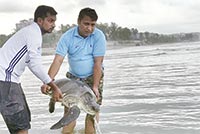
Long-term turtle conservation depends on marine protected areas and sustainable coastal management techniques. It is imperative that the country prioritize reducing plastic pollution, controlling tourism, encouraging turtle-safe fishing methods, and safeguarding nesting beaches.Sea turtles represent the robustness and well-being of ocean ecosystems, making them more than merely marine creatures. The state of our oceans and beaches is reflected in their survival. Thus, safeguarding sea turtles in Bangladesh entails safeguarding coastal ecosystems, marine biodiversity, and the Bay of Bengal's future.
Future generations might only be familiar with these amazing animals through pictures and history books if prompt and efficient conservation actions are not taken. We are all accountable for keeping kids safe.
The writer is from Genetic Engineering and Marine Biotechnology Department, Bangladesh Maritime University

Loading...
Loading...
Also read



Editor : Iqbal Sobhan Chowdhury
Published by the Editor on behalf of the Observer Ltd. from Globe Printers, 24/A, New Eskaton Road, Ramna, Dhaka.
Editorial, News and Commercial Offices : Aziz Bhaban (2nd floor), 93, Motijheel C/A, Dhaka-1000.
Phone: PABX- 41053001-06; Advertisement: 41053012; 01793317829, 01550707291, 01550707296
E-mail: [email protected], [email protected]. [email protected], [email protected], [email protected], [email protected], Online-email: [email protected]


