



| HEADLINE |

|

BB to Mandate Unified Payment Switch by 2027 to End Cash Silos
Published : Sunday, 19 April, 2026 at 12:00 AM
Shamsul Huda


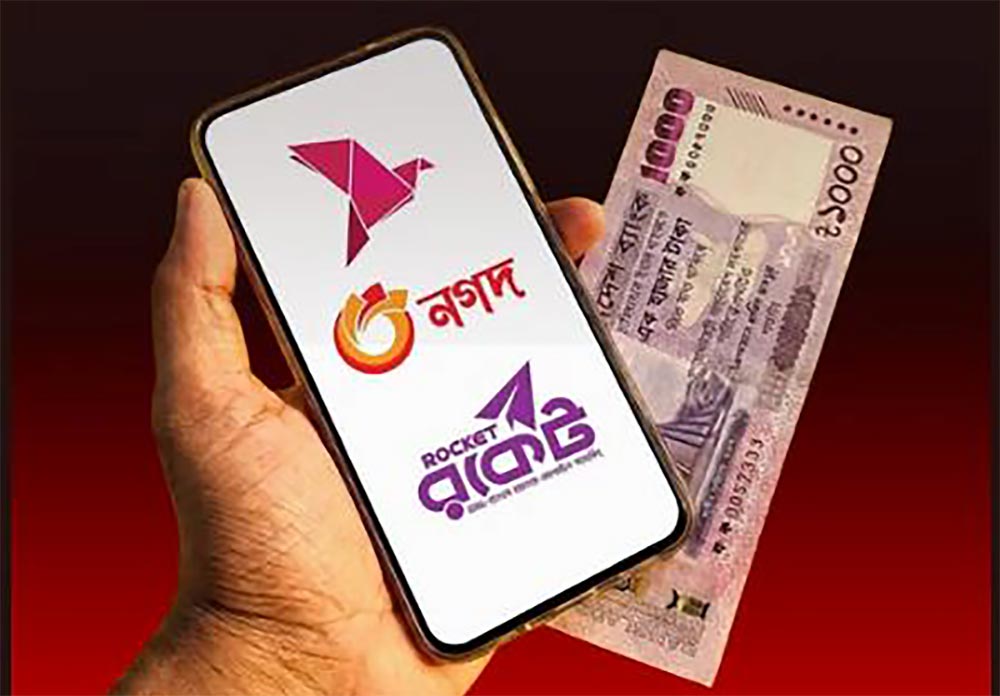 Bangladesh Bank is poised to enforce a sweeping transformation of the country's digital payments landscape, mandating all financial institutions to join a single interoperable platform by 2027 in a decisive bid to dismantle long-standing cash and digital silos.
At the heart of the overhaul is Mojaloop, an open-source payment switch that will power the Inclusive Instant Payment System (IIPS), enabling real-time, seamless transactions across banks, mobile wallets, microfinance institutions and other financial services.
Officials say the platform is scheduled for launch by July 2027, marking a structural shift from fragmented systems to a unified national network.
The initiative comes amid a rapid surge in digital transactions, though largely confined within isolated ecosystems. Mobile financial services have crossed 220 million registered accounts, with over 110 million active users driving monthly transactions exceeding Tk 3.5 trillion.
Leading platforms such as bKash, Rocket and Nagad have powered this growth, alongside more than one million QR-enabled merchant points nationwide.
Despite the expansion, interoperability remains a critical gap. Closed-loop systems continue to force users into costly cash-outs or restricted transfers, limiting the full potential of digital finance. The Mojaloop-driven IIPS aims to eliminate these inefficiencies by enabling instant fund transfers across all platforms-bank to wallet, wallet to microfinance account, or institution to individual-without friction.
"Earlier attempts at interoperability faltered due to partial participation," a senior central bank official said. "This time, integration will be mandatory. All licensed entities must connect-no exceptions, no parallel systems."
The economic implications are significant. Bangladesh currently spends an estimated $170 million annually on managing physical cash, a burden expected to decline sharply as digital rails take over. Officials anticipate lower transaction costs, reduced settlement risks and streamlined regulatory compliance under the unified system.
Described by policymakers as a structural reset rather than a mere technological upgrade, the IIPS will integrate QR payments, virtual identifiers and real-time settlement into a single national switch. This standardisation is expected to redefine how money circulates across the economy-from large corporate transactions to everyday retail payments.
The urgency of the reform is underscored by persistent gaps in financial inclusion. While urban areas have witnessed rapid digital adoption, large segments of rural and microfinance activity remain semi-formal. More than 30 million microfinance borrowers still rely on inefficient or partially manual channels for loan disbursement and repayment.
Under the new framework, these flows will become instant, transparent and fully traceable. Government transfers, remittances, wages and merchant payments will operate on the same infrastructure, effectively placing a rural borrower and an urban consumer on equal digital footing.
A street vendor equipped with a QR code will be as connected as a corporate entity.
Crucially, the adoption of Mojaloop-developed by the Mojaloop Foundation-signals a strategic move towards digital sovereignty. As an open-source platform, it allows Bangladesh to customise, scale and control its payment infrastructure without reliance on proprietary foreign systems.
Officials say this flexibility will accelerate innovation and deployment. "We can build and roll out solutions within weeks," one official noted, pointing to the country's growing domestic capability in financial technology.
Policy backing remains firm. Dr Rashed Al Mahmud Titumir, adviser to the Prime Minister on finance and planning, has confirmed that the government aims to unify all digital transactions under the Mojaloop-powered IIPS, targeting a fully cashless ecosystem by 2027.
Beyond convenience, the initiative carries broader economic significance. Analysts say it will play a pivotal role in formalising the economy, strengthening revenue mobilisation and curbing financial leakages. With transactions becoming instant and traceable, policymakers will gain enhanced oversight, businesses will improve efficiency, and citizens will gain wider access to financial services.
However, officials caution that success hinges on uncompromising implementation. The transition demands that all stakeholders abandon fragmented systems and fully embrace interoperability-an adjustment that may challenge entrenched interests within the existing ecosystem.
"This is not incremental reform," a senior BB official emphasised. "It is a complete redesign of how money moves across the economy."
If executed as planned, the Mojaloop-powered IIPS could mark a watershed moment in Bangladesh's financial evolution-collapsing entrenched silos, accelerating the shift away from cash, and establishing a unified, real-time and accountable digital payment system nationwide.
Loading...
Loading...
Also read



Editor : Iqbal Sobhan Chowdhury
Published by the Editor on behalf of the Observer Ltd. from Globe Printers, 24/A, New Eskaton Road, Ramna, Dhaka.
Editorial, News and Commercial Offices : Aziz Bhaban (2nd floor), 93, Motijheel C/A, Dhaka-1000.
Phone: PABX- 41053001-06; Advertisement: 41053012; 01793317829, 01550707291, E-mail: [email protected], [email protected] Online: email: [email protected] 41053014; 01550707297 Advertisement: 01550707296
Published by the Editor on behalf of the Observer Ltd. from Globe Printers, 24/A, New Eskaton Road, Ramna, Dhaka.
Editorial, News and Commercial Offices : Aziz Bhaban (2nd floor), 93, Motijheel C/A, Dhaka-1000.
Phone: PABX- 41053001-06; Advertisement: 41053012; 01793317829, 01550707291, E-mail: [email protected], [email protected] Online: email: [email protected] 41053014; 01550707297 Advertisement: 01550707296


