



| HEADLINE |

|

180-day plan to boost gas supply, reduce LNG costs
Published : Wednesday, 25 February, 2026 at 12:00 AM
Shahaj Begum


 Facing a steady decline in domestic gas production and rising pressure from costly LNG imports, the government has rolled out an ambitious 180-day action plan aimed at boosting local supply, easing fiscal strain and reducing dependence on the volatile global energy market.
The Energy and Mineral Resources Division has launched a fast-track programme to immediately increase gas supply to the national grid, as output from local fields continues to fall.
Domestic production has dropped from more than 2,100 million cubic feet per day (mmcfd) in 2023 to below 1,900 mmcfd in 2025, marking an average annual decline of around 150 mmcfd, Power, Energy and Mineral Resources Adviser Iqbal Hasan Mahmood told the Daily Observer.
He said the government identified energy supply as a top priority during its first week in office and initiated the six-month drive to increase domestic gas output and curb expensive imports at a time when mounting energy pressures are straining public finances and foreign exchange reserves.
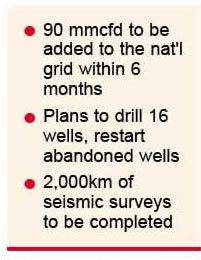
Under the plan, the government expects to add about 90 mmcfd of gas to the national grid within six months. The draft roadmap outlines efforts to restart production from several abandoned wells through workover operations. Proposals have been received to drill seven exploration wells, seven development wells and two workover wells in the short term.
Preparations are also underway to finalise the Production Sharing Contract (PSC) Model 2026 to attract foreign investment in both onshore and offshore exploration. The government plans to complete 2,000 line-kilometres of 2D seismic surveys within six months, while new 3D seismic surveys are scheduled in Rangpur, Lalmonirhat, Gaibandha, Joypurhat and Panchagarh.
Bangladesh spent approximately $6.9 billion on LNG imports, significantly intensifying pressure on already fragile foreign exchange reserves. "We cannot afford this for long," the adviser said. Fuel subsidies are adding further strain. In the 2025-26 fiscal year, around Tk6,000 crore has been allocated for energy subsidies.
Under commitments linked to a programme with the International Monetary Fund, Bangladesh has pledged to gradually phase out fuel subsidies by 2030, a move that could require additional tariff adjustments.
System losses, including technical inefficiencies and leakages, currently stand at about 6.38 per cent, resulting in estimated annual financial losses of Tk4,094 crore. The adviser warned that without accelerated upstream exploration and expanded regasification and pipeline capacity, Bangladesh's dependence on LNG will continue to rise, exposing the economy to global price volatility and exchange rate risks.
As of June 2025, remaining domestic gas reserves were estimated at 7.96 trillion cubic feet, underscoring growing concerns over the long-term sustainability of local supply.

Loading...
Loading...
Also read



Editor : Iqbal Sobhan Chowdhury
Published by the Editor on behalf of the Observer Ltd. from Globe Printers, 24/A, New Eskaton Road, Ramna, Dhaka.
Editorial, News and Commercial Offices : Aziz Bhaban (2nd floor), 93, Motijheel C/A, Dhaka-1000.
Phone: PABX- 41053001-06; Advertisement: 41053012; 01793317829, 01550707291, 01550707296
E-mail: [email protected], [email protected]. [email protected], [email protected], [email protected], [email protected], Online-email: [email protected]


