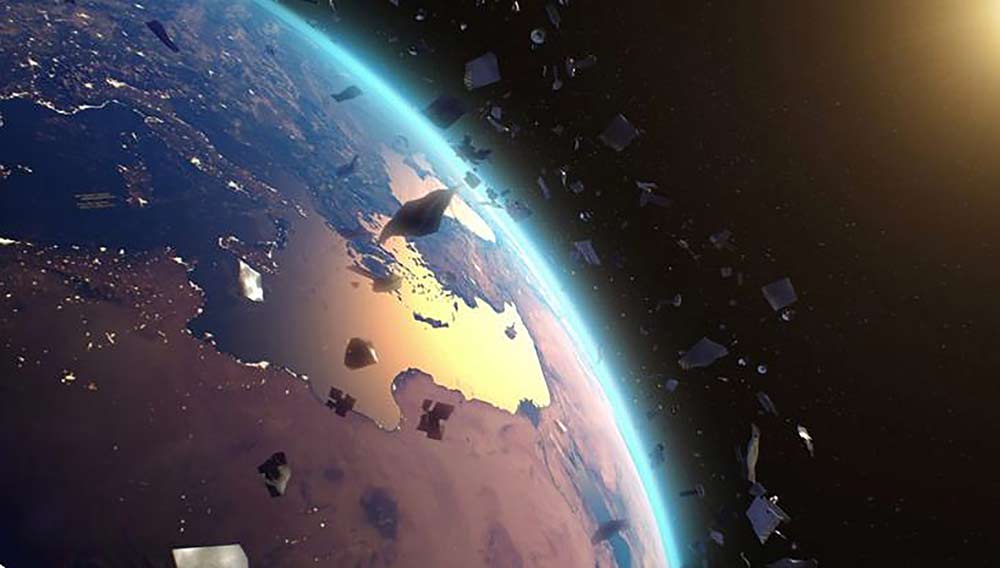
Feb 13: A new global assessment from the World Economic Forum warns that space debris will drain between $25.8 billion and $42.3 billion from the space economy over the next decade, even if no catastrophic collision occurs. That figure reflects what analysts describe as a "business-as-usual" future, one in which satellites keep launching, debris keeps accumulating and mitigation remains uneven.
The most dangerous zone sits roughly 1,000km above Earth. There, modelling shows a 29% probability of a major collision by around 2032. Two additional clusters at 775km and 840km carry lower but still serious risks of 8% and 6% respectively.
These figures are not abstract projections. They represent dense belts of defunct rocket bodies and fragments overlapping with active spacecraft, which is a volatile mix that compounds year after year.
The modelling, based on an orbital population simulation running from 2025 to 2040, shows debris density intensifying between 800km and 1,000km. Above 700km, atmospheric drag no longer clears fragments efficiently. Objects can remain in orbit for centuries.
Even small fragments pose outsized danger. Debris between 5mm and 1cm can trigger temporary satellite malfunctions. Pieces larger than 1cm can end a mission entirely. For every tracked fragment larger than 10cm, researchers estimate there are hundreds of smaller, untrackable but lethal shards.
The annual risk to a single satellite appears small. Across tens of thousands of spacecraft, it becomes systemic.
The projected $25.8-42.3 billion loss equates to roughly 0.9%-1.4% of the space sector's expected $3.03 trillion cumulative value between 2025 and 2035. Most losses stem not from dramatic smash-ups but from service disruption, degraded performance and shortened satellite lifetimes.
Service interruptions alone could account for up to $26.3 billion, exceeding infrastructure damage costs . That distinction matters. It means downstream industries, such as telecommunications, Earth observation, navigation and climate monitoring, bear much of the burden.
For the UK, heavily dependent on satellite-enabled services for finance, aviation, maritime navigation and defence, the implications extend far beyond launch providers.
Just six historic fragmentation events account for roughly half of today's fragment population in low Earth orbit. The model assumes additional rocket-body explosions in 2029, 2033 and 2037, reflecting past recurrence patterns.
No active debris removal missions are factored in before 2040. In other words, the forecast assumes incremental improvement, but no breakthrough clean-up effort.
That restraint makes the warning more severe. The $42.3 billion upper estimate excludes any cascading collision scenario.
The report argues that voluntary guidelines are no longer enough . Accelerated five-year post-mission disposal rules, spacecraft passivation and economic mechanisms such as performance bonds or revised insurance models are identified as levers to reverse trajectory. �"Orbital Today





