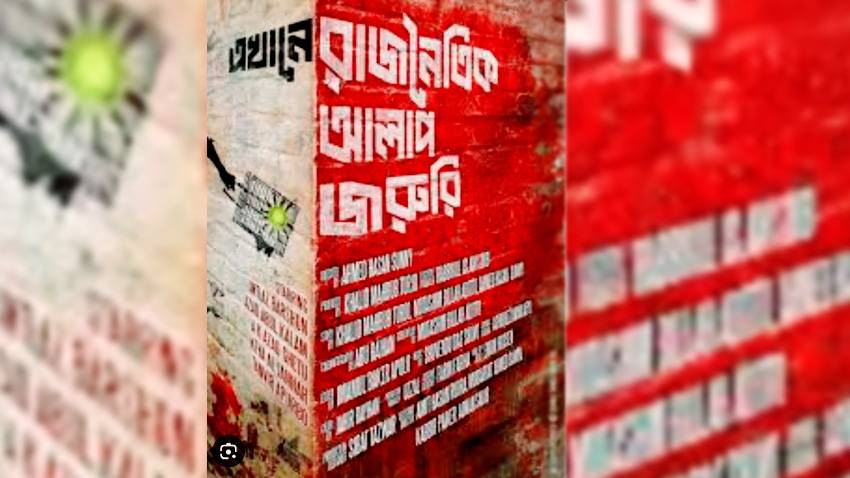
As far as movie titles go, the film Ekhane Rajnoitik Alap Joruri surely stands apart from the rest.
It’s a unique title for a film and strikes a chord with both film lovers and social observers since the film is released at a time when the country is poised to see a historic election following a seismic change in August 2024.
The movie is about Nur, a talented young man, who resides abroad and comes back to Bangladesh during the July-August uprising.
Caught in the middle of the tumult, he loses his younger brother, aptly named Mukto, to a wave of repression unleashed by the regime of the time, and then comes back a year after to relive the memories of his time spent with his brother and for some much- needed soul searching.
He goes to Kuakata, a town by the sea, to the southern part of Bangladesh where the political acumen of the general people impresses him along with their inherent idealism.
In the end, he decides to stay back and take part in the rebuilding of a nation which had been plagued with incongruities.
A simple plot but a poignant one because the underlying theme captures the values of the youth of Bangladesh who fuelled and sustained the mass movement in 2024.
However, there are certain parts of the movie which have nothing to do with the core theme but appear to be added to demonise Mughal history.
Cold and cruel portrayal of Aurangzeb’s daughter:
In the movie, Nur, visiting Bangladesh a year after the July-Aug Revolution, goes to a sea-side village where he meets an aged person, who is a local and lives with his young daughter.
Since Nur cannot return to the city the same day, he is invited by the local man to stay the night at his place where he naturally meets the daughter, also a poet.
Although in reality, a man, whatever his social class, would never invite a stranger when there’s a young girl at home, we accept it for the sake of the film.
During a discussion about poetry, she deviates to the story of Zebunnissa, the eldest daughter of Mughal emperor Aurangzeb, who was also a poet.
And then, goes on to relate an apocryphal story about Zebunnisa’s secret affair with Aqil Khan, who was roasted alive in a cauldron, reportedly at the order of Aurangzeb.
When Nur asked what happened after Akil had died, the girl replied casually: she carried on with her poetry!
Although there’s no historical evidence to suggest that such an episode ever took place, the reply about Zebunnissa’s alleged nonchalance at the death appeared to be driven by a motive to paint her as a cruel, insensitive woman, obsessed with her passion of poetry and indifferent to everything else.
The reality is far from what we are told in this movie.
Zebunnissa was the most talented of Aurangzeb’s daughter and an accomplished poet who wrote under the pen name Makhfi, meaning ‘The Hidden One’ in Persian.
With knowledge in mathematics, astronomy and philosophy, she was often consulted on state affairs by the emperor.
However, Zebunnissa’s last twenty years were spent in captivity at the order of her father, Aurangzeb.
Her material possessions were confiscated, her pension annulled.
Historians are divided as to the key reason, but three causes have gained traction: 1. She was in love with a courtier’s son during her father’s absence, 2. Aurangzeb, austere and puritanical, did not approve of music and poetry and, 3. She became embroiled in the succession feud and supported someone not approved by Aurangzeb.
Whatever the cause, the poet and the erudite Zebunnissa died in captivity – a sad end to a bright Mughal talent.
Unfortunately, the film Ekhane Rajnoitik Alap Joruri, obliquely tries to paint her as a frivolous person without emotional depth.
Now, this part is very small in the film but then again, it’s not trivial either because the story about Zebunnissa is related in the only lengthy conversation between Nur and the daughter of the man who put him up for the night.
Therefore, the story lingers in the mind.
Unless someone does a little research, the image of the Mughal daughter will remain a negative one.
Dehumanising Mughals:
The trend of dehumanising Mughals has been going on for some-time, with efforts made to find some form of dark fact or the other about all the emperors.
This is not to say the Mughals were perfect, they were far from it – from opium addiction to fratricide to eyeing/abducting wives of other courtiers to ruthlessly slaughtering enemies to allegations of sodomy – the list is a long one but against the vices there were also virtues – patron of the arts, construction of modern roads and sewerage systems, strategic alliances, abolishing of religious tax or Jiziya, development of spectacular forts and monuments and of course, making the sub-continent their home.
I dare say, the same mixture of vice and virtue was seen in all royals across the globe, not just in the sub-continent.
Suffice to say, Mughal rule is marked by stark contradictions!
Anyway, the denigrating of Mughals did not begin in Bangladesh and this pernicious practice was started as part of a calculated drive to portray the Mughal period solely as an age of debauchery and dogmatism.
The question is, why are we in Bangladesh taking part in it and why are we inserting unfounded stories without properly studying history?
The film Ekhane Rajnoitik Alap Joruri comes at a very sensitive time in the history of Bangladesh and the messages from the movie, both overt and covert, will influence mass narratives.
Not only for this movie, for all films that aim to reach out to the masses with a message, historical accuracy is a must.
No airbrushing or embellishing – just what is known to be true.
Otherwise, there will be a lingering feeling about the presence of a nefarious objective in maligning someone, either directly or indirectly.
Towheed Feroze is a former journalist!