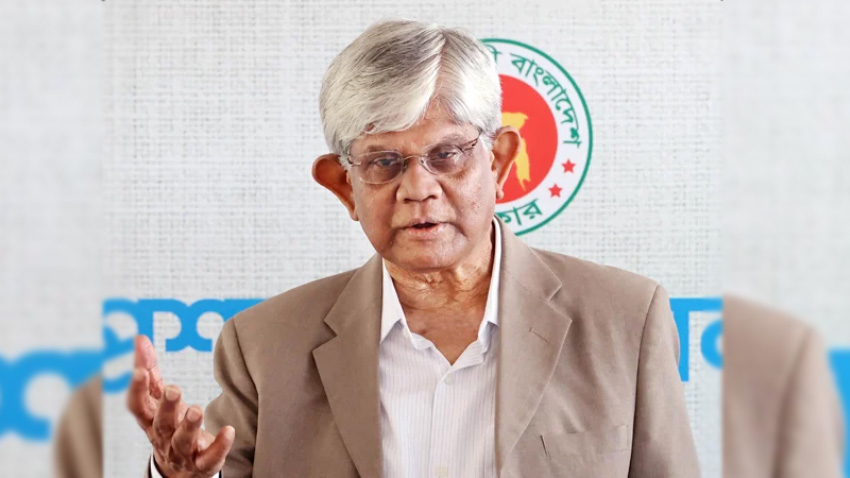
Finance Adviser Dr Salehuddin Ahmed on Tuesday said the government has formulated a long-term energy strategy, describing energy security as one of the most critical challenges facing country’s economy.
Speaking to reporters after chairing separate meetings of the Advisers Council Committee on Economic Affairs and the Advisers Council Committee on Government Purchase at the Secretariat, Dr Salehuddin said reliable energy supply is essential as both the power and broader energy sectors depend heavily on uninterrupted fuel availability.
He said a comprehensive energy roadmap has recently been prepared and presented, focusing on both immediate needs and long-term sustainability. The strategy examines the issue from multiple perspectives, including boosting domestic energy sources.
“There are two key components—power and energy—and we have taken an integrated approach,” he said. “The plan looks at offshore exploration, the use of coal, including domestic coal resources, and how these elements can be brought together under a single framework.”
Asked what the interim government would leave behind for the next elected administration with the national election approaching, Dr Salehuddin said it would be unrealistic to claim complete success. He acknowledged that some expectations could not be met due to various constraints.
He cited procedural complexities, the need for coordination among agencies, the role of officials, shortages of skilled manpower and limitations in institutional commitment as key challenges. “Without addressing these structural issues, it is not possible to implement everything simply because we planned it,” he said.
On the overall state of the economy, the finance adviser said Bangladesh continues to be viewed positively by the international community. He noted that global institutions, including the United Nations, have recognised Bangladesh’s capacity to mobilise financing, particularly in areas such as achieving the Sustainable Development Goals.
“Bangladesh is doing reasonably well,” he said, adding that political or economic shocks are not unusual and that no country experiences perfectly linear economic growth.
Addressing concerns over persistently high inflation, Dr Salehuddin said monetary policy alone cannot resolve the problem. He stressed that inflation is influenced by supply-side constraints, market behaviour, governance and public cooperation, not just interest rates or demand management.
“Price control is not purely an economic issue,” he said. “Political governance matters. Inflation cannot be controlled simply by deploying inspectors or magistrates. That approach does not work anywhere.”
On the ongoing cylinder gas supply issue, he confirmed that he was aware of correspondence from the Energy Ministry to the National Board of Revenue, describing the matter as part of a broader set of interconnected challenges. He said steps have already been taken to address the situation and that current efforts are focused on easing public hardship.