



| HEADLINE |

|
Why slum population on the rise
Published : Thursday, 18 December, 2025 at 12:00 AM
Nawshin Mushtary


 Despite impressive economic achievements in Bangladesh, the widespread presence of urban slums paints a different, uncomfortable reality. No matter how bright the development indicators appear, the existence of slums reveals a fundamental truth: the benefits of economic growth are not equally shared.
Recent surveys estimate that around 2.2 million people in Bangladesh currently live in slums. In 1997, the figure was 1.39 million meaning the slum-dwelling population has increased by more than 60 percent in 17 years. Today, the country has 13,938 slum settlements, a testament to the deep structural linkage between rapid urbanization and the limitations of our economic system. In Dhaka alone, nearly three million people either live directly in slums or in conditions that resemble them.
These numbers force us to confront a crucial question: Is the presence or absence of slums linked to a nation's economy? The answer, without hesitation, is "Yes" profoundly so.
Slums emerge from the intersection of three major economic forces: the pace of urbanization, income inequality, and the shortage of affordable housing. Bangladesh's rapid urban growth particularly in Dhaka has placed the labor market under immense pressure. People migrate from villages to cities seeking better jobs, higher incomes, and improved living standards. Yet the urban housing market, dominated by high-priced apartments, expensive land, and developer-driven construction, offers no viable space for low-income workers. For many, formal housing is simply unattainable. As a result, they turn to informal settlements built on precarious land, often without basic services. Slums therefore do not emerge merely from "poverty"; rather, they reflect failures in the housing market, limitations in urban planning, and an economic structure that excludes the very workers who keep the city running.
In reality, slum dwellers form the invisible backbone of urban economies. Dhaka's economic engine runs on the labor of rickshaw pullers, garment workers, construction laborers, restaurant staff, domestic workers, delivery riders, and small vendors many of whom live in slum clusters. If slums suddenly disappeared from the city, Dhaka's economy would come to a halt within a day. The informal sector which accounts for nearly 85 percent of Bangladesh's total employment depends overwhelmingly on this labor force. From the service industry to construction sites to the ready-made garments sector, the city's productivity depends on thousands of workers who walk out of slum settlements every dawn. Economists refer to this as the "low-cost labor advantage," a central factor that sustains Bangladesh's competitive production capacity.
The devastating fire that swept through Korail Slum on 26 November 2025 underscores this fragile dependence. With nearly 80,000 residents, many of whom were domestic workers, garment employees, day laborers, rickshaw pullers, or small traders, the blaze caused more than a humanitarian crisis, it caused a significant economic shock. About 1,500 shanties were destroyed, and thousands were left homeless. The narrow alleys and dense, flammable structures made firefighting extremely difficult.19 fire engines struggled for hours to bring the flames under control. The destruction of homes meant immediate displacement of entire families, disruption of daily wage work, and a sudden reduction of labor supply in crucial urban sectors such as construction, domestic services, and apparel manufacturing.
But Korail is not the only slum recently devastated by fire. In March 2025, a major fire raged through parts of Gabtoli Slum and Bhashantek Slum in Dhaka: in the twin incidents, at least 185 shanties were gutted. In Gabtoli's Shahi Masjid Slum, approximately 150 shanties, along with a small hotel, a photocopy shop and other small businesses, were lost. Meanwhile in Bhashantek's BRB-settlement fire destroyed another 35 shanties. No immediate casualties were reported in these fires, but the physical destruction renders many thousands of residents homeless. These recurring fires in different slums show a pattern: weak building standards, congested housing conditions, widespread use of flammable materials, inadequate infrastructure; all combine to keep slum dwellers perpetually vulnerable. Each such incident doesn't only displace people, it disrupts labor, informal businesses, supply chains, and the subtle network that keeps the city's economy ticking.
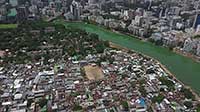
The economic consequences of these fires are heavy. Sudden loss of housing forces workers to migrate or stay out of work, informal small retailers and service providers lose their base, supply chains in informal economies get interrupted and the government is compelled to allocate funds for emergency relief and temporary shelter funds that could have been invested in long-term development like education, health or infrastructure. In effect, recurrent slum fires add a recurring "fiscal burden" to the state budget. They also erode trust among laborers; uncertainty about safe housing and stable livelihood can push some workers to leave the city or seek other jobs which undermines the urban labor supply that sustains key sectors of the economy.
Some might argue. Perhaps, removing slums and replacing them with formal housing would solve these problems. But the reality is more complex. Without slums or without replacement housing for their residents, the city risks losing its low-cost labor base. Production costs in garments or construction would rise dramatically. The garments industry, which forms the backbone of Bangladesh's export economy, would suffer from labor shortages. Construction and infrastructure projects would slow down due to rising labor and housing costs. Service sectors, distribution networks, and small enterprises typically reliant on informal labor would struggle or collapse.
In economic terms, slum removal without replacement ? labor shortage ? wage shock ? cost-push inflation. Bangladesh's competitive edge, driven by low-cost labor, would erode.
Still, this is not an argument in favor of slums themselves. Slums remain centres of deprivation, lacking sanitation, stability, health, and safety. Fires, floods, poor living conditions, inadequate services, all pose everyday risks. They reflect systemic failure not of the people but of planning, policy and inclusive growth.
Therefore, the solution is not eradication, but economic and social transformation. Slum dwellers must be integrated into the formal urban economy: through affordable housing, secure tenure, access to basic services, social safety nets, and inclusion in urban planning. Upgrading slum settlements, legalizing tenure, investing in infrastructure, and recognizing informal labor as a legitimate part of the economy are vital.
In Bangladesh, slums are not just a reflection of poverty. They are a structural element of urban economies, a mirror showing both the potential and the fragility of economic development. Their presence does not mean failure of growth rather it shows that growth has not been inclusive. The repeated fires in Korail, Gabtoli, Bhashantek and other slums remind us that slum crises are not only humanitarian tragedies, but economic tremors. Slums help drive the economy. But if left unaddressed in their unsafe and informal form, they threaten the very stability of that economy. For Bangladesh to achieve sustainable and inclusive development, slum dwellers should not just be seen. They should be recognized, protected, and integrated as essential contributors to the nation's economic future.
The writer is a student of the Department of Mass Communication and Journalism at University of Dhaka
Loading...
Loading...
Also read



Editor : Iqbal Sobhan Chowdhury
Published by the Editor on behalf of the Observer Ltd. from Globe Printers, 24/A, New Eskaton Road, Ramna, Dhaka.
Editorial, News and Commercial Offices : Aziz Bhaban (2nd floor), 93, Motijheel C/A, Dhaka-1000.
Phone: PABX- 41053001-06; Advertisement: 41053012; 01793317829, 01550707291, E-mail: [email protected], [email protected] Online: email: [email protected] 41053014; 01550707297 Advertisement: 01550707296
Published by the Editor on behalf of the Observer Ltd. from Globe Printers, 24/A, New Eskaton Road, Ramna, Dhaka.
Editorial, News and Commercial Offices : Aziz Bhaban (2nd floor), 93, Motijheel C/A, Dhaka-1000.
Phone: PABX- 41053001-06; Advertisement: 41053012; 01793317829, 01550707291, E-mail: [email protected], [email protected] Online: email: [email protected] 41053014; 01550707297 Advertisement: 01550707296


