With just weeks to go before the February 12 national election, a spate of shootings, bomb blasts and political clashes is fuelling public fear, raising urgent questions about law and order, and the safety of democracy itself.
As the country edges closer to the 13th national election, deep anxiety is gripping the country over a worsening law and order situation. Armed attacks on candidates, campaign clashes and explosions in public spaces have punctured hopes for a calm pre-election environment, prompting warnings from political parties, rights groups and security experts that unchecked violence could derail the democratic process.
The recent shooting of a prospective independent candidate in Dhaka--just hours after the election schedule was announced--has become a chilling symbol of the growing risks surrounding the polls. Analysts say these are no longer isolated criminal acts, but direct assaults on electoral integrity and public safety.
Candidates Under Fire
On November 5, BNP-nominated candidate Ershad Ullah was shot in Chattogram-8 (Boalkhali-Chandgaon-Bayezid), leaving one person dead and two others injured. Weeks later, on November 27, violence erupted during a Jamaat-e-Islami campaign event in Pabna-4, involving candidate and district ameer Abu Taleb Mondol.
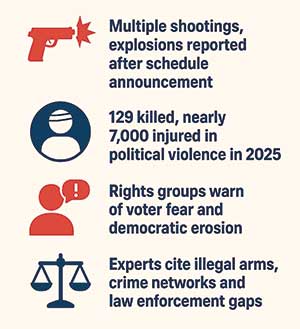
The sense of insecurity intensified dramatically when Sharif Osman Hadi, a prospective independent candidate in Dhaka-8, was shot within 24 hours of the election schedule announcement. Only hours later, a cocktail explosion inside the Agargaon Passport Office rattled the capital, though no casualties were reported.
Political parties say such attacks in broad daylight expose a grave deterioration in law and order, warning that failure to act decisively could embolden further violence.
Alarming Numbers
According to the Human Rights Observation Report 2025, published by the Human Rights Support Society (HRSS) on December 10, at least 129 people were killed and 6,966 injured in 852 incidents of political violence between January and November this year. An additional 156 deaths were recorded in 276 incidents of mob violence.
Among the dead were members of almost all major political forces, underscoring the scale and non-partisan nature of the bloodshed.
HRSS Executive Director Ejajul Islam warned that armed violence at a time when a peaceful atmosphere is essential for elections is spreading fear among voters.
Political and Expert Reactions BNP Acting Chairman Tarique Rahman described the attack on Osman Hadi as part of a wider conspiracy to destabilise the country, while Jamaat-e-Islami Ameer Dr Shafiqur Rahman called the incident "deeply alarming" given its timing.
Criminologists point to deeper structural problems. Dr Md Tawohidul Haque of Dhaka University cited the proliferation of illegal arms and organised criminal networks, while Dr Umar Faruq of Mawlana Bhashani Science and Technology University blamed failures in law enforcement.
Police officials have acknowledged demoralisation following the August 5 uprising last year but insist the force has regrouped. Home Affairs Adviser Lt Gen (retd) Jahangir Alam Chowdhury admitted there is no "magic solution" to stop all crimes before the election.
Following the latest attack, Chief Adviser Professor Muhammad Yunus convened an emergency meeting with political parties, calling the violence a "premeditated and deep conspiracy" aimed at derailing the polls, and urging unity and restraint.