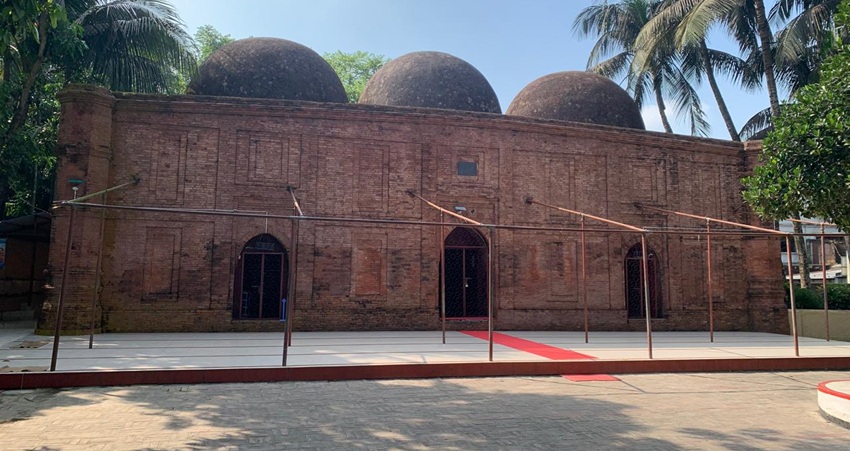
The Shahi Mosque of Pabna’s Chatmohar upazila stands as a magnificent relic of the Sultanate-Mughal architectural era — a 444-year-old monument that continues to embody the rich history and cultural heritage of northern Bangladesh.
Located about 1.5 kilometres north of Bhadu Nagar intersection on the Pabna-Bhangura highway, the three-domed mosque is believed to have been built in 1581 AD (989 Hijri) during the reign of Emperor Akbar by Syed Abul Fateh Mohammad Masum Khan Kabuli, a military commander under the Mughal Empire.
Historical records, including “Chalanbil-er Itikotha” by Principal Abdul Hamid, reveal that the mosque was constructed with funding from Masum Khan and designed by his brother Khan Mohammad Tuki Khan.
Masum Khan, a descendant of a noble family originally from Kabul, Afghanistan, served as a commander of 5,000 soldiers under Emperor Akbar. Disillusioned with Akbar’s religious policies, he joined forces with Bengal’s Baro Bhuiyans in 1579, declaring independence and briefly establishing his own rule in Pabna, with Chatmohar as his capital. He was later killed in battle against Mughal forces in 1599 at the age of 44.
Architecturally, the mosque—measuring 45 feet long, 22.5 feet wide, and 45 feet high—is built with thin, finely crafted bricks. The western wall contains three intricately designed mihrabs aligned with the three entrances. The mosque’s walls, 6 feet 9 inches thick, still showcase remnants of ancient terracotta artwork and sculptural motifs.
Over the centuries, much of the mosque’s structure deteriorated but it was fully restored by the Department of Archaeology in the 1980s, preserving its original Mughal-Sultanate design. The black stone inscription bearing the Kalima Shahadat (“La ilaha illallahu, Muhammadur Rasulullah”) still stands at the mosque’s front. A freshwater well once served worshippers here, though it has since been sealed.
In 1904, under the Ancient Monuments Preservation Act, the then government (of undivided Pakistan) initiated efforts to protect the mosque. A stone slab containing inscriptions in Persian on one side and depictions of Hindu deities on the other—suggesting the site’s earlier multi-faith history—is now preserved at the Varendra Research Museum in Rajshahi.
The mosque once stood alongside several guard posts that have since vanished with time and encroachment. Today, after government-led restoration and beautification, the site features boundary walls, gates and newly built minarets that enhance its grandeur.
Despite its modest interior—accommodating only two rows of worshippers—the Shahi Mosque remains a place of daily prayers and Friday congregations. Thousands gather here for Eid-ul-Fitr and Eid-ul-Azha prayers, while visitors from across the country continue to flock to witness this splendid piece of Mughal heritage—a living monument to Masum Khan Kabuli and the golden age of Bengal’s Islamic architecture.
-The writer is a Upazila Representative at The Daily Observer