



| HEADLINE |

|
CPD advises dropping proposal for bicameral parliament
Published : Thursday, 9 October, 2025 at 5:38 PM
Observer Online Report


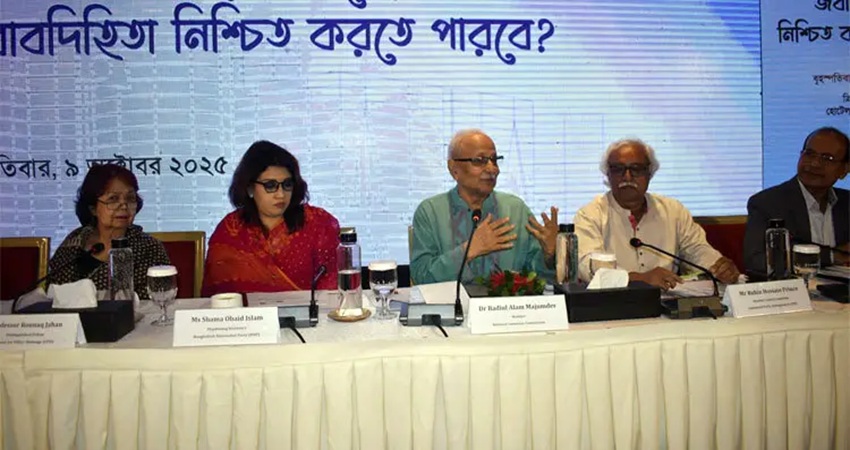
The Centre for Policy Dialogue (CPD) has advised removing the proposal to establish a bicameral parliament in the country, arguing that the country’s political culture makes such a system impractical.
Instead, CPD recommends strengthening the existing unicameral parliament through legal, institutional, and structural reforms.
The recommendation was made at a national dialogue organized by CPD on Thursday (October 9) at the Intercontinental Hotel in Dhaka, title “Can a proposed upper house ensure accountability of the majority in Parliament?”
Based on recent research on parliamentary reforms and accountability, CPD called on the Interim Government’s Consensus Commission to exclude the bicameral proposal from its final list. The research findings were presented by Dr. Khandakar Golam Mouazzem, Research Director at CPD, and Professor Nizam Ahmed of Chittagong University.
CPD’s analysis highlighted that reforms such as bicameralism, proportional representation, inclusion of non-partisan members, or forming nomination committees, while appealing in principle, are unlikely to work effectively in Bangladesh. The country’s entrenched party loyalty, patronage networks, and a “winner takes all” political culture make these proposals largely symbolic. The report warns that such measures could increase political deadlock, centralize power, and reduce accountability instead of enhancing it.
The think tank emphasized that structural and cultural reforms are essential to improving parliamentary accountability. Accordingly, it recommends focusing on reforming and empowering the existing parliament rather than creating a new upper house.
CPD also suggested several practical steps to strengthen parliamentary governance, including appointing opposition MPs as chairs of standing committees, ensuring transparency in party funding and expenditures, providing greater financial autonomy to local governments, expanding women’s participation in elections at local and national levels, and introducing legal measures to prevent party-switching.
The report further recommends that while the executive should retain the authority to make key constitutional and administrative appointments, these decisions should be subject to review by parliamentary oversight committees.
Finally, CPD proposed the creation of an independent commission to provide advice and assessment before and after the enactment of laws, modeled on the European Union’s legislative review system. Tentatively called the “Democracy, Lawmaking, Executive and Legislative Commission,” this body would focus on strengthening constitutional and legal frameworks, protecting citizens’ rights, and supporting the democratic development of local government.
The recommendation was made at a national dialogue organized by CPD on Thursday (October 9) at the Intercontinental Hotel in Dhaka, title “Can a proposed upper house ensure accountability of the majority in Parliament?”
Based on recent research on parliamentary reforms and accountability, CPD called on the Interim Government’s Consensus Commission to exclude the bicameral proposal from its final list. The research findings were presented by Dr. Khandakar Golam Mouazzem, Research Director at CPD, and Professor Nizam Ahmed of Chittagong University.
CPD’s analysis highlighted that reforms such as bicameralism, proportional representation, inclusion of non-partisan members, or forming nomination committees, while appealing in principle, are unlikely to work effectively in Bangladesh. The country’s entrenched party loyalty, patronage networks, and a “winner takes all” political culture make these proposals largely symbolic. The report warns that such measures could increase political deadlock, centralize power, and reduce accountability instead of enhancing it.
The think tank emphasized that structural and cultural reforms are essential to improving parliamentary accountability. Accordingly, it recommends focusing on reforming and empowering the existing parliament rather than creating a new upper house.
CPD also suggested several practical steps to strengthen parliamentary governance, including appointing opposition MPs as chairs of standing committees, ensuring transparency in party funding and expenditures, providing greater financial autonomy to local governments, expanding women’s participation in elections at local and national levels, and introducing legal measures to prevent party-switching.
The report further recommends that while the executive should retain the authority to make key constitutional and administrative appointments, these decisions should be subject to review by parliamentary oversight committees.
Finally, CPD proposed the creation of an independent commission to provide advice and assessment before and after the enactment of laws, modeled on the European Union’s legislative review system. Tentatively called the “Democracy, Lawmaking, Executive and Legislative Commission,” this body would focus on strengthening constitutional and legal frameworks, protecting citizens’ rights, and supporting the democratic development of local government.
HKJ
Loading...
Loading...
Also read









Editor : Iqbal Sobhan Chowdhury
Published by the Editor on behalf of the Observer Ltd. from Globe Printers, 24/A, New Eskaton Road, Ramna, Dhaka.
Editorial, News and Commercial Offices : Aziz Bhaban (2nd floor), 93, Motijheel C/A, Dhaka-1000.
Phone: PABX- 41053001-06; Advertisement: 41053012; 01793317829, 01550707291, E-mail: [email protected], [email protected] Online: email: [email protected] 41053014; 01550707297 Advertisement: 01550707296
Published by the Editor on behalf of the Observer Ltd. from Globe Printers, 24/A, New Eskaton Road, Ramna, Dhaka.
Editorial, News and Commercial Offices : Aziz Bhaban (2nd floor), 93, Motijheel C/A, Dhaka-1000.
Phone: PABX- 41053001-06; Advertisement: 41053012; 01793317829, 01550707291, E-mail: [email protected], [email protected] Online: email: [email protected] 41053014; 01550707297 Advertisement: 01550707296


