



| HEADLINE |

|
Bishwajit Chattar
A landmark against mobocracy


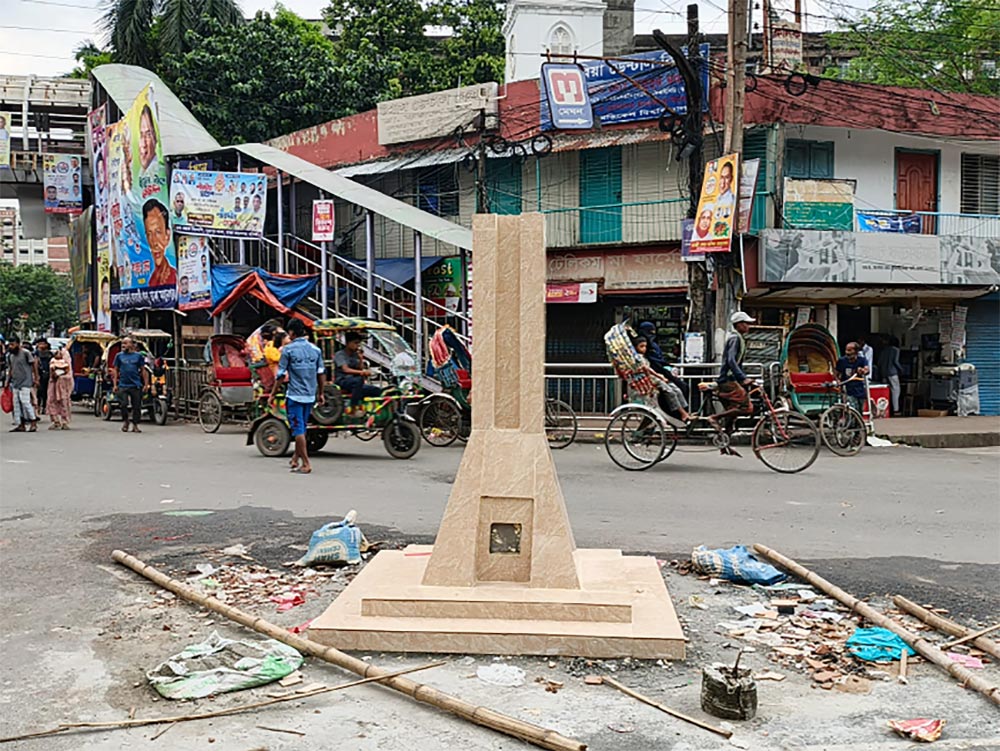 A decade after the horrific killing of tailor Bishwajit Das in Old Dhaka, the city is finally etching his memory into its landscape. A memorial named "Bishwajit Chattar" is being built at the intersection of Sadarghat and Shankharibazar, the same neighbourhood where his life was cut short on a December morning.
 For many at Jagannath University, it is more than a monument: it is a testament to his unjust death, a symbol of resistance against political violence, and a way to keep his story alive for generations.
Bishwajit Das was attacked with a machete by student political activists on December 9, 2012, during a half-day strike called by the Bangladesh Nationalist Party (BNP)-led 18-party alliance. He succumbed to his injuries on the way to Mitford Hospital.
Twelve years later, teachers and students of Jagannath University have taken the initiative to commemorate him. The memorial, "Bishwajit Chattar", began construction on Monday, September 29, with the aim of becoming a permanent landmark.
The site lies near Bahadur Shah Park's northern side, connecting Sadarghat and Shankharibazar. The first stage involves a symbolic structure, with a full-scale installation to follow after design approval.
Prof. Dr. Rais Uddin, General Secretary of the University Teachers' Association and Chair of the Islamic Studies Department, told the Daily Observer:
"We announced the construction of 'Bishwajit Chattar' to honour Bishwajit's sacrifice. The memorial is now underway."
Students echoed his words. Rifat Hasan, a history student from the 2021-22 session, said, "It is tragic that justice has still not been fully served after twelve years. But the memorial will immortalise his memory."
Sagar Debnath, a law student of the 2020-21 session, said, "We want the state to expedite the trial. At the same time, Bishwajit Chattar will serve as a symbol of the brutality of fascist oppression."
The initiative followed a teachers' rally on September 11 demanding the removal of the bus stand in front of the campus. It was there that Dr. Rais Uddin announced the plan to name the site Bishwajit Chattar. A formal application was later submitted, and construction began on Monday after city corporation approval.
Bishwajit's murder had sparked both national and international outrage. The accused were leaders and activists of the student wing of the ruling party at Jagannath University.
The legal process began with a case filed at Sutrapur Police Station by Sub-Inspector Jalal Ahmed against 25 unidentified individuals. After a three-month investigation, charges were filed against 21 accused on March 5, 2013. The trial started on June 2, 2013, at the Dhaka Metropolitan Sessions Judge Court.
On December 18, 2013, eight accused were sentenced to death and 13 to life imprisonment. Subsequent appeals and verdict revisions by the High Court have since altered some sentences, and the case remains under appeal.
For Bishwajit's family, the memorial is bittersweet recognition of their long, painful wait for justice.
His elder brother Uttam Das told the Daily Observer, "Even after ten years, justice is incomplete. But it is heartening to see a memorial being built in his name. At least the new generation will learn the history of this injustice."
His father, Ananta Das, shared similar feelings, "It feels very good to know that a memorial is being built in his memory after so many years. I hope to visit it when I can."
The Bishwajit Chattar memorial is not merely a tribute--it stands as a quiet protest against a culture of impunity. For Jagannath University students and teachers, it is a space to remember, reflect, and remind society of the cost of political violence.
As the first structure takes shape, it carries the weight of a decade-old tragedy and the hope of a future where such violence is not repeated.
Loading...
Loading...
Also read



Editor : Iqbal Sobhan Chowdhury
Published by the Editor on behalf of the Observer Ltd. from Globe Printers, 24/A, New Eskaton Road, Ramna, Dhaka.
Editorial, News and Commercial Offices : Aziz Bhaban (2nd floor), 93, Motijheel C/A, Dhaka-1000.
Phone: PABX- 41053001-06; Advertisement: 41053012; 01793317829, 01550707291, E-mail: [email protected], [email protected] Online: email: [email protected] 41053014; 01550707297 Advertisement: 01550707296
Published by the Editor on behalf of the Observer Ltd. from Globe Printers, 24/A, New Eskaton Road, Ramna, Dhaka.
Editorial, News and Commercial Offices : Aziz Bhaban (2nd floor), 93, Motijheel C/A, Dhaka-1000.
Phone: PABX- 41053001-06; Advertisement: 41053012; 01793317829, 01550707291, E-mail: [email protected], [email protected] Online: email: [email protected] 41053014; 01550707297 Advertisement: 01550707296


