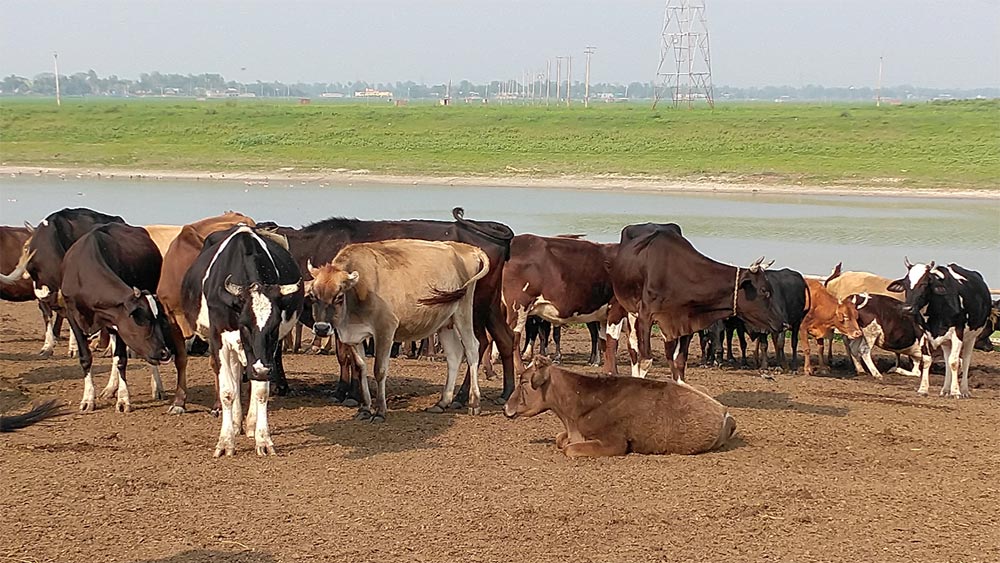
SIRAJGANJ, Oct 6: The history of cattle rearing and milk production in Sirajganj dates back nearly 150 years. Without significant support, the people of this region have independently established thousands of farms. The milk produced here is now widely appreciated across the country.
The cow milk produced in this district is supplied nationwide due to its high quality, creating substantial demand for milk from areas like Shahjadpur. However, over time, challenges such as the lack of proper utilisation, fair pricing, market development, guaranteed sales, rising cattle feed costs, and inadequate long-term protection of farmers' interests have persisted.
Despite increased milk production, no reliable large-scale market or sales assurance has been established, preventing small and medium-scale farmers from accessing broader markets.
The absence of guaranteed markets and proper marketing mechanisms, both government and private, often leaves farmers worried about selling their milk. As a result, thousands of farmers in the region are facing difficulties.
According to field sources, the Bangladesh Milk Producers' Cooperative Union Ltd. (Milk Vita) was established in 1973 at Baghabari, on the banks of the Baral River in Shahjadpur Upazila to support small, marginal, and landless milk producers through production, processing, and marketing. Over time, the number of farmers in the area grew, and almost every household began rearing cows. Today, Milk Vita has 713 primary dairy cooperative societies and 22,000 farmers under its umbrella, making it one of the largest cooperative-based dairy-processing plants in the country.
To meet the demand for cattle feed naturally, the government declared 1,409.07 acres of khas land in Shahjadpur Upazila and Pabna District as cattle grazing land in 2011. These lands were allocated to various societies on a yearly lease. Farmers are supposed to grow green grass, mashkolai, and kheshari kolai on these lands for cattle feed, with seeds supplied by Milk Vita. However, this is not being done properly. Moreover, despite regulations, these lands are often used to cultivate paddy and other crops for about seven months a year, leading to a severe shortage of naturally produced cattle feed. This forces farmers to buy feed at higher prices, increasing milk production costs.
With neither natural feed nor fair milk prices, farmers are incurring losses and growing increasingly frustrated.
Sources indicate that the largest dairy region in the country has developed around Baghabari, Milk Vita's base, covering several upazilas in Pabna and Sirajganj. Almost every farmer in the region rears dairy cattle, making cattle farming a dream for survival. Currently, about 10 lakh litres of milk are produced daily in the area.
In 2021-2022, Milk Vita's Baghabari plant collected nearly 200,000 litres of milk daily. Additional collection centres in Ullapara, Shahjadpur, Pabna, and Ishwardi contributed around 50,000 litres. However, daily collection has now dropped to just 20,000-30,000 litres.
Alongside Milk Vita, around 20 private companies, including Aarong, Pran Dairy, Amomilk, Farm Fresh, Aftab, Rangpur Dairy, and BRAC, collect and process several hundred thousand litres of liquid milk daily, marketing it across the country. Local traders and milk businesses also supply milk, ghee, and chhana to Dhaka and other regions. Sweet makers and tea stalls source milk from the Baghabari area. A significant portion of the country's milk demand is met by milk produced in Shahjadpur, earning it the title "Dairy Capital."
Dairy processing companies are the primary buyers for farmers. However, during Eid and other periods when Milk Vita and other companies reduce or halt milk collection, farmers struggle to sell their produce. Additionally, farmers have long demanded higher milk prices. Due to low prices, many have reduced supplies to Milk Vita, leading to the current decline in collection.
Milk Vita authorities, however, claim that reduced supplies from farmers have caused the drop in collection.
Jahangir Hossain, a farmer from Madla Notunpara, Potajia, Shahjadpur, stated that production cost per litre is about Tk 43, but companies pay only Tk 38-42 per litre based on fat content. Moreover, only registered farmers can sell to these companies, limiting their profitability. He demanded a price of Tk 50-55 per litre.
Alamgir Hossain from the same area mentioned that when companies reduce collection, farmers are forced to sell the remaining milk at Tk 30-40 per litre, incurring a loss of Tk 10-15 per litre daily. He called for year-round sales assurance and price increases.
Abdur Rahman from Reshimabari noted that reduced collection by Milk Vita and other companies has led farmers to sell milk locally at Tk 60-70 per litre, reducing supplies to Milk Vita.
Waz Uddin, President of the Potajia Primary Dairy Cooperative Society, stated that members previously supplied 7,000 litres daily to the society, but now only 2,000-2,500 litres are supplied due to low prices. He emphasised the need for government policy to ensure fair prices and year-round sales.
Abdur Rashid from Baghabari highlighted the shortage of subsidized seeds from Milk Vita for grass and pulse cultivation, increasing production costs.
Dr. Saidul Islam, Deputy Manager of the Baghabari Milk Vita plant, explained that milk collection stops during Eid due to staff shortages. He noted that price adjustments are beyond his authority and that seed distribution is linked to milk supply.
Amiya Kumar Mondal, Acting Deputy Manager of Samity Department of Milk Vita plant , defended Milk Vita, stating that the organization has helped create markets and increase production. He attributed reduced supplies to farmers selling milk externally at higher prices without quality checks.
Muhammad Nazrul Islam, Deputy Commissioner of Sirajganj, acknowledged the issue of leased grazing lands being used for other crops and assured that steps would be taken to ensure proper use of these lands for cattle feed cultivation.





