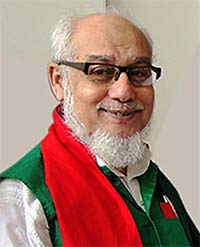
For Mahbub Alam Chashi, life was not a calculation of birth and death-it was only birth, expressed through creation. His journey was one of meditation, thought, and relentless practice, whether in diplomacy, human resource development, agriculture, rural cooperatives, or the struggle for freedom, reform, and justice. He was an uncompromising organizer, coordinator, and pioneer for the marginalized.
Born amidst the hills, rivers, and coastal lands of Chattogram, his education bore the rhythm of upheaval. In the shadow of partition, he completed his graduation from Islamia College, Kolkata in 1946-47. He sat for the Civil Service of Pakistan (CSP) examination, securing second place. But instead of joining the administration, he chose the diplomatic service in 1949, becoming part of its first batch. He turned down lucrative offers abroad to take a posting in Communist China, the only Bengali to do so.
Over the years he served in China, Japan, the UK, the US, and Karachi before returning to Dhaka in 1965-66 as head of Pakistan's first regional foreign service office. But the structural inequality and humiliation of East Pakistan became intolerable. In protest, he resigned from the foreign service after a heated exchange with Foreign Minister Zulfikar Ali Bhutto, choosing instead to return to his ancestral land in Rangunia, Chattogram. There, on reclaimed hills and wetlands, he founded Chashi Farm. Local peasants honored him with the title "Chashi" (farmer), and from 1968-69 he became Mahbub Alam "Chashi."
On November 12, 1970, after the devastating cyclone, Chashi moved with a cooperative team to Ramgati in Noakhali. There he initiated the country's first cluster village-a precursor to modern resettlement planning-where he worked shoulder-to-shoulder with laborers with shovel in hand. Relief, for him, was not charity but a resource for rebuilding.
When Bangladesh's independence was declared on March 26, 1971, Chashi was in Subarnachar, Noakhali, working with landless flood victims. On hearing the news, he renamed a local settlement Swadhin Gram ("Freedom Village") to inspire villagers. Soon after, he crossed into Agartala, where he established the first Secretariat-in-Exile of Bangladesh. As Secretary General of the provisional government, he coordinated with Indian authorities, laying the administrative foundations of the liberation struggle.
Yet, on November 19, 1971-before victory-he resigned from his government post, declaring that his calling was rural development, not bureaucracy. After independence, Bangabandhu Sheikh Mujibur Rahman entrusted him with the Ministry of Local Government, Rural Development and Cooperatives, and later with the Bangladesh Academy for Rural Development (BARD), Comilla.
Out of the 1974 famine emerged the Comprehensive Village Development (CVD) program under his stewardship, which led to the creation of Gram Sarkar (village government). In 1975, he pioneered the Swarnirvar Bangladesh movement. Later, under President Ziaur Rahman's declaration that "local government is the real government," the self-reliant village government was institutionalized in 1980-a revolutionary reform rooted in Chashi's vision of grassroots democracy and bottom-up development.
Chashi was more than a diplomat or policymaker, He was a thinker, a doer, and an organizer who blended idealism with practice. His books In Quest of Shawnirvar and Mukti Pother Sandhane remain indispensable to understanding his philosophy of self-reliance and grassroots empowerment. His essay Shawnirvarey Panch Sathi reflects his belief in moral purification and collective responsibility.
Mahbub Alam Chashi lived and died by his principles. He wished to be buried at his Chashi Farm, overlooking the Ghumai Beel wetlands, among the peasants with whom he worked. On September 4, 1983, while on pilgrimage, he passed away in a road accident in the deserts of Arabia.
He left behind three daughters, a son, and a legacy that transcends family-rooted in justice, equality, and rural empowerment. From village governments to micro-credit, from literacy to cooperative farming, his life's work forms the blueprint for a self-reliant Bangladesh.
Mahbub Alam Chashi was born on October 1, 1927. His was not merely a birth into this world, but the birth of creation itself. On his birth anniversary, let us remember his message:
"Do the work yourself, then teach others."
Bangladesh today needs the combined strength of its people, public servants, and political representatives-the three J's of Janata, Janosebok, and Janoprotinidhi-to pursue his vision of an inclusive, self-reliant, and equitable nation.
May Allah guide us to that path.
The writer is founder of RDP and recipient of the Gusi International Peace Prize





