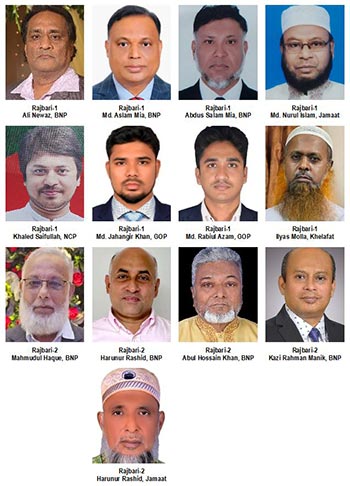
RAJBARI, a district located in the country's central part under the Dhaka Division, is a place where history, culture, and politics intersect in fascinating ways. Though smaller in size compared to some other districts, Rajbari has long commanded attention due to its rich zamindari heritage, vibrant cultural tradition, and its importance as an agricultural hub.
Today, as Bangladesh prepares for the upcoming national election scheduled for February 2026, Rajbari once again finds itself in the national spotlight. The district's two parliamentary constituencies are poised to witness intense competition among major political parties, reflecting both the continuity of history and the evolving aspirations of its people.
The identity of Rajbari is deeply tied to its past. During the British colonial era, the district was home to powerful zamindar families, including the Nawabs of Baliakandi and the zamindars of Pangsha and Goalanda. Their estates, with their grandeur and influence, shaped local politics, economy, and culture in lasting ways. Although these palatial structures now stand mostly as relics, they symbolise Rajbari's history as a place where authority and prestige were once negotiated through land, wealth, and patronage. Equally significant is the historic Goalanda Ghat, once among the busiest river ports of Bengal. Long before railways and highways took prominence, steamers from Goalanda connected Dhaka with Kolkata, Assam, and beyond. The port made Rajbari a vital commercial and transport hub, embedding it firmly in the memory of generations of travellers and traders.
This layered heritage continues to inform the political consciousness of Rajbari's people. The district is well known for its cultural diversity and religious harmony. Hindu and Muslim communities celebrate their festivals side by side, with Durga Puja in Pangsha or Kalukhali drawing as much vibrancy as Eid in the Rajbari town. This spirit of coexistence often spills into politics, where candidates must balance promises of development with reassurances of unity and inclusivity. Folk traditions such as jatra (folk theatre) and village fairs further strengthen this sense of shared identity, ensuring that politics in Rajbari is never divorced from culture.
As Bangladesh moves towards the 2026 general election, the district's two parliamentary constituencies are shaping up as crucial battlegrounds. The district has a total of 947,294 registered voters, almost evenly split between men and women. In Rajbari-1 there are approximately 410,777 voters, while Rajbari-2 has around 536,517. These figures underscore the weight of Rajbari's electorate, which could influence national political equations in a tightly contested election.
The political history of Rajbari shows that no single party can take its results for granted. Since the return to parliamentary democracy in 1991, both the Awami League (AL) and the Bangladesh Nationalist Party (BNP) have secured victories here, with Jamaat-e-Islami also managing to win in earlier contests.
BNP has several potential contenders who are attempting to galvanise supporters through neighbourhood gatherings, small rallies, and personal interactions in tea stalls and bazaars. Their rhetoric focuses on rising commodity prices, unemployment, and what they describe as governance failures.
The issues at stake in Rajbari mirror those of rural Bangladesh more broadly. Farmers want better prices for their produce, protection against river erosion, and modernised irrigation systems. Young voters, many of whom will be casting ballots for the first time, are demanding jobs, skills training, and opportunities to escape the cycle of underemployment. Women voters are placing emphasis on healthcare facilities, education for girls, and safer rural roads. At the same time, Rajbari's identity as a cultural hub means that preservation of heritage and promotion of communal harmony also enter the electoral conversation.
RAJBARI-1: This constituency includes Sadar and Goalanda upazilas.
BNP, has several hopefuls vying for the nomination. Among them are Ali Newaz Mahmud Khaiyam, a former Member of Parliament (MP) and a member of the BNP's central executive committee, along with Advocate Md. Aslam Mia, Co-Vice President of the Central Krishok Dal and Joint Convener of the District BNP, and Md. Abdus Salam Mia, former senior joint general secretary of the District BNP.
Beyond the major parties, several notable "star candidates" are also making their presence felt. They include Khaled Saifullah, a Central Joint Convener of the newly formed National Citizen Party (NCP); Md. Jahangir Khan, a Joint Convener of the Rajbari District branch of the Gono Odhikar Parishad (GOP) and an expatriate living in Oman; and Md. Rabiul Azam, District Member Secretary of the same party. Additionally, Advocate Jahangir Alam Khan Jahid Hasan, President of the Rajbari District branch of Islami Andolan Bangladesh (IAB), and Aminul Islam Kashemi, a central member of IAB, are also in the race.
Adding to the mix, some parties have already declared their candidates. Jamaat has officially declared Advocate Md. Nurul Islam, a member of the party's Central Majlis-e-Shura and the District Chief. Similarly, Hafez Maulana Ilyas Molla, President of the District branch of the Bangladesh Khelafat Majlish, has also been declared as a candidate.
RAJBARI-2: This constituency covers Pangsha, Kalukhali, and Baliakandi upazilas.
Jamaat has declared Harunur Rashid, a member of the District Shura Parishad and a teacher at Pangsha Abdul Majed Academy, as their sole candidate for this seat.
The BNP's current District Convener Advocate Liaquat Ali is a strong contender. Other potential BNP candidates include Harunur Rashid, former general secretary of the Rajbari District BNP; Principal A.R. Mahmudul Haque Rozen, former convener of the Pangsha Upazila BNP; and Abul Hossain Khan, former president of the Baliakandi Upazila BNP. Also in contention is Barrister Kazi Rahman Manik, former joint general secretary of the Central Committee of the Swechasebak Dal.
New faces include Sayed Jamil, a Central Member of the NCP and a political analyst, as well as Engineer Jahid Sheikh, President of the Dhaka North City and Tejgaon Model Thana branches of the GOP.
Across both constituencies, a peculiar campaign trend has emerged. Potential candidates are using large, eye-catching posters, banners, and gates to attract attention. The interesting twist is that these promotional materials are often attributed to "the people of the area" rather than the candidates themselves, a clever and somewhat deceptive tactic to show popular support from the start.





