



| HEADLINE |

|
Election Landscape In Districts
BNP confident to recover all seats, Jamaat candidates strengthen campaign in Jamalpur District
Published : Friday, 19 September, 2025 at 12:00 AM
Our Correspondent


 JAMALPUR, a district enriched with history and heritage on the banks of the Old Brahmaputra, is once again turning into a hotbed of political activity as the 13th parliamentary election approaches.
 The district, named after the revered saint Hazrat Shah Jamal whose shrine still stands in the town, is not only a political battleground but also a district with immense cultural and historical significance. It is home to the Doyemoyee Temple, a spiritual center for the Hindu community, attracting thousands of pilgrims each year, particularly during the sacred Astomi Snan in the Brahmaputra. The district also boasts popular sites like Lauchapra in Bakshiganj, a scenic picnic spot.
Jamalpur holds a proud place in Bangladesh's liberation history. Kamalpur, located in Bakshiganj Upazila, was one of the fiercest battlefronts of the 1971 Liberation War under Sector 11, commanded by Major (later Colonel) Abu Taher. With headquarters just across the border in India's Meghalaya, the sector witnessed 18 bloody battles between June and November 1971, where 194 freedom fighters embraced martyrdom.
The battle claimed the leg of Sector Commander Abu Taher himself, while Pakistani forces suffered heavy losses. The fall of the Kamalpur camp to allied forces on December 4, 1971, was a turning point, leading to the liberation of Jamalpur and Sherpur. This legacy of sacrifice continues to shape the district's political consciousness.
Administratively, Jamalpur is divided into seven upazilas and five parliamentary constituencies. For decades, the Awami League (AL) has enjoyed electoral dominance across most constituencies, with heavyweight candidates like Mirza Azam holding firm ground since the early 1990s, who is now absconding.
In the absence of Awami League activity in Jamalpur, BNP has intensified its organizational programmes with the participation of senior central leaders. Local leaders and activists have been holding a series of meetings and rallies to energize grassroots workers ahead of the upcoming 13th parliamentary elections.
In the 11th parliamentary elections held on December 30, 2018, a total of 32 candidates from 12 political parties contested across five constituencies in Jamalpur. Of them, five each represented the AL, BNP, and Islami Andolan Bangladesh (IAB); four were from Jatiya Party (JaPa-Ershad); three from the Communist Party of Bangladesh (CPB); two each from Bangladesh Nationalist Front (BNF), Zaker Party, and Bangladesh Jatiya Party; and one each from Gano Forum, Bangladesh Muslim League, Bangladesh Khelafat Andolan, and Bangladesh National Awami Party (NAP).
The BNP, however, retains deep roots in the district, particularly in Sarishabari, the birthplace of its late stalwart Barrister Abdus Salam Talukdar. Yet, the party's fortunes have been uneven in recent years, worsened by internal divisions and a boycott of the 2018 general election amid allegations of widespread rigging.
BNP candidates who contested in the 2018 election eventually boycotted the polls, alleging widespread rigging. This time, however, the party is determined to contest fully, with the ambitious goal of winning all five constituencies in the district.
Alongside BNP, Jamaat-e-Islami and IAB, which are not facing internal organizational problems, also held meetings with their central leaders in the district.
As part of its election preparations, BNP convened its triennial district council on August 23 this year after a long gap of nine years. Party insiders said the council helped reduce internal rifts, following instructions from acting chairperson Tarique Rahman, who stressed unity and discipline to ensure victory in the next polls.
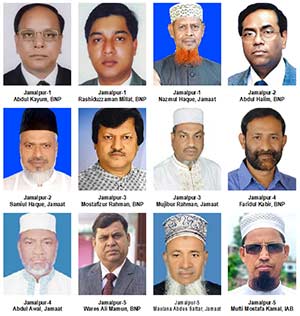
JAMALPUR-1: This parliamentary area covers Bakshiganj and Dewanganj upazilas.
Traditionally an AL stronghold, this seat may witness a tight contest this time. Former inspector general of police Abdul Kayum, hailing from Bakshiganj, has emerged as a strong BNP contender. He is actively campaigning in his upazila, focusing on local grievances and his national-level reputation.
Meanwhile, another BNP heavyweight, former Member of Parliament (MP) M Rashiduzzaman Millat of Dewanganj, is also vying for nomination. Millat, a Central BNP treasurer, has been holding meetings across Dewanganj, signalling his determination.
From the Islamist parties, Jamaat has fielded Central Majlish-e-Shura Member Nazmul Haque Saidee while IAB has nominated Arif Khan Rasel, President of Dewanganj Upazila unit.
JAMALPUR-2: The constituency encompasses Islampur Upazila.
BNP is placing high hopes on ASM Abdul Halim, an Adviser to Party Chairperson Begum Khaleda Zia and former cabinet secretary.
Halim has been visible in public events, promising solutions to local issues like river erosion, poor infrastructure, and unemployment. His bureaucratic background and close ties with BNP leadership strengthen his candidacy.
However, former BNP MP Sultan Mahmud Babu remains in contention for the party ticket. The Islamist camp is also mobilising, with Jamaat nominating its Central Organising Secretary Samiul Haque Faruki and IAB nominating District Secretary Maulana Sultan Mahmud Sirazi.
JAMALPUR-3: The constituency incorporates Madarganj and Melandaha upazilas.
Since 1991, AL's Mirza Azam, now absconding, has been an unshakable force in this constituency, winning consecutive elections with wide margins. BNP, however, is betting on a change of tide. Md Mostafizur Rahman Babul, Joint Secretary of BNP's National Executive Committee, has intensified campaigns in both Madarganj and Melandaha. Alongside him, Rezabuddaula Chowdhury, former information and research secretary of National Executive Committee, and Daulatuzzaman Ansary, Vice-President of Central Krishak Dal, are also lobbying for nomination.
On the opposition front, Jamaat has declared Maulana Mujibur Rahman, District Executive Committee Member, as its candidate.
National Citizen Party (NCP) has floated Lutfar Rahman, Central Joint Member Secretary, as a probable candidate.
JAMALPUR-4: This constituency includes Sarishabari Upazila.
Historically a BNP stronghold due to the legacy of Barrister Abdus Salam Talukdar, Sarishabari remains a critical seat for the party. After Talukdar's death, his nephew Md Faridul Kabir Talukdar Shamim, a multiple-term president of District BNP, has risen as the natural successor. Widely seen as BNP's strongest candidate, Shamim is consolidating grassroots support.
For Jamaat, District Secretary Md Abdul Awal has been nominated while IAB has endorsed local leader Hafez Maulana Md Ali Akbar Siddiqui.
Yet, BNP's organizational muscle in Sarishabari may prove decisive.
JAMALPUR-5: This parliamentary area covers Sadar Upazila of the district.
District BNP General Secretary Advocate Shah Md Wares Ali Mamun, a two-time mayor and Central BNP Co-Organising Secretary, is the party's most popular face in Sadar. His strong rapport with ordinary voters and record of service as mayor give him an edge. Mamun was BNP's candidate in 2018 and is expected to be renominated.
Still, competition exists within BNP, as central leader Nilofar Chowdhury Moni has also expressed interest in achieving nomination.
On the other side, Jamaat has declared District Ameer Maulana Abdus Sattar as its candidate while IAB has nominated District President Mufti Mostafa Kamal.
One of the most notable developments this year has been BNP's apparent success in easing internal strife. For years, rival factions within Jamalpur BNP undermined collective strength, often splitting votes or weakening campaigns. Acting Chairman Tarique Rahman's direct intervention-ordering reconciliation and prioritising organizational unity-appears to have yielded results. Local leaders who previously worked in isolation are now engaging in joint programs, enhancing BNP's visibility.
Moreover, the district council has re-energized grassroots workers who felt demoralized after the 2018 boycott. BNP leaders are also strategically reaching out to nonpartisan voters and local influencers, recognizing that winning Jamalpur will require broad-based coalitions.
As the election clock ticks, Jamalpur is shaping up as a fascinating battleground. BNP's renewed organizational vigour and efforts to overcome factionalism reflect a party eager to prove its relevance after years of setbacks. If it can successfully translate unity into votes and tap into public discontent, BNP may well reclaim some of its lost glory in the district.
Loading...
Loading...
Also read



Editor : Iqbal Sobhan Chowdhury
Published by the Editor on behalf of the Observer Ltd. from Globe Printers, 24/A, New Eskaton Road, Ramna, Dhaka.
Editorial, News and Commercial Offices : Aziz Bhaban (2nd floor), 93, Motijheel C/A, Dhaka-1000.
Phone: PABX- 41053001-06; Advertisement: 41053012; 01793317829, 01550707291, E-mail: [email protected], [email protected] Online: email: [email protected] 41053014; 01550707297 Advertisement: 01550707296
Published by the Editor on behalf of the Observer Ltd. from Globe Printers, 24/A, New Eskaton Road, Ramna, Dhaka.
Editorial, News and Commercial Offices : Aziz Bhaban (2nd floor), 93, Motijheel C/A, Dhaka-1000.
Phone: PABX- 41053001-06; Advertisement: 41053012; 01793317829, 01550707291, E-mail: [email protected], [email protected] Online: email: [email protected] 41053014; 01550707297 Advertisement: 01550707296


