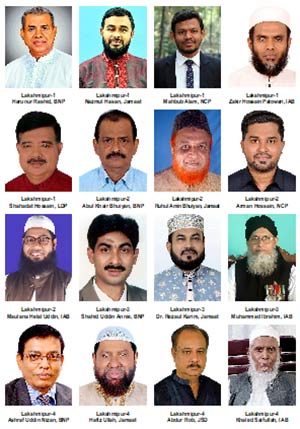
LAXMIPUR, a district under Chattogram Division in south-eastern Bangladesh, has long been a focal point in the country's political landscape. Known for its vibrant political culture, rich agricultural production, and a significant remittance-driven economy, this district is a relatively small district that exerts influence far beyond its geographical size. It's historical, educational, and religious heritage further add to its prominence, making it a highly contested arena during national elections.
Originally part of Noakhali, Laxmipur was formally upgraded to a district on February 15, 1984, when the western portion of Noakhali was reorganised into the new district. This administrative move was intended to improve governance and local development. Over the decades, Laxmipur has produced notable political figures and continues to attract nationwide attention during elections. Both the Awami League (AL) and the Bangladesh Nationalist Party (BNP) consider the district strategically important, often fielding their strongest candidates here.
According to the 2022 Bangladesh Census, Laxmipur has 459,344 households and a population of 1,937,948, averaging 4.16 people per household. The district encompasses four municipalities, 58 union parishads, 514 villages, 3,539 mosques, 45 temples, and one church. Its mix of educational institutions, including madrasas, schools, and colleges, has produced both modern scholars and renowned Islamic teachers, reflecting the district's dynamic blend of tradition and modernity.
Historically, Laxmipur has been a BNP stronghold. During previous elections, BNP Chairperson Begum Khaleda Zia contested and won parliamentary seats from this district, securing her position as a national leader. At one point, all four constituencies in Laxmipur were firmly under BNP's control. However, following periods of political upheaval and authoritarian intervention, the AL captured these seats.
Currently, BNP hopefuls are actively participating in meetings, rallies, and grassroots campaign to mobilise supporters and restore party discipline. Their primary goal is to reclaim the district's constituencies in the upcoming 13th Jatiya Sangsad election.
While BNP has long been the dominant force, Bangladesh Jamaat-e-Islami and Islami Andolan Bangladesh (IAB) are now visibly stepping up their presence in Lakshmipur. The Jamaat has finalised candidates for all four constituencies and has begun intensive campaigns aimed at challenging BNP's dominance. The IAB is also fielding candidates though other political parties are yet to finalise their nominees. Some smaller parties are reportedly struggling to organize effectively, leaving a significant gap in the political field.
LAKSHMIPUR-1: This constituency covers Ramganj Upazila.
In this seat, multiple BNP leaders have declared their intentions to contest here, while Jamaat and IAB have formally announced their candidates. BNP's potential candidates include Harunur Rashid VP, Senior Joint Convener of Dhaka Metropolitan South BNP; VP Abdur Rahim, former general secretary of Ramganj BNP; Yasin Ali, Central Vice-President of BNP's volunteer wing; and Mashfiqul Haque Joy, son of former state minister Ziaul Haque Zia. Shahadat Hossain Selim, Chairman of Liberal Democratic Party (LDP), has expressed support for BNP's efforts.
Jamaat's declared candidate for this seat is Nazmul Hasan Patowary, Upazila Ameer. In the face of multiple BNP aspirants, Patowary has consolidated his grassroots base, positioning himself as a strong contender.
IAB has announced Md. Zakir Hossain Patowary, Upazila Vice-President, as its candidate.
National Citizen Party (NCP) Joint Convener Mahbub Alam has also expressed interest though no official nomination has been made yet. Mahbub Alam, the younger brother of Mahfuz Alam, BNP's Information and Publicity Adviser, is considered the NCP's likely candidate.
LAXMIPUR-2: The constituency encompasses Raipur Upazila and eight union parishads of Laxmipur Sadar Upazila.
Previously, BNP Chairperson Khaleda Zia won this constituency in 1996 and 2001 though she later vacated the seat in by-elections. Her Political Adviser Abul Khair Bhuiyan has maintained BNP's hold here, serving as MP three times. Senior BNP leader Harunur Rashid VP has also expressed interest, positioning himself as a potential nominee.
Jamaat's declared candidate is Ruhul Amin Bhuiyan, a veteran politician and District Ameer, who remains active in all party activities.
IAB's nominee is Maulana Helal Uddin, Secretary of Raipur Upazila, while NCP's campaign is led by Central Organizer Arman Hossain, a former member of the Judicial Reform Commission and Anti-Discrimination Student Movement Coordinator.
Other parties are yet to announce candidates, leaving BNP and Islamist groups as the primary contenders.
LAXMIPUR-3: The constituency includes Laxmipur Sadar Upazila.
BNP's sole hopeful here is Shahid Uddin Chowdhury Annie, Central Joint Secretary of BNP and a two-time former MP. He is widely expected to win and possibly assume a ministerial position in the next government. Another BNP aspirant is Md. Mosleh Uddin Hawlader Arif, former president of Australia BNP and ex-senior joint convenor.
Annie faces competition from Jamaat's Central Committee Member Dr. Rezaul Karim, who has long been active in local politics.
IAB has nominated former District president and honorary Captain Muhammad Ibrahim while Khelafat Majlish has fielded Golam Mostofa, District President. NCP is still organising its presence in this constituency.
LAXMIPUR-4: This parliamentary area covers Ramgati and Kamalnagar upazilas.
BNP has multiple considerations here. For coalition reasons, the central BNP leadership has supported A S M Abdur Rob, president of the Jatiya Samajtantrik Dal (JSD). However, local BNP supporters prefer ABM Ashraf Uddin Nizan, who has previously won as MP in 2001 and 2008. Nizan also ran in the 2018 election but lost to AL-backed candidate.
ABM Ashraf Uddin Nizan has maintained BNP's grassroots structure and kept party activists engaged, while A S M Rob's spouse, Tania Rob, manages local campaign activities due to her husband's limited presence. Another BNP aspirant is Beethika Binte Hosain, widow of the late Shafiul Alam Babu and former Central President of BNP's volunteer wing. She is Chairman of the social organization Arpan Alok Sangho.
Jamaat's candidate in this constituency is AR Hafiz Ullah, former District Naeb-e- Ameer and current Acting Secretary, while IAB enjoys strong support for Allama Khaled Saifullah, who has held positions from UP chairman to Upazila chairman as an independent candidate during the AL tenure.
Dr. Rezaul Karim of Jamaat emphasised the need for a fair election: "We want a free, fair, and impartial election. However, before that, we demand state-level infrastructural reforms, visible justice for the July massacres, and adherence to election declarations. We do not want elections where day-time voting ends up being counted at night. We seek a 'level-playing field' before the election."
Hasibur Rahman, Joint Convenor of Laxmipur BNP, reinforced the party's confidence: "Laxmipur is BNP's stronghold. Whoever receives the party's nomination under the 'Paddy Sheaf' symbol will win. Historically, we have always emerged victorious here.
In all competitive elections in 1991, 1996, 2001, and 2008, BNP has won. If the upcoming elections are free and fair, we will reclaim all four constituencies, Inshallah."
Laxmipur's electoral landscape demonstrates a blend of historical loyalty and evolving political challenges. While BNP remains the dominant force, the increasing activism of Jamaat and IAB introduces a competitive dimension that cannot be ignored.
Moreover, each constituency exhibits unique dynamics. In Ramganj, multiple BNP aspirants face competition from Jamaat and IAB, making candidate selection critical. Raipur and Sadar remain under the influence of senior BNP figures though Jamaat and IAB continue to mobilise grassroots campaigns. Ramgati and Kamalnagar reflects coalition negotiations and strategic considerations, where local and central preferences may differ.
Demographically, the district's mix of urban and rural population, coupled with high political awareness, ensures that electoral outcomes here often have wider implications for national politics. Voter engagement is expected to be high, and campaign strategies emphasise both local issues and national concerns, including infrastructure development, agricultural policies, and governance reforms.
With elections approaching, political parties are increasingly focused on grassroots mobilisation. BNP candidates have been actively attending local meetings, distributing materials, and engaging with supporters to solidify their base. Similarly, Jamaat and IAB have intensified outreach efforts, hosting rallies and community discussions. Smaller parties are attempting to organize but face structural and logistical challenges.
Voters in Laxmipur are well-informed and politically conscious. Issues such as agricultural productivity, local employment, infrastructure development, and governance transparency dominate public discourse. The district's history of political participation ensures that campaigns are closely scrutinised, and promises are weighed against past performance.
As Laxmipur prepares for the 13th national parliamentary election, all eyes are on this politically vibrant district. BNP seeks to reclaim its historical stronghold, leveraging its established base and experienced leaders. Jamaat and IAB aim to capitalise growing support and contest the dominance of BNP.





