MUNSHIGANJ, historically known as Bikrampur, stands on the bank of the mighty Padma River as one of the most historically vibrant and culturally significant districts of the country. Once a part of Dhaka District for centuries, it became an independent district in 1984. Though relatively new in administrative identity, its legacy stretches back over a thousand years, making it one of the oldest centres of learning and civilisation in Bengal.
Munshiganj is well-known for its cultural and archaeological richness. Excavations in Bikrampur unearthed the Bikrampur Vihara, a thousand-year-old Buddhist monastery linked to Ati?a, the great scholar of the Pala Empire. This discovery connects the district to a glorious intellectual past, when Bengal was a seat of Buddhist learning and scholarship.
The district also houses the Baba Adam Mosque, built in 1483, a unique example of early Islamic architecture in Bengal. The Sonarang Twin Temples, constructed in the 19th century, symbolise the artistic excellence of Hindu religious structures, with twin spires dedicated to Lord Shiva and Goddess Kali.
Surrounded by the Padma, Meghna, and Dhaleshwari rivers, Munshiganj has always thrived as a river-based district. Traditional boat races, vibrant fishing activities, and riverine agriculture are deeply embedded in its lifestyle and culture.
The district also takes pride in producing eminent personalities. It is the birthplace of scientist Jagadish Chandra Bose, whose pioneering work in plant physiology and radio waves made him world-renowned. The Bikrampur Museum preserves artefacts that showcase the area's rich past.
Today, this district is a hub of agriculture, especially for potatoes, which supply much of the demand in Dhaka and other parts of Bangladesh. Tourist attractions like Idrakpur Fort, Sonarang Temples, Bhagyakul Zamindar House, and the scenic Mawa Point on the Padma River continue to draw visitors.
Beyond history and culture, Munshiganj holds a significant place in the country's political map. Ahead of the next national parliamentary election, a show of force is underway by nomination aspirants across the three parliamentary constituencies in this district. Some candidates are organizing their campaigns based on their involvement in the recent opposition movement. Even candidates who previously had no contact with the area are now starting to visit. They are trying to win over party leaders and workers to their side.
With three parliamentary constituencies, the district is known as a Bangladesh Nationalist Party (BNP) stronghold. For decades, this district has been considered the "fortress" of the BNP, where the party's electoral symbol, the 'Paddy Sheaf', has enjoyed overwhelming popularity-particularly among women voters. Election observers note that while male voters tend to split, female voters have consistently favoured the BNP in past polls.
Following the lessons learned from the Dhaka University Central Students Union (DUCSU) election, party activists are demanding that the nomination be given to grassroots-friendly and dedicated leaders who were active in the recent opposition movement.
Activists have warned that if the wrong candidates are nominated, the BNP may have to pay the price in the national election, just as it did in the DUCSU election.
Despite this, the Awami League (AL) has governed the district for 15-16 years through controversial elections. The AL rule has been marked by instances of night-time voting, early voting, and forced voting. In this environment of power grabs, new voters have been deprived of their right to vote.
Meanwhile, for the upcoming election, there are more than three potential BNP candidates for each of the three parliamentary constituencies in this district. In Munshiganj-2 Constituency, nearly all the aspirants are new faces. The absence of seasoned leadership has further deepened competition. The once dominant figure, five-time MP and former District BNP president Abdul Hai, is now bedridden due to prolonged illness, leaving a vacuum in leadership.
The party's organizational structure has also faced turbulence. District BNP Convener Mizanur Rahman Sinha, who had earlier resigned citing business and health reasons in 2020, surprisingly returned in 2021 as the convener. Later, the BNP Central Committee appointed Abdul Hai's younger brother, Md. Mohiuddin, as member secretary of a seven-member ad hoc body, which was expanded to a 59-member Convening Committee in June. Several members of this committee has faced criticism for allegedly having ties with the AL or benefitting from its rule, sparking discontent within the grassroots activists.
The inclusion of Major (Retd) Masudur Rahman Kaiyum as a committee member triggered major controversy. Local BNP activists accused him of torturing party leaders and extracting money during the 2007 military-backed caretaker government, when he served at the Munshiganj army camp. His selection has angered a section of the BNP rank and file, who see it as an injustice to dedicated activists who endured jail, harassment, and cases during the movement.
Party workers insist that nomination this time must be given to those who remained loyal during the anti-government movements, facing lawsuits, police brutality, and imprisonment.
While the BNP boasts a long list of heavyweight aspirants, other major parties are also actively preparing for the polls, ensuring a multi-cornered contest in each of the three constituencies. The political manoeuvring is already in full swing, with candidates engaging in public relations and mobilising their supporters in anticipation of the official election schedule. Reports suggest that at least 11 names are being circulated as possible BNP nominees across Munshiganj's three constituencies.
Meanwhile, Jamaat-e-Islami has fielded candidates in all three constituencies and may play a factor in vote-splitting.
Other political parties such as the Nationalist Citizen Party (NCP), Jatiya Party (JaPa), and Islami Andolan Bangladesh (IAB) are also testing their ground. In one constituency, a candidate from Gono Odhikar Parishad (GOP) is expected to contest.
According to the District Election Office, this district has a total of 1,418,738 registered voters. Among them, 729,853 are men, 688,881 are women, and 4 belong to the third gender category. Interestingly, female voters slightly outnumber male voters in terms of electoral influence, and their consistent tilt towards BNP could be decisive.
MUNSHIGANJ-1: This constituency comprises Sreenagar and Sirajdikhan upazilas.
The seat has become a key battleground for the BNP, with several influential figures vying for the party's nomination.
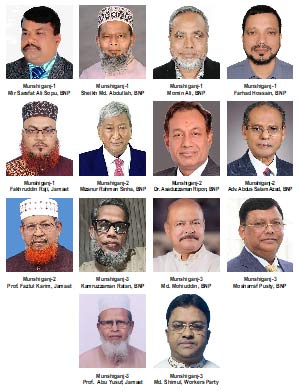
Among them is Mir Sarafat Ali Sopu, BNP's Central Committee Secretary for Volunteer Affairs. Another strong contender is Sheikh Md. Abdullah, President of Sirajdikhan Upazila BNP and a member of the District BNP Convener Committee.
The list of aspirants also includes Md. Momin Ali, a member of District BNP Convener Committee and former president of Sreenagar Upazila BNP and former chairman of the Sreenagar Upazila Parishad.
Adding to the competition is Md. Farhad Hossain, a Joint Convener of the Dhaka Metropolitan South BNP. The presence of so many senior leaders reflects the fierce internal competition within the party for this seat.
Beyond the BNP, other parties are also making their presence felt. The Munshiganj District Secretary of Jamaat-e-Islami, AKM Fakhruddin Raji, has been declared the party candidate.
GOP has also named its Central Committee Vice-President, Mohammad Zahidur Rahman, as a candidate. Furthermore, KM Atiqur Rahman, Assistant Secretary General of IAB, is actively preparing for the electoral race in the constituency.
MUNSHIGANJ-2: This parliamentary area consists of Louhajang and Tongibari upazilas.
The political dynamic in this seat is defined by the presence of three major BNP hopefuls, all of whom are considered heavyweights.
Former state minister for health and current District BNP Convener, Mizanur Rahman Sinha, is a prominent contender. He is facing competition from two other senior leaders: Dr. Asaduzzaman Ripon, a BNP Vice-Chairman, and Advocate Abdus Salam Azad, a Joint Secretary General of the BNP Central Committee. All three potential candidates are actively campaigning and organizing their followers in the area, setting the stage for an intense internal party contest.
Meanwhile, other parties have also finalised their candidates. Jamaat has declared its former District Ameer Professor ABM Fazlul Karim as its candidate for this seat.
Abdullah Saeed, a leader of the Bangladesh Khelafat Majlish, is preparing to join the electoral fray.
K. M. Billal Hossen, Secretary General of Islami Sramik Andolan and adviser of IAB Munshiganj District Unit, is also preparing to join the election race.
MUNSHIGANJ-3: This constituency incorporates Munshiganj Sadar and Gajaria upazilas.
In this constituency, BNP's list of aspirants includes some of the party's key leaders. Md. Kamruzzaman Ratan, a member of the BNP Central Executive Committee and former District BNP member secretary, is a strong contender.
Md. Mohiuddin, District BNP Convener Committee Member Secretary and President of Munshiganj Sadar Upazila BNP, is also nomination seeker.
Also in the running is businessman Mosharraf Hossain Pusty, a member of the District BNP Convener Committee and former chairman of Rampal Union Parishad.
There is also public talk that Engineer Saiful Islam Babu, son of former information minister M. Shamsul Islam and a former president of the Dhaka Chamber of Commerce and Industry, might seek the BNP's nomination. However, reports from the area suggest he has not maintained active contact with local voters.
Jamaat's declared candidate for this seat is Professor Md. Abu Yusuf, a former chairman of the Department of Mathematics at Jagannath University, ensuring a wide range of choices for the voters.
Maulana Mahmudur Hasan Suman Dewan, a local leader of Sadar Upazila has been selected as the IAB candidate.
Other parties are also fielding candidates. The Revolutionary Workers Party might nominate its District Committee Secretary and central member Journalist Sheikh Md. Shimul.





