



| HEADLINE |

|
Glorious history of DUCSU
Published : Sunday, 14 September, 2025 at 12:00 AM
Sanjida Nourin Jhinuk


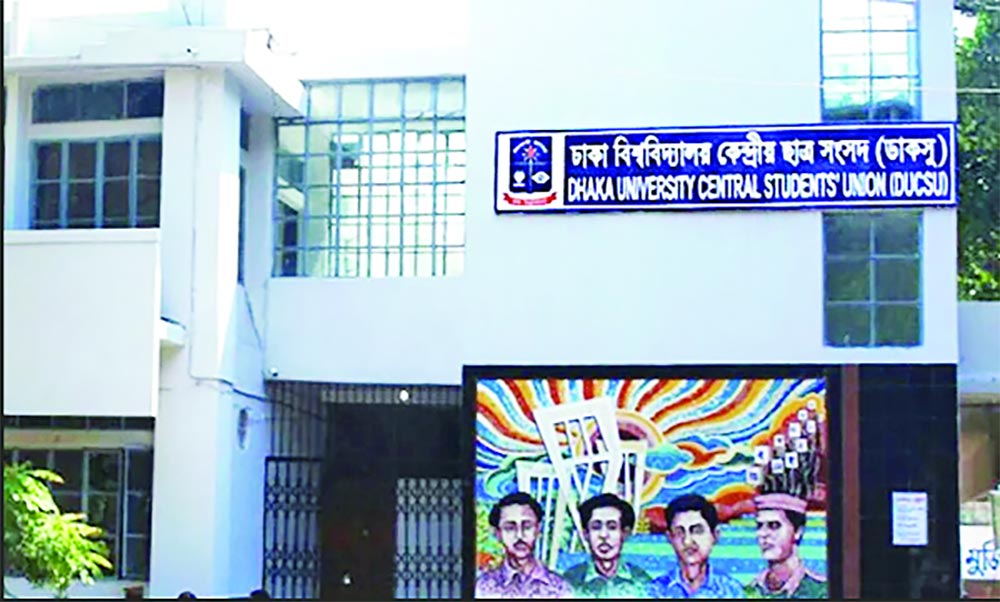 In the corridors of Dhaka University where generations of students have dreamed, debated and struggled, a power has always shaped the nation's destiny: the Dhaka University Central Students' Union or DUCSU. Born from the vision of its founders and inspired by the student movements at Aligarh Muslim University, DUCSU was designed not merely as a council of students but as a miniature parliament, a platform where youth could confront ideas and challenge authority for reformation. Its story begins in the early 1920s, when Sir A. F. Rahman initiated student councils in the university's three residential halls which are Muslim Hall, Jagannath Hall and Dhaka Hall. These embryonic councils evolved into the Dhaka University Students' Council which after three decades of growth and formalization, took its enduring name- DUCSU in 1953-54.
From its earliest days, DUCSU was intertwined with the fate of the nation. Each hall sent representatives to the council, while teachers and the vice-chancellor supervised ensuring legitimacy and order. By 1945-46, under Vice-Chancellor P. J. Hartog, the first president was appointed ex officio with Ahmedul Kabir as vice president and Sudhir Dutta as general secretary. The union became the cradle of leadership producing voices that would steer the nation through the turbulence of the mid-20th century. DUCSU students were at the forefront of the 1952 Language Movement, the 1966 Six-Point Program, the 1969 mass uprising and the 1971 Liberation War. For this reason, the union has often been called the "Second Parliament" of Bangladesh.
Yet, DUCSU's history has always been a mix of glory and shadow. After independence, the early 1970s saw the rise of Islami Chhatra Shibir whose confrontations with Chhatra League and secular student groups turned dormitories into battlefields. Dormitories, once safe havens of learning, became arenas for ideological clashes, armed control and violent takeovers. Fear and factional dominance often eclipsed democratic debate leaving students trapped between political allegiance and personal safety.
The 1990s and 2000s added a darker layer to DUCSU's narrative. Following the fall of General Ershad in 1990, DUCSU elections were repeatedly announced and canceled. The 1991 election, planned for June, was aborted amid violence; elections in 1994, 1995, 1998 and 2005 never materialized due to opposition from dominant student wings particularly Chhatra League and administrative hesitancy. During this period, the Awami League, wary of Shibir's influence, curtailed its visible activity on campus forcing its networks underground while maintaining strict control over halls and student politics. Students responded with protests, black flag demonstrations, strikes and organized forums but their voices were largely unheard. Hall-level clashes and even deaths such as the killing of Abu Bakar Siddique in 2010 reminded everyone that DUCSU was as much a battlefield as it was a student parliament.
When elections finally returned in March 2019, the outcome brought a flicker of hope. Nurul Haque Nur, representing a general student rights platform, won the vice presidency signaling the possibility of reclaiming DUCSU for ordinary students. Yet the promise was fragile. Allegations of vote-rigging, boycotts by opposition groups and repeated attacks on Nur and his supporters underscored how deeply trust in campus democracy had eroded over decades of political manipulation and violence.
Then came the dramatic turn of 2025. For the first time in decades, Islami Chhatra Shibir openly contested as Shibir through the "Oikyaboddha Shikkharthi Jote" (United Students' Alliance). Their candidates swept the key posts including vice president and general secretary, securing a dominant presence among member seats as well. This resurgence was not merely electoral; it marked a political turning point. The younger generation of students disillusioned with old party-dominated politics, cast their votes for alternatives. The elections signaled that the name Shibir could again operate openly signaling a shift in the national student political landscape. With Shibir now at the helm, questions hang in the air like a heavy fog. Can they respect the many voices and ideas that have long shaped campus life? Can DUCSU truly be a space for all students, where freedoms are protected and women's rights and safety are not sidelined? Or will this concentration of power on campus become a reflection of the tensions in the country, deepening divisions far beyond the university walls? Students who have dreamed of a meaningful, representative union now watch with a mixture of hope and anxiety. Some see a chance for a focused, organized leadership that might finally deliver real change. Others fear the return of old patterns of control, exclusion and the quiet intimidation of dissent.
The next chapter of DUCSU is still unwritten, and its impact will ripple far beyond classrooms and dormitories. Here a generation is watching and waiting to see whose footsteps will leave a mark and whether those steps will illuminate a path of hope or cast long complexity over the future.
The writer is an Undergraduate Student, Department of International Relations, University of Dhaka
Loading...
Loading...
Also read



Editor : Iqbal Sobhan Chowdhury
Published by the Editor on behalf of the Observer Ltd. from Globe Printers, 24/A, New Eskaton Road, Ramna, Dhaka.
Editorial, News and Commercial Offices : Aziz Bhaban (2nd floor), 93, Motijheel C/A, Dhaka-1000.
Phone: PABX- 41053001-06; Advertisement: 41053012; 01793317829, 01550707291, E-mail: [email protected], [email protected] Online: email: [email protected] 41053014; 01550707297 Advertisement: 01550707296
Published by the Editor on behalf of the Observer Ltd. from Globe Printers, 24/A, New Eskaton Road, Ramna, Dhaka.
Editorial, News and Commercial Offices : Aziz Bhaban (2nd floor), 93, Motijheel C/A, Dhaka-1000.
Phone: PABX- 41053001-06; Advertisement: 41053012; 01793317829, 01550707291, E-mail: [email protected], [email protected] Online: email: [email protected] 41053014; 01550707297 Advertisement: 01550707296


