Dhaka University Central Students' Union (DUCSU) elections scheduled for Tuesday face mounting concerns over transparency and fairness as teachers, candidates, and observers raise serious questions about the election commission's neutrality and administrative arrangements.
Multiple stakeholders have voiced alarm about potential irregularities threatening the credibility of elections involving approximately 40,000 eligible voters in Bangladesh's premier university.
The University Teachers' Network issued a comprehensive 10-point alert following observations from the controversial 2019 DUCSU polls, whilst competing political panels have accused the election commission of losing impartiality.
The Teachers' Network specifically called for female teachers to verify female students' identities, publication of clear guidelines for journalists and polling agents, and provision of resting facilities for observers.
They demanded strict accountability from the election commission and administration in cases of opacity or irregularities, emphasising the need for polling agents to access stations freely.
A total of 471 candidates will contest for 28 posts. Among the major posts, 45 candidates will compete for the position of Vice-President (VP), 19 for General Secretary (GS) and 25 for Assistant General Secretary (AGS).
A total of 17 candidates will contest the Liberation War and Democratic Movement Affairs Secretary, 11 for Common Room, Reading Room and Cafeteria Secretary, 14 for International Affairs Secretary and 19 for Literature and Cultural Affairs Secretary.
In addition, 12 candidates will vie for Science and Technology Secretary, nine for Research and Publication Secretary, 13 for Sports Secretary, 12 for Student Transport Secretary, 17 for Social Service Secretary, 15 for Health and Environment
Secretary, 11 for Human Rights and Legal Affairs Secretary and 15 for Career Development Secretary.
A total of 217 candidates will contest for member posts.
The 2025 Dhaka University Central Students' Union (DUCSU) election saw participation from a total of nine panels, each fielding candidates for the three key leadership positions-Vice President (VP), General Secretary (GS), and Assistant General Secretary (AGS).
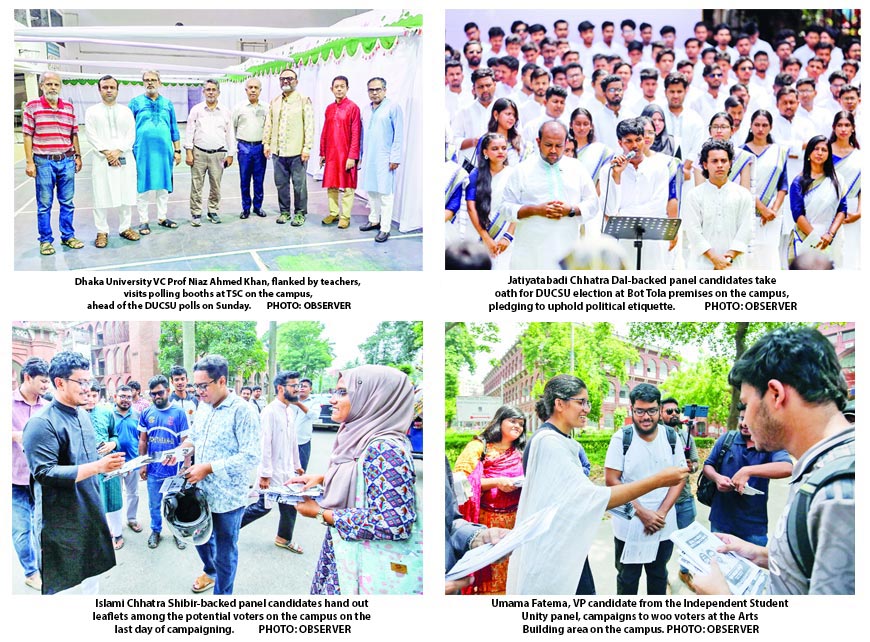
The Oikkoboddho Shikkharthi Jote, backed by Islami Chhatra Shibir, nominated Shadik Kayem for VP, SM Farhad for GS, and Mohiuddin Khan for AGS. The Boisommobirodhi Shikkharthi Sangsad, supported by Bangladesh Ganotantrik Chhatra Sangsad, put forward Abdul Qader for VP, Abu Baker Majumder for GS, and Ashrefa Khatun for AGS. Representing the Bangladesh Jatiyatabadi Chhatra Dal, the Abid-Hamim-Mayed Parshad nominated Md Abidul Islam Khan for VP, Sheikh Tanvir Baree Hamim for GS, and Tanvir Al Hadi Mayed for AGS.
The Swatantra Shikkharthi Oikko, a panel without political affiliation, fielded Umama Fatema as its VP candidate, Al Sadi Bhuiyan for GS, and Jahid Ahmed for AGS. From the leftist student front, Pratirodh Parshad nominated Sheikh Tasnim Afroze Emi for VP, Meghmallar Basu for GS, and Md. Jabir Ahmed Jubel for AGS. Another panel, DUCSU For Change, backed by Chhatra Adhikar Parishad, nominated Bin Yamin Molla for VP, Sabina Yasmin for GS, and Rakibul Islam for AGS.
The Swacheton Shikkharthi Sangsad, supported by Islami Chhatra Andolon, presented Yasin Arafat as its VP candidate, Khairul Ahsan Marzan for GS, and Saif Mohammad Alauddin for AGS. Meanwhile, the Swamonnito Shikkharthi Jote nominated Jalaluddin Muhammad Khalid for VP, Fateha Sharmin Anny for AGS, though its GS candidate, Md. Mahin Sarkar, later withdrew his candidacy. Finally, the leftist alliance Oporajeyo 71, Odommo 24 nominated Md. Nayem Hasan for VP, Enamul Hasan Ayon for GS, and Aditi Islam for AGS.
The final day of campaign witnessed multiple panels making their last appeals to approximately 40,000 eligible voters. The Jatiyatabadi Chhatra Dal (JCD)-nominated Abid-Hamim-Mayed panel took an oath at the historic Bot-tola, pledging to prevent the return of oppressive common room systems and guest room abuses that characterised previous regimes.
"We will never allow the hateful political misconduct that emerged during past fascist regimes to return under any circumstances," declared VP candidate Abidul Islam Khan during the ceremony.
The panel committed to transforming Dhaka University into a safe space for female students whilst ensuring legitimate hall seats for all students.
Meanwhile, Resistance Council's GS candidate Meghmallar Basu appealed particularly to non-residential students, stating: "Your vote can change the entire equation. No anti-freedom forces will be able to win a single post here."
The Anti-Discrimination Student Parliament raised significant concerns about the Election Commission's impartiality. GS candidate Abu Bakar Majumder alleged: "Every day, the Election Commission is losing its neutrality. Those who violated the code of conduct have not faced any action."
The panel criticised polling centre arrangements, citing the grouping of three halls at Curzon Hall as illogical. They expressed particular concern about external political pressure on students' families, claiming local BNP and Jamaat leaders were contacting students at home using allegedly leaked administrative information.
With nearly 50 per cent of the electorate comprising women, female students' preferences could determine election outcomes. Campus interviews reveal a clear preference for mature, competent candidates over traditional political affiliations.
"My first priority is to vote for someone who is not tied to political organisations," stated Farzana Akhter, a Linguistics student. The sentiment reflects broader post-August aspirations rejecting conventional politics in favour of candidates who prioritise day-to-day student rights including legitimate dormitory seats, hygienic food access, and proper study environments.
University Teachers Link submitted 10 detailed proposals to ensure free and fair elections. The recommendations include preventing fake voters through ID issuance suspension, ensuring OMR machine transparency via expert audits, and implementing polling-centre based result announcements.
The organisation emphasised technology-based surveillance, proposing operational CCTV verification and body cameras for comprehensive vote recording. They recommended establishing centralised control rooms with helpline services and deploying female law enforcement at women's polling centres.
Analysis of competing manifestos reveals remarkably similar promises across panels. All major contenders pledge annual DUCSU elections, complete student housing, enhanced food safety, modernised healthcare, and improved female student security.
However, many promises fall outside DUCSU's constitutional authority, which primarily covers common room maintenance, indoor games organisation, and cultural programme arrangement.
Political Science Professor Kazi Mohammad Mahbubur Rahman noted that whilst candidates can present demands to administration, actual implementation depends largely on university authorities rather than DUCSU representatives.
The election represents a crucial test for democratic practices at Bangladesh's premier university, with both domestic and international observers monitoring proceedings closely.