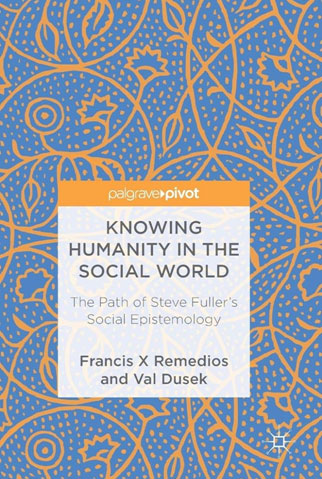
Knowing Humanity in the Social World (2018) is an intellectually rich and critical exploration of Steve Fuller's later work, particularly his contributions to social epistemology and its intersections with science, technology, and the evolving conception of humanity. Written by Francis X. Remedios and Val Dusek, the book situates Fuller's thought in the broader landscape of science and technology studies (STS), philosophy of science, and the shifting boundaries between human and posthuman conditions.
Reviewed by Dr Matiur Rahman
The authors provide a comprehensive account of Fuller's trajectory, tracing his early defence of normative social epistemology to his more recent explorations of transhumanism, Intelligent Design (ID), and the metaphysical question: What kind of being should the knower be? This shift, as the book highlights, reflects Fuller's attempt to move beyond mere descriptions of science to a more interventionist, policy-oriented, and metaphysically engaged project.
One of the book's strengths lies in its detailed exposition of Fuller's complex engagements with prominent figures such as Thomas Kuhn, Bruno Latour, and Karl Popper. Fuller's critique of Kuhn is portrayed as both scathing and deeply political, accusing Kuhn of aestheticising science while avoiding its entanglements with Cold War power structures. Against Latour's actor-network theory, which dissolves human agency into a mesh of actants, Fuller defends the unique epistemic agency of humans while acknowledging the potential role of artificial intelligence and biotechnology in reshaping that agency.
The chapters on transhumanism, Gnosticism, and Cosmism reveal Fuller as a provocative thinker willing to embrace controversial positions-such as supporting the inclusion of Intelligent Design in education-not from dogmatic belief but as part of his broader project of defending human centrality in an era of posthumanist and neoliberal tendencies. His notion of Humanity 2.0, as the book elucidates, envisions an enhanced, technologically mediated humanity capable of transcending biological limitations, while remaining deeply entangled with theological and historical traditions.
Remedios and Dusek approach Fuller's oeuvre both critically and sympathetically. They neither canonise nor caricature him; instead, they dissect his intellectual provocations, his opportunistic engagement with public controversies, and his tendency to act as an "intellectual provocateur" within and beyond academia. The book's glossary and structured chapters make it accessible to readers new to Fuller. At the same time, its in-depth exploration of historical and philosophical contexts offers value for experts in STS and the philosophy of science.
However, the book does not shy away from exposing the tensions and contradictions in Fuller's project. His flirtation with Gnostic themes, his reliance on theological metaphors in a purportedly secular project, and his advocacy for risk-taking under the proactionary principle are presented as double-edged: visionary to some, reckless to others. The authors suggest that Fuller's commitment to human enhancement and radical interdisciplinarity often clashes with academic and political conservatism, making him both an outlier and a catalyst in contemporary debates.
In the context of today's accelerating advancements in AI, genetic engineering, and synthetic biology, the book is timely. It forces readers to confront uncomfortable questions: Should humanity resist or embrace its technological transformation? Does defending human dignity require theological scaffolding? And can universities survive as sites of public good amid neoliberal pressures, or will they become client-driven corporate agents?
Overall, Knowing Humanity in the Social World is an indispensable resource for understanding Steve Fuller's provocative intellectual journey. It is not merely a biography of ideas but a critical lens through which the reader can examine the ongoing struggle between descriptive and normative accounts of knowledge, the fate of human agency, and the politics of science in the twenty-first century. For scholars, policymakers, and engaged readers grappling with the ethical and epistemic challenges of our technoscientific era, this book offers both a map and a set of provocations.
The reviewer is a researcher and development professional





