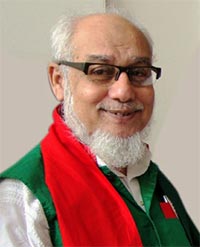
In the journey of Bangladesh, we often remember political leaders, freedom fighters and social reformers who shaped our destiny. Yet, there are also figures who quietly, through their sacrifice and vision, left an indelible mark on the nation. One such personality is Mahbub Alam Chashi, who chose to walk away from the glamorous world of diplomacy to toil in muddy fields alongside farmers. His life story is not just about a career change; it is about transformation, service and the pursuit of a poverty-free, self-reliant Bangladesh.
As we observe his 42nd death anniversary on 4th September 2025, it is important to revisit his extraordinary life and legacy for not merely to honor him, but also to reflect on how his vision remains unfinished in today's Bangladesh. Mahbub Alam was born on October 1, 1927 in Chittagong. His ancestral home was in Pashchim Sultanpur, Rauzan, while his parents lived in Debpahar Lane of the port city. He was the son of Abul Qasem, a respected District Judge, known as a strong moralist. From his early life, Mahbub Alam inherited discipline, integrity and a commitment to justice.
He was an exceptional student, completing his graduation from Islamia College, Calcutta, during the turbulent years of 1946-47-the partition of India and the creation of Pakistan. Later, he studied Economics at the University of Dhaka, residing at Salimullah Muslim Hall. His academic brilliance was evident when he excelled in both the Civil Service of Pakistan (CSP) examination and the Commissioned Officer's test for the Pakistan Army. Though initially selected for the Army, parental insistence guided him toward the Civil Service, where he joined the very first batch of the Pakistan Foreign Service in 1949.
For nearly two decades, Mahbub Alam served Pakistan with distinction. His postings took him to Communist China, Japan, Britain, United States and finally in Karachi, the then-capital of Pakistan. His diplomatic skills and intellectual capacity earned him respect in international circles.
Yet, despite these achievements, he could not ignore the glaring discrimination against East Pakistanis. At the Foreign Service Desk in Dhaka, he witnessed how Bengalis were treated as second-class citizens in their own land. In 1967, amid Ayub Khan's regime and Zulfikar Ali Bhutto's tenure as Foreign Minister, Mahbub Alam resigned from service in protest which was a rare act of courage that cost him prestige but gave him peace of conscience. Instead of continuing in the corridors of power, he chose to return to Chittagong, dedicating himself to agriculture. At Gumai Beel, he began cultivating High Yielding Varieties (HYV) of rice with the slogan: "Let the beggar's hand turn into a worker's hand."
Unlike most elites, he did not merely promote farming, he worked with farmers, tilling the soil with his own hands. The neglected rural poor, who were often looked down upon by society, found in him a genuine companion. Out of gratitude, they gave him the name "Chashi" (farmer). He accepted it with pride and began using it as part of his identity. From then on, he was no longer just Mahbub Alam, the diplomat, he became Mahbub Alam Chashi, the farmer, reformer and people's friend.

The devastating cyclone of 12 November 1970, which killed over half a million people in coastal East Pakistan, was a turning point. While the state machinery failed, Chashi rushed to the affected areas of Ramgati, Noakhali, where he organized relief, rehabilitation and cooperative farming for cyclone-hit farmers and fishermen. He introduced the idea of clustered villages for rehabilitation, a model that still inspires rural planning today.
Only months later, history called again. On 26th March 1971, the War of Independence began. Crossing into India through Belunia, Chashi joined the Mujibnagar Government as Foreign Secretary of the Exile Government of Bangladesh. For nine months, he tirelessly worked to secure international recognition and diplomatic support for the liberation struggle. His contribution in the diplomatic front of the war remains one of his greatest legacies. Yet, true to his character, once Bangladesh was liberated, he resigned from his high office to return to his mission of rebuilding rural Bangladesh.
Bangabandhu Sheikh Mujibur Rahman, upon his release from Pakistani jail and assumption of office as Prime Minister, called upon Mahbub Alam Chashi to join the government. He was made Secretary of the Ministry of Rural Development and Cooperatives, later serving as Vice-Chairman of the Bangladesh Academy for Rural Development (BARD) in Cumilla.
In the aftermath of the 1974 flood and famine, Chashi played a pivotal role in organizing the After Flood Recovery Organisation (AFRO), which brought together commissioners, freedom fighters, local leaders and farmers to rebuild livelihoods. From this, the Total Village Development (TVD) approach evolved, which emphasized grassroots participation, self-help and local leadership. During President Ziaur Rahman's era, Chashi's vision took shape as the Shawnirvar Gram Sarkar (Self-Reliant Village Government), a unique bottom-up model of rural governance launched nationally in 1978. It was a bold experiment in local democracy and economic self-reliance. Unfortunately, after Zia's assassination in 1981, the program lost momentum and under President Ershad, it was eventually dismantled, robbing Bangladesh of a grassroots revolution in governance.
Mahbub Alam Chashi was not only a practitioner but also a thinker. His writings-In Quest of Shawnirvar and Mukti Pother Sandhaney, remain valuable guides for development practitioners. His lesser-known booklet, Shawnirvar Panch Sathi is a remarkable exercise in self-criticism and collective accountability, rare in our bureaucratic culture. Through his books, he argued that true national progress cannot come from dependency on aid or top-down programs but from self-reliance, cooperative development and empowerment of rural people.
Tragically, Mahbub Alam Chashi's life ended prematurely. On September 4, 1983, at the age of only 56, he died in a car accident in Al Ghasim, Saudi Arabia while traveling to Mecca to perform Hajj. He was buried at the hilltop of his Chashi Farm in Rangunia, overlooking the fields he so dearly loved. In 1977, he was awarded the Shadhinata Padak, one of Bangladesh's highest civilian honors. Yet, his true reward was the respect of the ordinary farmers who accepted him as one of their own.
Today, Bangladesh has made remarkable progress in food security and rural development, yet poverty and inequality still persist. In many ways, Chashi's call for a self-reliant, bottom-up, people-centered model of development remains as relevant as ever. On his 42nd death anniversary, we must ask ourselves: Have we honored his vision of turning dependency into dignity? Are we empowering villages as he once dreamed or are we still trapped in a top-down system? Can we revive the spirit of Shawnirvar Gram Sarkar in today's context, blending modern innovation with grassroots empowerment?
Mahbub Alam Chashi's life reminds us that true leadership lies not in titles or positions but in service to the people. He was a diplomat, a freedom fighter, a reformer, and finally, a farmer-but above all, he was a visionary who believed in the power of ordinary people to transform their destiny.
The writer is a columnist





