NILPHAMARI, a district in the Rangpur Division, is widely regarded as the industrial heartland of the country's northern region. Saidpur, the district's main commercial hub, serves as a crucial transport link for the entire Rangpur Division.
Historically, Nilphamari belonged to the Rajshahi Division until administrative restructuring placed it under Rangpur. The subdivision was established in 1875 and later turned into a full district in 1984. It consists of six upazilas, four municipalities, 60 union parishads, 370 mouzas, and 378 villages.
The district carries a significant political and cultural heritage. The Tebhaga Movement of the 1940s spread through Domar and Dimla upazilas, while indigo was once widely cultivated here. Saidpur is famous for housing the largest railway workshop of the Assam-Bengal railway, established in 1870, which brought a large Urdu-speaking non-Bengali population to the area.
Traditionally, Nilphamari's four constituencies were considered strongholds of the Awami League (AL) and Jatiya Party (JaPa). However, with the decline of AL influence in recent years and growing anti-incumbency sentiment, Jamaat-e-Islami has emerged as a powerful contender. Jamaat is dominant in one constituency and enjoys significant support in the other three. Using this momentum, Jamaat leaders are working relentlessly to turn all four constituencies in their favour, conducting door-to-door campaign to mobilise voters.
BNP, once Jamaat's electoral ally, is now preparing for a head-to-head battle. While AL remains cornered due to its political setbacks, BNP is looking to capitalise on its grassroots strength. At the same time, smaller parties like Jamiat Ulema-e-Islam, Islami Andolan Bangladesh (IAB), National Citizen Party (NCP), and Gono Odhikar Parishad (GOP) are also active in the district, trying to carve out their presence.
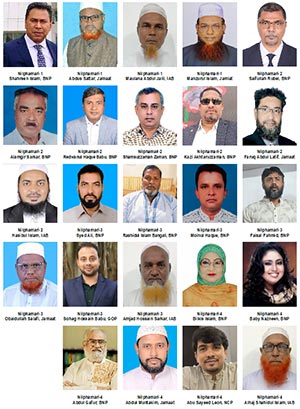
NILPHAMARI-1: This constituency comprises Domar and Dimla upazilas along with one municipality.
In the constituency, BNP candidate is former district BNP president, former Member of Parliament (MP), and Begum Khaleda Zia's nephew, Engineer Shahreen Islam Chowdhury Tuhin.
On the Jamaat side, the party has declared Principal Abdus Sattar, District Ameer, as its candidate.
The seat also sees heavyweight competition from Maulana Manjurul Islam Afendi, Central Secretary-General of Jamiat Ulema. In addition, IAB has nominated Maulana Abdul Jalil, President of the Domar Upazila, as its candidate.
Traditionally, this seat was dominated by AL and JaPa, but with the absence of AL this time, BNP and Jamaat are positioning themselves as the main contenders. Both parties have roughly equal voter bases, making the race highly competitive. BNP and Jamaat, once coalition partners under the 20-party alliance, are now contesting against each other, turning this election into a matter of prestige for both.
Grassroots workers believe Jamaat currently holds an advantage due to its consistent organizational presence in the area. Yet BNP is determined to reclaim ground, while smaller parties like Jamiat and IAB may play the role of spoilers.
NILPHAMARI-2: This constituency includes all 15 unions and one municipality of Sadar Upazila.
It is the most politically significant seat of the district.
BNP's nomination race has attracted multiple contenders: AHM Saifullah Rubel, District BNP's Member Secretary; Alamgir Sarkar, former district president; Shamsuzzaman Zaman, Former general secretary, Kazi Akhtaruzzaman Jewel, Member of District BNP and Redwanul Haque Babu, former Central Chatra Dal leader and current Convening Committee Member.
Jamaat has already declared Advocate Al Faruq Abdul Latif, District Assistant Secretary and President of the District Bar Association, as its candidate.
IAB has put forward Organizational Secretary of Rangpur Division Advocate Hafiz Maulana M. Hasibul Islam, while Jahangir Alam, District President of GOP, is also vying for nomination.
Posters, banners, and billboards of hopefuls have flooded Nilphamari town, signalling an intense contest ahead. Most analysts predict a two-way race between BNP and Jamaat, with smaller parties campaigning vigorously but unlikely to win.
The constituency has historically been AL-dominated, but with AL absent from the race, BNP is trying to fill the vacuum.
However, observers note that Jamaat enjoys a long history of electioneering here and maintains strong grassroots control, giving it a structural advantage.
Local observers note that Hindu voters may prove decisive in the upcoming elections for the seat, as their turnout and candidate preference are expected to significantly shape the final outcome.
Redwanul Haque Babu has outlined an ambitious vision: transforming Nilphamari into a modern, environmentally sustainable industrial hub, establishing a medical hub, a university for agriculture and technology, and expanding gas pipelines to industries. He has also pledged poverty alleviation programmes and foreign remittance growth through vocational training.
Redwanul Haque Babu has said that if elected, he will transform Nilphamari into an eco-friendly, industrialised, and modern planned district.
NILPHAMARI-3: This constituency consists of Jaldhaka and three unions of Kishoreganj Upazila.
Known as a stronghold of Jamaat, this seat has repeatedly been left to the party by its alliance partner, BNP.
In the upcoming election, BNP is determined to reclaim the seat. Aspirants for nomination include Alhaz Syed Ali, a two-time Upazila Chairman and a member of the District BNP; Md. Rashidul Islam Bangali, a District BNP member; and Md. Moinul Haque, another District BNP member. Although the name of former Jaldhaka Upazila BNP president and former municipal mayor Faisal Fahmid Chowdhury is being circulated, he has been relieved of responsibilities from the party.
Syed Ali has built BNP's organizational base in his electoral area and has raised hopes of victory even in this Jamaat's fortress. He said, "Jaldhaka will be transformed into a model Upazila - prosperous, corruption-free, and work-oriented."
On the other hand, Jamaat remains confident as it has won multiple times in this constituency. Their declared candidate this time is Obaidullah Salafi, former secretary of Rangpur Metropolitan Jamaat. He, too, has been actively campaigning and connecting with voters.
Sohag Hossain Babu, Central Joint Secretary for Publicity and Publication of the GOP, has also joined the race and is making widespread contacts across the constituency.
In addition, Amjad Hossain Sarkar, President of the Jaldhaka Upazila IAB , is also in the field.
Since the ruling AL is not contesting in this constituency, parties like BNP, Jamaat, IAB, and GOP are working to consolidate their presence on the ground ahead of the election.
Nomination-seekers are desperate to secure their place, holding rallies, meetings, and programmes. Although AL is absent in the field, grassroots people believe their supporters could influence the BNP vote bank, given that the party has significant support in this seat.
GOP's Central Joint Secretary for Publicity and Publication, Sohag Hossain Babu, said: "If elected, I will focus on overall infrastructural development in Jaldhaka Upazila, including the Teesta River and surrounding areas, rivers, canals, wetlands, and road networks. I will also build public awareness against drugs, terrorism, extortion, abduction, killings, and rape. Through this, social justice, civility, and human dignity will be established."
NILPHAMARI-4: This constituency covers Saidpur Upazila and six unions of Kishoreganj.
Several strong hopefuls of BNP are Bilkis Islam, BNP Executive Committee Member and former MP; Baby Nazneen, renowned singer and Adviser to the BNP Chairperson; and Abdul Gafur Sarkar, District BNP President.
Jamaat has declared Hafiz Maulana Abdul Muntakim, Saidpur Upazila Ameer, as its candidate while IAB nominated Alhaj Shahidul Islam, Organizational Secretary of the Mujahid Committee. NCP has put forward Abu Sayeed Leon, Central Joint Chief Organizer of the party.
This seat is unique for its large population of non-Bengali residents, who form a significant vote bank. All candidates are working hard to win their support, acknowledging that their decision could determine the outcome.
BNP's Bilkis Islam is seen as popular among both party workers and ordinary people due to her grassroots connections. Baby Nazneen, too, enjoys wide name recognition beyond politics.
Bilkis Islam said that in the past she had led the party in various movements and struggles. She carried out mass communication in villages and towns, presenting Tarique Rahman's 31-point programme.
From Jamaat's side, Muntakim is expected to consolidate their traditional base, while NCP's Abu Sayeed Leon has stressed that his party may not participate unless there are clear assurance of constitutional reforms and fair electoral arrangements.
Leon emphasised that Saidpur would be given special attention if he contests, promising to make it a stronger business hub of the north, create employment opportunities for youth, expand education in Kishoreganj, improve healthcare, and enhance civic opportunities for Urdu-speaking residents.
Nilphamari is shaping up to be one of the most fiercely contested districts in northern Bangladesh. With four constituencies at stake, BNP and Jamaat are on a collision course, each determined to assert dominance after years of alliance. The absence of the AL has dramatically changed the electoral dynamics, leaving the field open for opposition parties to consolidate their influence.
While Jamaat appears to hold an organizational advantage in several constituencies, BNP hopes to ride on its larger national presence and grassroots momentum. Smaller parties like Jamiat, IAB, GOP, and NCP are unlikely to secure victories but could still shape results by splitting votes.





