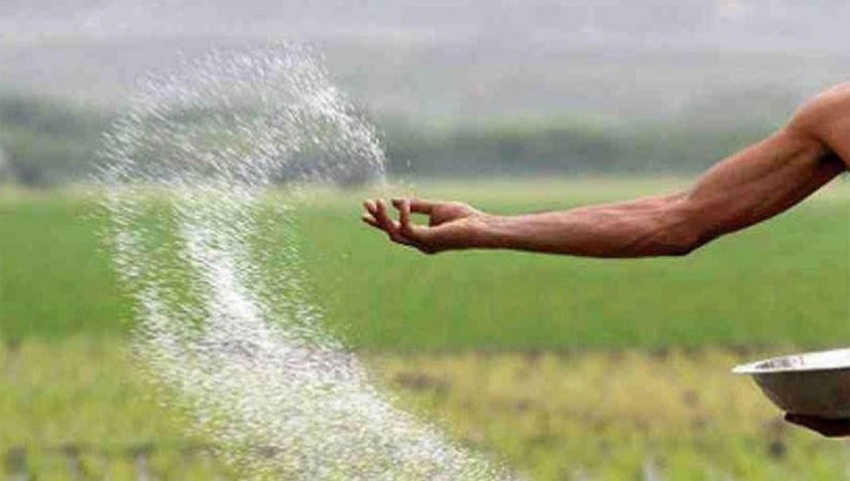
The fertilizer market in Rajshahi remains entangled in syndicate control, creating an artificial crisis that is forcing farmers to buy fertilizers at prices well above government-set rates.
Farmers say the situation is not new but has become more severe this year, despite expectations that newly elected government would clamp down on the illegal practices.
Investigations reveal that certain transport contractors and licensed dealers are hoarding fertilizers to manipulate the market, with some reportedly using multiple licenses to operate an illegal distribution syndicate.
While mobile courts have been deployed to curb these practices, farmers argue that such efforts are insufficient and demand stronger government intervention.
A field visit to several upazilas in the district confirmed the price hike; dealers are charging Tk 50 to Tk 500 more per 50-kg bag of fertilizer.
For example, DAP, which is supposed to sell at Tk 1,050 per bag, is being sold at Tk 1,200 to Tk 1,500. TSP, priced officially at Tk 1,350, is selling for up to Tk 1,700, while Urea, meant to be between Tk 1,400 and Tk 1,500, is being sold for as much as Tk 1,600. MOP is reportedly being sold at Tk 25 to Tk 30 per kg, also above the official price.
In July, farmers at Kakonhat area of Godagari upazila staged a protest after failing to buy fertilizer at fair prices.
They demanded the cancellation of a dealer’s license, accusing him of refusing to sell without overcharging.
This problem isn’t isolated to Godagari. Across all upazilas in Rajshahi, similar complaints have surfaced.
Farmers at Poba upazila’s Bagdhani area say the price manipulation is ongoing year after year.
Saidul Islam, who cultivated Aman paddy on four bighas of land, said, “Every year the same syndicate controls the fertilizer market. We hoped the new government would stop this, but it’s the same situation again.”
Rafiqul Islam, a local farmer, said he recently bought DAP at Tk 1,450 per bag; Tk 400 more than the fixed price. “We’re forced to buy it because there’s no other option. This raises our production costs significantly,” he said.
At Bidirpur of Godagari upazila, farmer Alam Ali shared a similar frustration; “We already suffered heavy losses from potato farming. Now, we have paddy in the fields, but with fertilizer prices so high, we can't even afford to maintain our crops.”
Recent heavy rains have further worsened the situation. Waterlogging in low-lying fields has caused crop damage, particularly to transplanted Aman paddy.
Farmers have had to replant their fields, which has increased their labor costs in addition to fertilizer expenses.
Rahim Ali, a farmer from Durgapur upazila, said, “This year’s rainfall is the worst I’ve seen in years. Waterlogged fields rotted our paddy and now we’re replanting. With high fertilizer prices, it's hard to survive. If we don’t get fair prices for our produce after spending so much, we’ll be ruined.”
A local fertilizer seller, speaking anonymously, denied profiteering. “We’re not overcharging. Transport costs have gone up, so we add only Tk 2 to Tk 3 per kg. Everyone is doing the same nationwide. But yes, those who hoard illegally are the real problem.”
When approached for comment, local BADC (Bangladesh Agricultural Development Corporation) dealers refused to speak.
According to BADC, there are around 2,000 licensed fertilizer dealers in Rajshahi division.
This season, there is no shortage of supply. Zulfikar Ali, Joint Director (Fertilizer) of BADC Rajshahi, said, “This year, we've allocated 19,798 metric tons of DAP, TSP, MOP and other fertilizers. We’re confident that farmers will get sufficient supplies.”
Umme Salma, Deputy Director of Department of Agricultural Extension in Rajshahi, echoed this, saying, “There’s no shortage of fertilizer this year. But farmers need to use fertilizers wisely; excessive use can damage soil health. We urge the media to help raise awareness.”
Despite these assurances, many farmers continue to face the brunt of a system they say is skewed against them. Until the syndicates are dismantled and strict enforcement ensures fair pricing, agricultural sector in Rajshahi may continue to suffer.
RHF/SH