RANGAMATI Hill District, the country's largest district, is located in the scenic south-eastern corner of Bangladesh. Famed for its breathtaking natural beauty, it is a popular tourist destination, home to attractions like Sajek Valley, Kaptai Lake, Shuvolong Waterfalls, Kaptai National Park, and the iconic Hanging Bridge. Thousands of tourists flock to these spots annually, drawn by the district's stunning landscapes.
Beyond its scenic appeal, Rangamati holds a unique geographical distinction as the only district in Bangladesh with international borders with two countries: India and Myanmar. Its vast area of 6,116 square kilometre (km) is composed of 1,292 square km of rivers and 4,825 square km of forest.
The district's demographic makeup is equally distinct. According to the 2022 census, ethnic peoples constitute 57.58% of the population, totalling 372,875. The largest ethnic group is the Chakma, comprising 42.63% of the population, followed closely by Bengalis, who make up 42.42%. The district is administratively divided into 10 upazilas, 1 municipality, 50 union parishads, 162 mouzas, and 1,347 villages.
RANGAMATI-1: The district has a single constituency- the 299th in the Jatiya Sangsad, which encompasses the entire district and is the largest parliamentary seat in Bangladesh by area.
This diverse and politically complex region is now entering a new chapter. The political winds have begun to stir in this district following reports of a meeting between the Chief Adviser Professor Dr. Mohammad Yunus and Acting Chairman of Bangladesh Nationalist Party (BNP) Tarique Rahman in London, where a tentative timeline for the national parliamentary election was discussed.
This single constituency is seeing a flurry of activity as political parties and their candidates prepare for a crucial electoral battle.
Alongside the Bengali population, 13 ethnic minority groups also live here, making the electoral dynamics very different from the plains.
Nearly half of the population is ethnic, many aligned with their own organizations, while BNP and Awami League (AL) politics also exert considerable influence.
With the AL likely absence from the race, the primary contenders appear to be the Jumma people's regional organization, the Parbatya Chattagram Jana Samhati Samiti (PCJSS), led by Shantu Larma, alongside the BNP and Bangladesh Jamaat-e-Islami.
While the BNP has multiple hopefuls vying for nomination, it is believed the final choice will narrow down to three individuals.
Jamaat-e-Islami has already finalised a single candidate, while the PCJSS is yet to officially declare theirs, though sources suggest a likely pick. Revolutionary Workers Party of Bangladesh (RWPB) has also selected a single potential candidate for the seat.
The Islami Andolan Bangladesh (IAB) is also preparing to field a candidate, while the NCP and Gono Odhikar Parishad (GOP) are yet to finalise their plans.
This year marks a significant return for Jamaat-e-Islami, which is fielding a candidate in the Rangamati seat after a 29-year hiatus. The last time the party contested here was in the 1996 election.
Seasoned political observers believe that if Jamaat's candidate remains in the race, it could pose a serious challenge to the BNP, potentially splitting the Bengali vote and creating an opportunity for the PCJSS-backed candidate to win.
This sets the stage for a triangular contest, with the PCJSS and BNP as the main rivals. It is also speculated that the silent support of AL and minority voters could be a deciding factor.
The BNP's nomination hopefuls are engaging in various activities that have energised party leaders and workers. The PCJSS and Jamaat are also highly active on the ground.
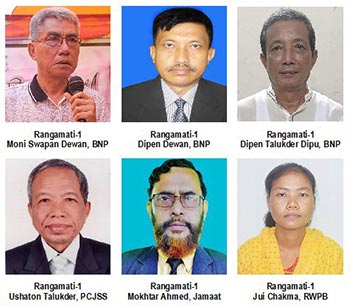
The BNP's nomination hopefuls include Advocate Dipen Dewan, Central BNP's Assistant Religious Affairs Secretary; Moni Swapan Dewan, former Member of Parliament (MP), who was elected in 2001 and received the party's nomination again in 2018, and Dipen Talukdar Dipu, the current President of the District BNP.
On the other hand, Jamaat-e-Islami declared its candidate few months ago, who has already begun campaigning. The candidate is Advocate Mokhtar Ahmed, former president of the Rangamati District Bar Association. The party is stepping up its social and organizational activities with their candidate.
Meanwhile, the PCJSS, an influential regional party, is reportedly in the midst of its election mission. According to party sources, former MP Ushatan Talukdar is likely to be the final PCJSS candidate. He was previously elected to parliament in 2014 with JSS support.
Additionally, RWPB's prospective candidate for the Rangamati-299 seat is the District Committee's General Secretary Jui Chakma. She contested the 11th National Parliament Election in 2018 for the same seat under "Spade" symbol of the party.
While BNP's aspiring leaders are busy lobbying for the nomination, they have all expressed their commitment to accepting the party's final decision. They state that they will work for whoever gets the nomination.
These leaders have their own strong support bases and are well-known on the ground, making the nomination race a fiercely competitive one, as noted by party activists and supporters.
District BNP President Dipu Talukdar said that the BNP is stronger than ever here due to its long history of struggle and activism.
"Rangamati BNP is fully prepared for the election," he said.
Expressing his own hopes, he added, "I have led the party through difficult times, and I hope the party will nominate me. If I am chosen, I am committed to winning this seat for the party."
A PCJSS source, who wished to remain anonymous, said that while discussions are ongoing within the party regarding the election, no official candidate has been formally announced yet.
However, despite several names being in contention, it is widely believed that former MP Ushatan Talukdar will ultimately take the PCJSS's charge.
Professor Abdul Alim, the District Ameer of Jamaat, said that the people are disillusioned after witnessing 53 years of rule by various parties.
"In this new Bangladesh, born from the 2024 student-led popular uprising, people want change," he said. He expressed hope that the voters of the district will choose the Jamaat candidate, whom he described as honest and capable.
While the election is still some time away, general voters have already started calculating their votes. Analysts suggest that even without a direct candidate, AL voters and minority communities could play a pivotal behind-the-scenes role in determining the outcome. If Jamaat's candidate remains in the race, it could damage the BNP's chances, creating an opportunity for the PCJSS candidate to win.
However, as the sole Bengali candidate with widespread popularity in the district, Jamaat's Advocate Mokhtar Ahmed also has high hopes for victory, believing he can secure a significant portion of the vote.
With these complex equations, the election will likely be a three-way contest between the BNP, Jamaat, and PCJSS. Voters believe the fight will be a triangular one.
In the last three controversial national elections over the past 15 years, AL's Dipankar Talukdar was elected MP twice. In between, PCJSS-backed Ushatan Talukdar defeated Dipankar Talukdar to win the seat. Before the "one-eleven" government, Mani Swapan Dewan was elected as the first BNP MP from this seat.





