The international community has been struggling to effectively eliminate the practices of contemporary forms of slavery or slavery-like practices at sea. Under Target 8.7 of the Sustainable Development Goals (SDGs), States are committed to, among other objectives, ending modern slavery. The United Nations Convention on the Law of the Sea (UNCLOS) contains a few provisions related to slavery and the slave trade on the high seas. Interestingly, however, neither the term "modern slavery" nor the terms "slavery" and "slave trade" are clearly defined in any international legal instruments. In the absence of clear definitions, interpretation becomes challenging. This raises an important question: how can these terms be interpreted, and what measures should be taken by the international community or individual States to free the victims from the illegal practices of modern slavery at sea?
It is evident that the international community has faced significant challenges in effectively addressing the issue of modern slavery at sea. As noted in Target 8.7 of the SDGs, States are committed to taking immediate and effective measures to eradicate forced labour, end modern slavery and human trafficking, and to secure the prohibition and elimination of the worst forms of child labour. Furthermore, by 2025, States aim to end child labour in all its forms.
Although there is no clear definition of the term "modern slavery" in international legal instruments, the International Labour Organization (ILO) provides a practical understanding of the concept. According to the ILO, modern slavery covers a set of specific legal concepts including forced labour, debt bondage, forced marriage, other slavery and slavery-like practices, and human trafficking. While modern slavery is not defined in law, it is used as an umbrella term that focuses attention on commonalities across these legal concepts. Essentially, it refers to situations of exploitation that a person cannot refuse or leave because of threats, violence, coercion, deception, and/or abuse of power.
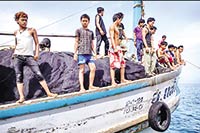
There have been many shocking incidents of modern slavery at sea that have come to light, and likely many more remain undisclosed due to fear or other unknown reasons. One horrifying story illustrates the severity of the issue. According to a report in *The Guardian* titled "Such brutality: tricked into slavery in the Thai fishing industry" by Steve Dow (22 September 2019), in 2006 a young Cambodian sculptor, Vannak Anan Prum, left his village to look for labouring work to pay for his wife's hospital stay. A middleman on the Thai-Cambodian border promised him good wages drying fish, but he was instead sold into slave labour and sent to sea on a fishing trawler. Prum was forced to work around the clock, allowed only two hours of sleep during the day and two at night, even during storms. Violence was a daily occurrence aboard the boat, used to maintain control. He reported seeing people disappear without warning, likely killed and thrown into the sea. One night, he even witnessed a man being beheaded with a cleaver by another worker.
UNCLOS contains limited but significant provisions on slavery and the slave trade. According to an article published by Brill titled *Modern Slavery and the Law of the Sea: Proposal for a Functional Approach* (Chie Kojiama, The Korean Journal of International and Comparative Law, 28 May 2021), Article 99 of UNCLOS addresses the flag State's obligation to prevent and punish the transport of slaves in vessels flying its flag, while Article 110 provides for the right to visit a foreign ship suspected of engaging in the slave trade on the high seas. The article also refers to the view of Papastavridis, who argues that the common denominator between historical and modern slavery is that people are enslaved by violence and held against their will for purposes of exploitation. While modern victims may not experience legal ownership in the classical sense, they suffer from de facto control and deprivation of their juridical personality, leading to equally devastating outcomes.
This perspective supports the idea that international conventions relevant to the elimination of modern slavery, along with developments in international human rights law-now largely considered general international law-are significant in reinterpreting Articles 99 and 110 of UNCLOS. Although UNCLOS is often referred to as the "Constitution of the Oceans," its interpretation is considered flexible and responsive to emerging global challenges. Articles 99 and 110, which may reflect customary international law, must be interpreted and applied in conjunction with other treaty regimes and general international law.
As stakeholders to the SDGs and parties to relevant international legal instruments, both State and non-State actors must take necessary measures and initiatives aligned with their commitments to eradicate modern slavery at sea. To this end, concerned States should undertake comprehensive legal, judicial, and administrative reforms domestically, in accordance with their international obligations, to prevent, combat, and punish the practices of modern slavery occurring at sea.
The writer is a barrister-at-law, human rights activist and an advocate at the Supreme Court of Bangladesh





