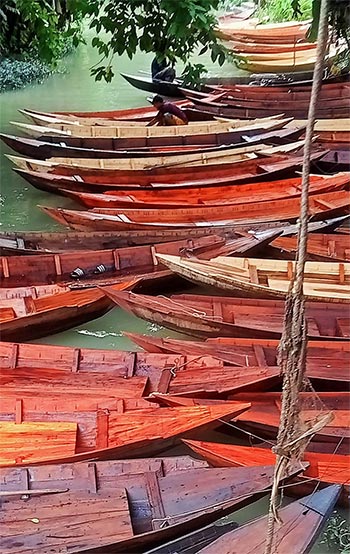
PIROJPUR, July 21: Traditional boat markets have been an integral part of the heritage of Pirojpur for over a century. Atghore Village, under Atghore-Kuriana Union in Nesarabad Upazila, is not only renowned across the country for its guava cultivation and trade, but also for its historic legacy in small boat manufacturing and commerce.
In Pirojpur, these boats play a vital role in transporting agricultural produce such as guava, hog plum, lemon, green bananas, booby chillies, and a variety of saplings and seedlings. During the harvest season, boats are the primary mode of transport for farmers and traders.
Another notable tradition in the district is the production and distribution of floating seedlings, particularly in Nazirpur Upazila. This unique agricultural practice has earned global recognition as a cultural heritage.
Both Nesarabad and Nazirpur, located in the northern part of the district, have historically lacked strong road connectivity. As a result, boats have long served as the most accessible and affordable means of transportation. Students use boats to commute to schools, locals travel to markets and upazila headquarters, and patients are transported to health complexes via waterways-especially during the monsoon season. This centuries-old tradition of boat use remains visible and vital to daily life.
Highlighting the importance of this heritage, Dr. Abdul Wahab AS Saidani, High Commissioner of Algeria to Bangladesh, recently visited the area. On his recent visit, he toured guava orchards and Sarshina Madrasa, accompanied by local government officials and law enforcement personnel.
The High Commissioner expressed keen interest in the local boat-making industry and assured support for purchasing boats and exploring investment opportunities in the sector. His remarks sparked optimism among locals, who believe this initiative could usher in a new era for the region-boosting economic growth, preserving cultural traditions, and creating much-needed employment.





