



| HEADLINE |

|
RU scientists develop low-cost method for quality pineapple seedlings


Researchers from Department of Agronomy and Agricultural Extension at Rajshahi University (RU) have developed a low-cost, method for producing high-quality pineapple seedlings using tissue culture.
Most pineapples sold in markets tend to have a sour taste. One key reason is the artificial ripening process using chemical agents employed by traders to quickly harvest large quantities of fruit at once. This practice compromises the natural taste, aroma and nutritional quality of the pineapple.
To tackle this issue, Professor Dr. Md. Giasuddin Ahmed from Agronomy and Agricultural Extension Department at Rajshahi University has introduced advanced biotechnology in pineapple cultivation.
His research focuses on producing high-quality seedlings using tissue culture, enabling large-scale propagation of healthy, sweet and robust pineapple plants with minimal cost.
Working alongside MS student Sharmin Sultana and PhD fellow Maksuda Parvin, Dr. Giasuddin’s team has successfully implemented somatic embryogenesis; a tissue culture method, at university's Agrotechnology Lab.
In the lab’s controlled growth chamber, embryonic seedlings are generated from pineapple crowns. These are further developed into healthy, transplantable plants within 3 to 4 months and later adapted to outdoor conditions through an acclimatization process.
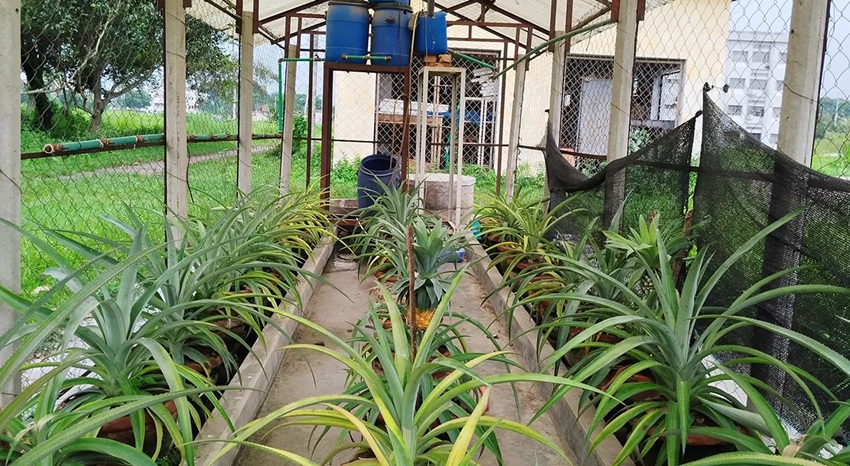
The seedlings are then transferred to a specially maintained experimental plot near the lab, where they are grown in pots with pH-controlled drip irrigation systems. Some plants in the experimental setup have already started bearing fruit, demonstrating the potential of this method.
Pineapple plants typically propagate through three parts: suckers, slips and crowns. The research utilizes a small portion of the crown to induce callus formation using artificial growth regulators and MS media. These calluses—clusters of plant cells are then subdivided and cultured to regenerate into new plants through a process called sub-culturing.
Explaining the motivation behind the project, Professor Giasuddin said, “To grow pineapple on a commercial scale, thousands of seedlings are needed at once, which isn’t feasible through traditional propagation methods. Tissue culture, specifically micropropagation, allows us to mass-produce seedlings efficiently.”
The entire process takes about three months, from callus development to rooting and acclimatization. Once the roots form, seedlings are gradually adapted to open-air conditions using a specially prepared organic soil mix with balanced pH. Initially, they are exposed to light sunlight before being transplanted into the field.
Professor Giasuddin noted that this same tissue culture technique is also being applied successfully to produce seedlings of potatoes and strawberries. Compared to conventional methods; where a single plant may yield only 3-4 seedlings, tissue culture allows hundreds of healthy seedlings to be produced simultaneously. These lab-grown plants tend to be larger, sweeter and more resistant to pests and diseases, while also reducing production costs significantly.
This innovative approach offers a promising path toward sustainable and profitable pineapple farming in Bangladesh.
Most pineapples sold in markets tend to have a sour taste. One key reason is the artificial ripening process using chemical agents employed by traders to quickly harvest large quantities of fruit at once. This practice compromises the natural taste, aroma and nutritional quality of the pineapple.
To tackle this issue, Professor Dr. Md. Giasuddin Ahmed from Agronomy and Agricultural Extension Department at Rajshahi University has introduced advanced biotechnology in pineapple cultivation.
His research focuses on producing high-quality seedlings using tissue culture, enabling large-scale propagation of healthy, sweet and robust pineapple plants with minimal cost.
Working alongside MS student Sharmin Sultana and PhD fellow Maksuda Parvin, Dr. Giasuddin’s team has successfully implemented somatic embryogenesis; a tissue culture method, at university's Agrotechnology Lab.
In the lab’s controlled growth chamber, embryonic seedlings are generated from pineapple crowns. These are further developed into healthy, transplantable plants within 3 to 4 months and later adapted to outdoor conditions through an acclimatization process.
The seedlings are then transferred to a specially maintained experimental plot near the lab, where they are grown in pots with pH-controlled drip irrigation systems. Some plants in the experimental setup have already started bearing fruit, demonstrating the potential of this method.
Pineapple plants typically propagate through three parts: suckers, slips and crowns. The research utilizes a small portion of the crown to induce callus formation using artificial growth regulators and MS media. These calluses—clusters of plant cells are then subdivided and cultured to regenerate into new plants through a process called sub-culturing.
Explaining the motivation behind the project, Professor Giasuddin said, “To grow pineapple on a commercial scale, thousands of seedlings are needed at once, which isn’t feasible through traditional propagation methods. Tissue culture, specifically micropropagation, allows us to mass-produce seedlings efficiently.”
The entire process takes about three months, from callus development to rooting and acclimatization. Once the roots form, seedlings are gradually adapted to open-air conditions using a specially prepared organic soil mix with balanced pH. Initially, they are exposed to light sunlight before being transplanted into the field.
Professor Giasuddin noted that this same tissue culture technique is also being applied successfully to produce seedlings of potatoes and strawberries. Compared to conventional methods; where a single plant may yield only 3-4 seedlings, tissue culture allows hundreds of healthy seedlings to be produced simultaneously. These lab-grown plants tend to be larger, sweeter and more resistant to pests and diseases, while also reducing production costs significantly.
This innovative approach offers a promising path toward sustainable and profitable pineapple farming in Bangladesh.
FA/SH
Loading...
Loading...
Also read









Editor : Iqbal Sobhan Chowdhury
Published by the Editor on behalf of the Observer Ltd. from Globe Printers, 24/A, New Eskaton Road, Ramna, Dhaka.
Editorial, News and Commercial Offices : Aziz Bhaban (2nd floor), 93, Motijheel C/A, Dhaka-1000.
Phone: PABX- 41053001-06; Advertisement: 41053012; 01793317829, 01550707291, E-mail: [email protected], [email protected] Online: email: [email protected] 41053014; 01550707297 Advertisement: 01550707296
Published by the Editor on behalf of the Observer Ltd. from Globe Printers, 24/A, New Eskaton Road, Ramna, Dhaka.
Editorial, News and Commercial Offices : Aziz Bhaban (2nd floor), 93, Motijheel C/A, Dhaka-1000.
Phone: PABX- 41053001-06; Advertisement: 41053012; 01793317829, 01550707291, E-mail: [email protected], [email protected] Online: email: [email protected] 41053014; 01550707297 Advertisement: 01550707296


