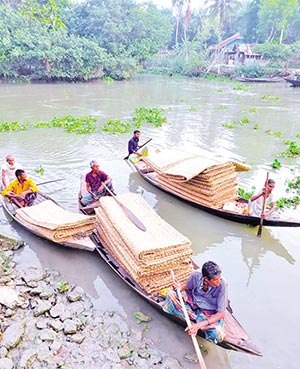
PIROJPUR, July 7: In the lush riverine landscape of southern Bangladesh, a time-honoured craft continues to support the lives and livelihoods of many. The tradition of Hogla mat making-a skill passed down through generations-is still alive in the villages of Pirojpur, where marginal communities depend on this craft as a vital source of seasonal income.
This ancient profession begins with the collection of Hogla leaves, a type of aquatic plant that grows abundantly along riverbanks, low-lying wetlands, and roadside ditches. Once mature, these long, green leaves are harvested, sun-dried, and carefully stored. After drying, the weaving begins-by both men and women-who turn these natural resources into beautifully handcrafted mats.
The entire process, from harvesting to market-ready product, takes approximately 10 days. Weavers skilfully interlace the dried Hogla strands to create mats of various sizes, patterns, and textures. These mats are not just utilitarian; they reflect the artistry, patience, and cultural heritage of rural Bangladesh.
According to Anis, a mat maker from Nazirpur Upazila, "This is a traditional profession we inherited from our ancestors. It's not just a livelihood; it's our heritage and pride. Despite alternatives flooding the market, we continue to weave mats as a symbol of resilience."
However, he added that mat making is largely seasonal work, with many artisans turning to other agricultural labour during off-seasons to sustain their families.
Hogla mats serve diverse purposes in both rural and urban settings. In villages, they are commonly used for: Storing and drying crops, processing agricultural products, fish packing (placing fish on mats with ice for transportation), seating arrangements during religious gatherings, weddings, and cultural functions.
In urban areas, especially during Eid-ul-Azha, these mats are in high demand for meat cutting and distribution, helping to maintain hygiene standards in both homes and mosques. Additionally, during food distribution drives, mats offer a sanitary and organized sitting arrangement for large groups of people.
In an era increasingly focused on environmental sustainability, these handmade mats provide a compelling alternative to plastic or synthetic products.
Nikhil Kumar Dhali, District Environmental Officer, said, "Hogla leaf mats are entirely biodegradable and non-polluting. In fact, they contribute positively to environmental conservation. Promoting such natural products aligns perfectly with our ecological goals."
Md. Saiful Islam, Deputy Director of the Department of Agricultural Extension (DAE), said, "Mat making plays a significant role in our rural economy. It provides income for many landless and marginal families-especially women-while supporting agricultural processes such as harvesting and crop storage."
He also highlighted the dual value of the Hogla plant: "Not only do the leaves support the mat-making industry, but the roots are edible and hold nutritional value. Village residents often consume them without cost, making it a truly nature-given resource."
Despite its cultural and environmental benefits, the future of Hogla mat weaving faces challenges. The influx of plastic and synthetic alternatives threatens the profession's viability. Additionally, lack of proper marketing channels and support services restricts artisans from reaching wider markets or upgrading their skills.
Mat making is more than an income source-it is a living symbol of Bangladesh's cultural identity, eco-conscious living, and rural resilience. Supporting this industry can not only help protect the environment but also uplift marginal communities who rely on nature and tradition for survival.





