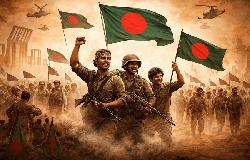
History is not the personal property of any individual. It is a repository of a nation's collective memory, struggle, and consciousness. It shapes national identity, guides future trajectories, and forms the foundation for informed decision-making. However, in the context of Bangladesh, a systematic and dangerous culture of historical distortion and name-changing has taken root—spreading across generations and regimes. With every change in political power, there follows a series of renamings—of days, institutions, monuments, and streets—that seems like a deliberate attempt to uproot a nation’s historical roots.
The Politics of Historical Revision: What Happened Under Whose Rule?
In post-independence Bangladesh, the distortion of history began in earnest following the brutal assassination of Bangabandhu Sheikh Mujibur Rahman and his family on August 15, 1975. This event marked the beginning of a political competition to rewrite national history.
After assuming power, Ziaur Rahman sought to establish his role in the Liberation War by altering the historical narrative. Bangabandhu's March 7 speech, his name, and image were removed from textbooks. By the 1980s, textbooks stated that “Ziaur Rahman declared independence”—a claim that remains historically contested.
During General H.M. Ershad's military regime, Islam was declared the state religion, and he infused communal undertones into national days and symbols. He introduced “National Revolution and Solidarity Day” on November 7—an attempt to reinterpret history to fit his narrative.
Under Khaleda Zia’s rule, the term “Liberation War” was replaced by “National Liberation Struggle,” and key figures like Tajuddin Ahmad, Mansur Ali, Kamaruzzaman, and Shaheed Janani Jahanara Imam were sidelined in the national discourse.
In contrast, Sheikh Hasina’s government reinstated Bangabandhu’s role in the Liberation War and reintroduced related content in textbooks after 2009. Bangabandhu's March 7 speech gained UNESCO recognition. However, opposition critics often brand this as “one-eyed history.”
Political Capture of Textbooks
Textbooks serve as the primary tool for shaping the minds of future generations. Yet in Bangladesh, they have become weapons of political propaganda. In 1979, the word "Bangabandhu" was removed from primary school books. One government adds certain historical facts; the next removes them. As a result, students are not learning objective history—they are being indoctrinated into partisan narratives. As Professor Dr. Zainul Abedin noted, “This signals a dangerous future.”
The Politics of Renaming Days, Monuments, and Institutions: This culture of renaming extends beyond textbooks. It affects state institutions, Shaheed Minars, government buildings, roads—even monuments commemorating the Language Movement. For instance: In 2021, Dhaka’s “Shaheed Qadri Sarani” was renamed “Bangabandhu Road.”In 2023, a plan to rename “Shaheed Kamaruzzaman College” was halted amid public outcry. At Rajshahi, students from the history department wrote an open letter against the renaming of “Shaheed Abul Kashem College” after a political figure.In Khulna, “Bhasha Shaheed Road” was nearly renamed after a former mayor, prompting protests from martyr families. In Noakhali, a “Freedom Fighters’ Complex” was renamed after an MP who was not a freedom fighter.At the University of Chittagong, a building named after freedom fighter Renu Begum was renamed—again triggering controversy.These examples illustrate a growing trend where political rulers attempt to immortalize their legacy by appropriating historical symbols and narratives.
Channels such as Voice of Freedom, History Reloaded, and Unheard BD are now broadcasting alternate versions of history. Some refuse to acknowledge Bangabandhu as the sole leader of independence; others claim Ziaur Rahman alone declared it. These conflicting narratives are creating confusion among the youth and turning history into a battlefield of ideological polarization.
Perspectives from Historians and Analysts
Dr. Mahfuzul Haque: “Renaming is a political tool to negate history. This trend is severing the nation from its roots.”
Dr. Farhana Chowdhury: “Names are vessels of historical memory. Each regime seeks to overwrite the past with its own ideology.”
Dr. Zahidur Rahman: “Bengali history is multilayered. Attempts to reduce it to a linear narrative amount to historical suicide.”
Dr. Rehan Kabir: “Renaming is an exercise in power projection. It reflects a desire by ruling elites to impose their worldview.”
Professor Rubina Sultana: “When freedom fighters are erased from commemorations and irrelevant politicians take their place, history becomes deeply biased.”
Md. Shahidul Islam: “The renaming frenzy is just another political gimmick. History isn’t a press release—it’s accountable to the court of time.”
Why This Trend Is Dangerous
The politicization of names, days, and symbols sows confusion in national identity and heritage. Changing a plaque on a Shaheed Minar erases a legacy of sacrifice. Branding Bangabandhu’s homecoming day as the "culmination of independence" diminishes the significance of December 16. Such symbolic manipulations polarize state and society, leading to historical amnesia, fragmented memory, and weakened national unity.
What Must Be Done: Ensure impartial historical research free from party affiliations, rooted in evidence and context.
Involve professional historians in curriculum development and maintain neutrality regardless of which party is in power.
Organize national consultations before changing names of institutions or commemorative days.
Form an independent History Commission to prevent political interference in preserving national heritage.
A nation that forgets its past loses sight of its future. This toxic culture of renaming is not history—it is a political tool. It poses a severe threat to democracy, public consciousness, and national unity. The time is now to liberate history from partisan captivity and restore it as a revered collective memory and foundation for objective education.
The writer is an Assistant Professor and Head, Department of Sociology, Rosey Mozammel Women’s Honors College; Journalist and Columnist, The Daily Observer