



| HEADLINE |

|
DU allocates only 2.08% for research in TK 1035.45cr budget
FY 2025-26 Budget sees mere 4.18% hike despite mounting academic, operational pressures
Published : Tuesday, 17 June, 2025 at 8:35 PM
DU Correspondent


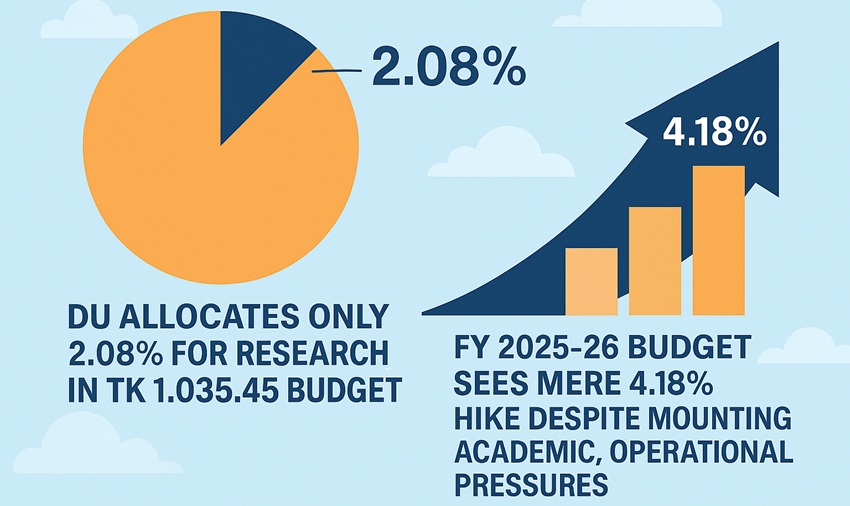
Dhaka University has allocated only 2.08% of its Tk 1,035.45 crore budget for research in the 2025–26 fiscal year, raising concerns among academics about the institution’s commitment to innovation and knowledge production.
The decision was finalised at Syndicate’s regular meeting held on Monday.
Professor Dr M Jahangir Alam Chowdhury, Treasurer of Dhaka University, is scheduled to brief media Tuesday at 3 PM regarding the full breakdown of allocations.
Despite a 4.18% overall budget increase from the previous year, funding for research saw only a marginal rise, reflecting a persistent imbalance in academic investment priorities.
Research funding sees only a negligible rise to Tk 21.57 crore, only 2.08% up slightly from last year’s Tk 20.07 crore, highlighting continued underinvestment in academic advancement.
DU approved a proposed budget of Tk 1,035.45 crore for the 2025–26 fiscal year, reflecting a meagre 4.18% rise from last year’s revised budget of Tk 993.93 crore, a limited increase that falls short of addressing the university’s growing academic and infrastructural demands.
Primary healthcare support increases by Tk 75 lakh to Tk 1 crore, while ICT support declines by Tk 10 lakh, indicating a disappointing reduction in technology prioritisation.
The proposed allocation exposes Dhaka University’s overwhelming reliance on UGC grants, which cover 85.28% (Tk 883.04 crore) of the total budget, highlighting a worrying lack of financial independence. Internal sources contribute only 8.69%, revealing limited revenue-generating capacity within the institution.
Meanwhile, a 6.03% deficit (Tk 62.41 crore) persists, signalling poor long-term planning and an unsustainable financial structure that leaves little room for strategic academic growth.
The claim that this year’s budget reflects a “tighter, more balanced financial plan” is misleading. Compared to last year’s revised budget, where internal sources contributed a stronger 11.07% (Tk 110 crore), this year’s drop to just 8.69% signals declining institutional self-reliance.
Although the deficit has slightly decreased from 6.48% to 6.03%, the university's growing dependence on UGC funding (rising from 82.45% to 85.28%) suggests a shrinking scope for internal innovation and fiscal autonomy rather than genuine financial improvement.
Experts suggest that excessive reliance on government funding (85.28% dependence on UGC grants) can undermine the institution’s financial autonomy and leave it vulnerable to increased government influence.
When a university lacks strong internal revenue streams, such as endowments, consultancy, alumni contributions or research-commercialisation income, it becomes more susceptible to external pressure over its administrative decisions, academic freedom and research priorities.
In such a scenario, the government can exert control by conditioning or limiting funds, delaying disbursements or pushing policy changes under the pretext of budgetary compliance.
Over time, this financial dependency risks eroding the university’s ability to make independent choices on curriculum design, faculty recruitment, campus politics and research directions—ultimately diluting its academic integrity and democratic character.
The sharp rise in expenditure on salaries (28.34%), allowances (20.84%) and particularly pensions and retirement benefits, which surged by a staggering 83.17% to Tk 138.87 crore, reveals a budget overly tilted toward administrative upkeep rather than academic development.
While spending on goods and services rose by 25.05%, these figures reflect a bloated operational framework rather than genuine investment in educational excellence or student outcomes.
While the increase in equipment grants to Tk 35.42 crore and capital grants to Tk 30 crore may appear as progress, the stagnant allocations for vehicles and ICT reflect a lack of genuine modernisation. In a digital age where advanced technology and smart mobility are essential for academic competitiveness, flat ICT and vehicle funding signals complacency rather than innovation.
Moreover, the focus on capital spending without proportional increases in research, digital infrastructure or academic programming raises concerns that infrastructure is being prioritised for appearances rather than actual academic enhancement. Investing in buildings without parallel investment in ideas and innovation risks turning the university into a well-painted shell, modern in look but hollow in intellectual substance.
Reflecting on the changes, university officials noted a careful balancing of academic, administrative and capital needs.
The claim that the new budget “aims to streamline spending while addressing pressing institutional gaps” rings hollow when last year’s pattern of spending remains largely unchanged.
A hefty 29.21% of the previous budget went to salaries, allowances and pensions, overshadowing academic priorities. Research received only Tk 20.07 crore, a mere fraction of the total, revealing a continued neglect of the university’s core mission; knowledge creation.
The budget’s overwhelming focus on maintaining bureaucracy, rather than expanding research, innovation or teaching capacity, raises serious concerns about misplaced priorities. Labelling this as “operational efficiency” masks the deeper issue; the university is spending more to sustain itself rather than transform itself.
With goods and services consuming 23% of funds and research still severely underfunded, the pattern suggests bureaucratic maintenance is prioritised over intellectual advancement.
The university appears more committed to sustaining its administrative structure than transforming itself into a dynamic centre of learning and innovation.
NRE/SH
The decision was finalised at Syndicate’s regular meeting held on Monday.
Professor Dr M Jahangir Alam Chowdhury, Treasurer of Dhaka University, is scheduled to brief media Tuesday at 3 PM regarding the full breakdown of allocations.
Despite a 4.18% overall budget increase from the previous year, funding for research saw only a marginal rise, reflecting a persistent imbalance in academic investment priorities.
Research funding sees only a negligible rise to Tk 21.57 crore, only 2.08% up slightly from last year’s Tk 20.07 crore, highlighting continued underinvestment in academic advancement.
DU approved a proposed budget of Tk 1,035.45 crore for the 2025–26 fiscal year, reflecting a meagre 4.18% rise from last year’s revised budget of Tk 993.93 crore, a limited increase that falls short of addressing the university’s growing academic and infrastructural demands.
Primary healthcare support increases by Tk 75 lakh to Tk 1 crore, while ICT support declines by Tk 10 lakh, indicating a disappointing reduction in technology prioritisation.
The proposed allocation exposes Dhaka University’s overwhelming reliance on UGC grants, which cover 85.28% (Tk 883.04 crore) of the total budget, highlighting a worrying lack of financial independence. Internal sources contribute only 8.69%, revealing limited revenue-generating capacity within the institution.
Meanwhile, a 6.03% deficit (Tk 62.41 crore) persists, signalling poor long-term planning and an unsustainable financial structure that leaves little room for strategic academic growth.
The claim that this year’s budget reflects a “tighter, more balanced financial plan” is misleading. Compared to last year’s revised budget, where internal sources contributed a stronger 11.07% (Tk 110 crore), this year’s drop to just 8.69% signals declining institutional self-reliance.
Although the deficit has slightly decreased from 6.48% to 6.03%, the university's growing dependence on UGC funding (rising from 82.45% to 85.28%) suggests a shrinking scope for internal innovation and fiscal autonomy rather than genuine financial improvement.
Experts suggest that excessive reliance on government funding (85.28% dependence on UGC grants) can undermine the institution’s financial autonomy and leave it vulnerable to increased government influence.
When a university lacks strong internal revenue streams, such as endowments, consultancy, alumni contributions or research-commercialisation income, it becomes more susceptible to external pressure over its administrative decisions, academic freedom and research priorities.
In such a scenario, the government can exert control by conditioning or limiting funds, delaying disbursements or pushing policy changes under the pretext of budgetary compliance.
Over time, this financial dependency risks eroding the university’s ability to make independent choices on curriculum design, faculty recruitment, campus politics and research directions—ultimately diluting its academic integrity and democratic character.
The sharp rise in expenditure on salaries (28.34%), allowances (20.84%) and particularly pensions and retirement benefits, which surged by a staggering 83.17% to Tk 138.87 crore, reveals a budget overly tilted toward administrative upkeep rather than academic development.
While spending on goods and services rose by 25.05%, these figures reflect a bloated operational framework rather than genuine investment in educational excellence or student outcomes.
While the increase in equipment grants to Tk 35.42 crore and capital grants to Tk 30 crore may appear as progress, the stagnant allocations for vehicles and ICT reflect a lack of genuine modernisation. In a digital age where advanced technology and smart mobility are essential for academic competitiveness, flat ICT and vehicle funding signals complacency rather than innovation.
Moreover, the focus on capital spending without proportional increases in research, digital infrastructure or academic programming raises concerns that infrastructure is being prioritised for appearances rather than actual academic enhancement. Investing in buildings without parallel investment in ideas and innovation risks turning the university into a well-painted shell, modern in look but hollow in intellectual substance.
Reflecting on the changes, university officials noted a careful balancing of academic, administrative and capital needs.
The claim that the new budget “aims to streamline spending while addressing pressing institutional gaps” rings hollow when last year’s pattern of spending remains largely unchanged.
A hefty 29.21% of the previous budget went to salaries, allowances and pensions, overshadowing academic priorities. Research received only Tk 20.07 crore, a mere fraction of the total, revealing a continued neglect of the university’s core mission; knowledge creation.
The budget’s overwhelming focus on maintaining bureaucracy, rather than expanding research, innovation or teaching capacity, raises serious concerns about misplaced priorities. Labelling this as “operational efficiency” masks the deeper issue; the university is spending more to sustain itself rather than transform itself.
With goods and services consuming 23% of funds and research still severely underfunded, the pattern suggests bureaucratic maintenance is prioritised over intellectual advancement.
The university appears more committed to sustaining its administrative structure than transforming itself into a dynamic centre of learning and innovation.
NRE/SH
Loading...
Loading...
Also read






Editor : Iqbal Sobhan Chowdhury
Published by the Editor on behalf of the Observer Ltd. from Globe Printers, 24/A, New Eskaton Road, Ramna, Dhaka.
Editorial, News and Commercial Offices : Aziz Bhaban (2nd floor), 93, Motijheel C/A, Dhaka-1000.
Phone: PABX- 41053001-06; Advertisement: 41053012; 01793317829, 01550707291, E-mail: [email protected], [email protected] Online: email: [email protected] 41053014; 01550707297 Advertisement: 01550707296
Published by the Editor on behalf of the Observer Ltd. from Globe Printers, 24/A, New Eskaton Road, Ramna, Dhaka.
Editorial, News and Commercial Offices : Aziz Bhaban (2nd floor), 93, Motijheel C/A, Dhaka-1000.
Phone: PABX- 41053001-06; Advertisement: 41053012; 01793317829, 01550707291, E-mail: [email protected], [email protected] Online: email: [email protected] 41053014; 01550707297 Advertisement: 01550707296


