



| HEADLINE |

|
Samid Razzak inspiring visit to NASA Jet Propulsion Laboratory: Bridging youth empowerment, global science
Published : Thursday, 22 May, 2025 at 3:21 PM
Observer Online Desk


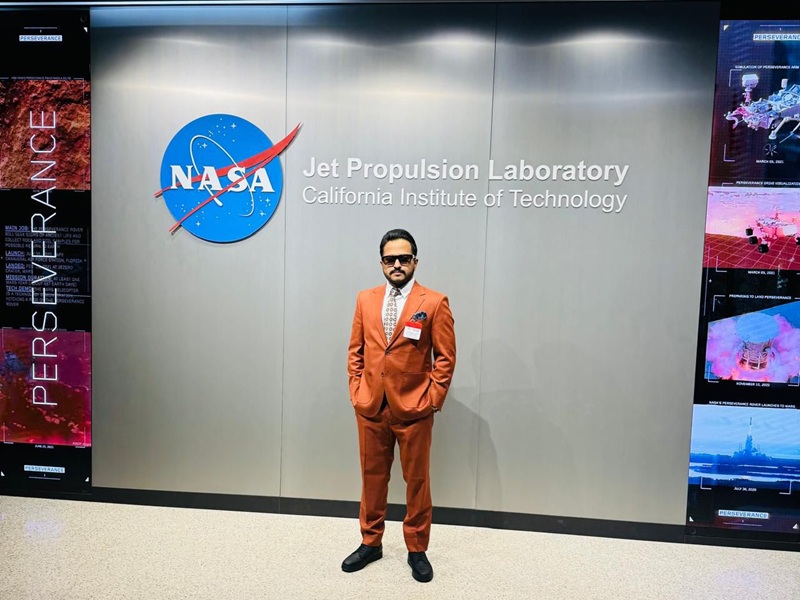
In today’s world, where imagination and innovation increasingly merge, stories that connect these realms offer powerful inspiration. Samid Razzak, a Bangladeshi educator and entrepreneur, recently visited NASA’s Jet Propulsion Laboratory (JPL) in California, highlighting the intersection of global science, youth empowerment, and visionary leadership.
JPL: The Center of Space Exploration
Located on a 177-acre campus and operated by the California Institute of Technology (Caltech) for NASA, JPL is often called the “Center of the Universe.” It controls some of humanity’s most daring space missions—from robotic rovers exploring Mars to satellites tracking asteroids that could threaten Earth.
JPL is not only a laboratory but also the nerve center of NASA’s Deep Space Network, which maintains communication with spacecraft billions of miles away. It is also where Mars rovers were developed, turning Mars into the only planet inhabited solely by robots.
A Unique and Purposeful Visit
Invited by a friend working on NASA projects, Samid toured JPL’s facilities, witnessing mission planning and live operations usually reserved for top scientists and officials. The mission control center, where teams monitor spacecraft like the Mars Perseverance rover in real time, revealed the intense teamwork and advanced technology needed to operate robots millions of miles away.
He also visited the laboratories where robotic rovers and probes undergo rigorous testing. Simulations mimic extreme planetary conditions such as heat, dust storms, and rocky terrain, ensuring durability. These tests showcase the blend of precision engineering and innovation essential for mission success.
Additionally, Samid learned about the Deep Space Network antennas forming a global system that keeps continuous contact with spacecraft throughout the solar system, enabling NASA to send commands and receive scientific data.
A unique aspect of his visit was recording youth development content inside JPL for young minds—a rare opportunity, as this space is often used to brief U.S. Presidents and international leaders on space technology advancements.
The Question That Matters
During his visit, Samid asked a question reflecting many young Bangladeshis’ dreams:
“How can an aspiring Bangladeshi student secure a job at NASA?”
NASA engineers answered honestly: talent alone is insufficient. A strong foundation in STEM—Science, Technology, Engineering, and Mathematics—is critical, combined with consistent academic excellence, research, and innovation. Above all, vision and perseverance are vital.
Samid recalled, “They said something that stayed with me: You have to dream big.”
Inspiring a Generation Back Home
Since returning, Samid has shared his experience widely, aiming to motivate young minds. He emphasizes that this journey is more than a personal achievement—it is a source of inspiration.
“The journey to space doesn’t begin with a rocket—it begins with a question: What if?” he often tells aspiring youths.
A Proven Track Record in Youth Empowerment
Samid’s commitment to empowering youth spans over a decade across education, entrepreneurship, corporate leadership, and social impact. A graduate of Notre Dame College and North South University, he was in the founding team of 10 Minute School, Bangladesh’s largest online education platform. He co-founded the Youth Empower Foundation, supporting youth through mentorship, training, and resources.
He advises Aims Digital School- focused on digital skills, Astronus Tech—a US-Canada AI company—and SR Corporation. As a TEDx speaker, trainer, and writer, Samid has conducted hundreds of workshops nationwide to promote skills and innovation.
His global recognition includes an Honorable Mention Award at the GIST Tech-I Competition hosted by Stanford University, acknowledging his contributions to technology and education.
In an increasingly technology-driven world, Samid’s story offers more than inspiration—it provides a roadmap grounded in education, fueled by passion, and driven by a commitment to serve others.
JPL: The Center of Space Exploration
Located on a 177-acre campus and operated by the California Institute of Technology (Caltech) for NASA, JPL is often called the “Center of the Universe.” It controls some of humanity’s most daring space missions—from robotic rovers exploring Mars to satellites tracking asteroids that could threaten Earth.
JPL is not only a laboratory but also the nerve center of NASA’s Deep Space Network, which maintains communication with spacecraft billions of miles away. It is also where Mars rovers were developed, turning Mars into the only planet inhabited solely by robots.
A Unique and Purposeful Visit
Invited by a friend working on NASA projects, Samid toured JPL’s facilities, witnessing mission planning and live operations usually reserved for top scientists and officials. The mission control center, where teams monitor spacecraft like the Mars Perseverance rover in real time, revealed the intense teamwork and advanced technology needed to operate robots millions of miles away.
He also visited the laboratories where robotic rovers and probes undergo rigorous testing. Simulations mimic extreme planetary conditions such as heat, dust storms, and rocky terrain, ensuring durability. These tests showcase the blend of precision engineering and innovation essential for mission success.
Additionally, Samid learned about the Deep Space Network antennas forming a global system that keeps continuous contact with spacecraft throughout the solar system, enabling NASA to send commands and receive scientific data.
A unique aspect of his visit was recording youth development content inside JPL for young minds—a rare opportunity, as this space is often used to brief U.S. Presidents and international leaders on space technology advancements.
The Question That Matters
During his visit, Samid asked a question reflecting many young Bangladeshis’ dreams:
“How can an aspiring Bangladeshi student secure a job at NASA?”
NASA engineers answered honestly: talent alone is insufficient. A strong foundation in STEM—Science, Technology, Engineering, and Mathematics—is critical, combined with consistent academic excellence, research, and innovation. Above all, vision and perseverance are vital.
Samid recalled, “They said something that stayed with me: You have to dream big.”
Inspiring a Generation Back Home
Since returning, Samid has shared his experience widely, aiming to motivate young minds. He emphasizes that this journey is more than a personal achievement—it is a source of inspiration.
“The journey to space doesn’t begin with a rocket—it begins with a question: What if?” he often tells aspiring youths.
A Proven Track Record in Youth Empowerment
Samid’s commitment to empowering youth spans over a decade across education, entrepreneurship, corporate leadership, and social impact. A graduate of Notre Dame College and North South University, he was in the founding team of 10 Minute School, Bangladesh’s largest online education platform. He co-founded the Youth Empower Foundation, supporting youth through mentorship, training, and resources.
He advises Aims Digital School- focused on digital skills, Astronus Tech—a US-Canada AI company—and SR Corporation. As a TEDx speaker, trainer, and writer, Samid has conducted hundreds of workshops nationwide to promote skills and innovation.
His global recognition includes an Honorable Mention Award at the GIST Tech-I Competition hosted by Stanford University, acknowledging his contributions to technology and education.
In an increasingly technology-driven world, Samid’s story offers more than inspiration—it provides a roadmap grounded in education, fueled by passion, and driven by a commitment to serve others.
Loading...
Loading...
Also read







Editor : Iqbal Sobhan Chowdhury
Published by the Editor on behalf of the Observer Ltd. from Globe Printers, 24/A, New Eskaton Road, Ramna, Dhaka.
Editorial, News and Commercial Offices : Aziz Bhaban (2nd floor), 93, Motijheel C/A, Dhaka-1000.
Phone: PABX- 41053001-06; Advertisement: 41053012; 01793317829, 01550707291, E-mail: [email protected], [email protected] Online: email: [email protected] 41053014; 01550707297 Advertisement: 01550707296
Published by the Editor on behalf of the Observer Ltd. from Globe Printers, 24/A, New Eskaton Road, Ramna, Dhaka.
Editorial, News and Commercial Offices : Aziz Bhaban (2nd floor), 93, Motijheel C/A, Dhaka-1000.
Phone: PABX- 41053001-06; Advertisement: 41053012; 01793317829, 01550707291, E-mail: [email protected], [email protected] Online: email: [email protected] 41053014; 01550707297 Advertisement: 01550707296


