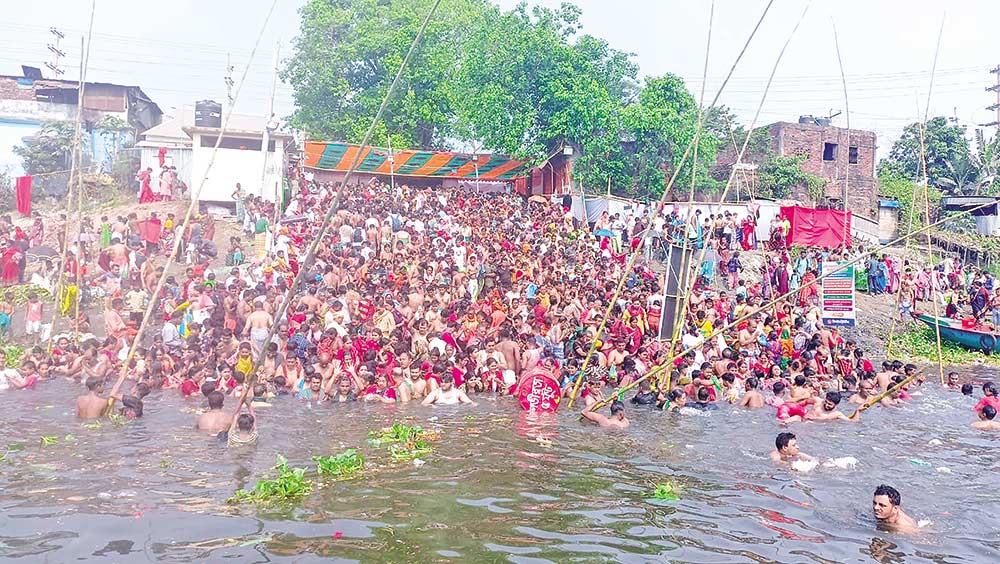
Thousands of Hindu worshippers participated in the sacred ritual of Ashtami Snan on Saturday, immersing themselves in the holy waters of the Brahmaputra River at various locations, including Narayanganj, Kurigram, and Mymensingh. As per Hindu beliefs, bathing in the Brahmaputra during a particular lunar phase cleanses one's sins and grants divine blessings.
The Ashtami Snan takes place on the eighth day of the lunar calendar, aligning with the Bangla month of Chaitra. This year, the auspicious bathing period commenced at 2:08 AM on Saturday and concluded at 12:45 AM on Sunday, according to the Hindu almanac.
In Langalbandh, Narayanganj, devotees from across Bangladesh and neighboring nations such as India, Nepal, and Bhutan gathered to seek spiritual purification. Organizers arranged twenty ghats along a three-kilometer stretch covering Bandar and Sonargaon upazilas to accommodate the influx of participants. According to Joy K Roy Chowdhury, an adviser to the Langalband Bathing Festival Celebration Committee, approximately one million people took part in the event this year. Devotees carried offerings like flowers, sacred grasses, fruits, Tulsi leaves, and mango leaves as they performed their ritualistic bath in the river.
A traditional fair also accompanied the religious gathering on the riverbank. Following a tragic stampede in 2015 that claimed ten lives, authorities have since implemented strict measures to ensure safety and order during the event.
In Kurigram, worshippers assembled on the Brahmaputra shoal in Chilmari upazila for the ritual. The upazila administration designated multiple bathing sites, including Ramna Ghat, Balabari Haat, Raniganj Haat, and Fakirer Haat, stated Chilmari UNO Sabuj Kumar Basak.
"I have come here to immerse myself in the Brahmaputra to cleanse my soul and rid myself of sins," shared 70-year-old devotee Ramesh Chandra Das from Chowdhurani, Rangpur. Around 300,000 devotees joined the festival in Chilmari, according to organizer Sachindra Nath Barman.





