



| HEADLINE |

|
Great homage to language martyrs
Published : Friday, 21 February, 2025 at 12:00 AM
MAHBUBUR RAHMAN


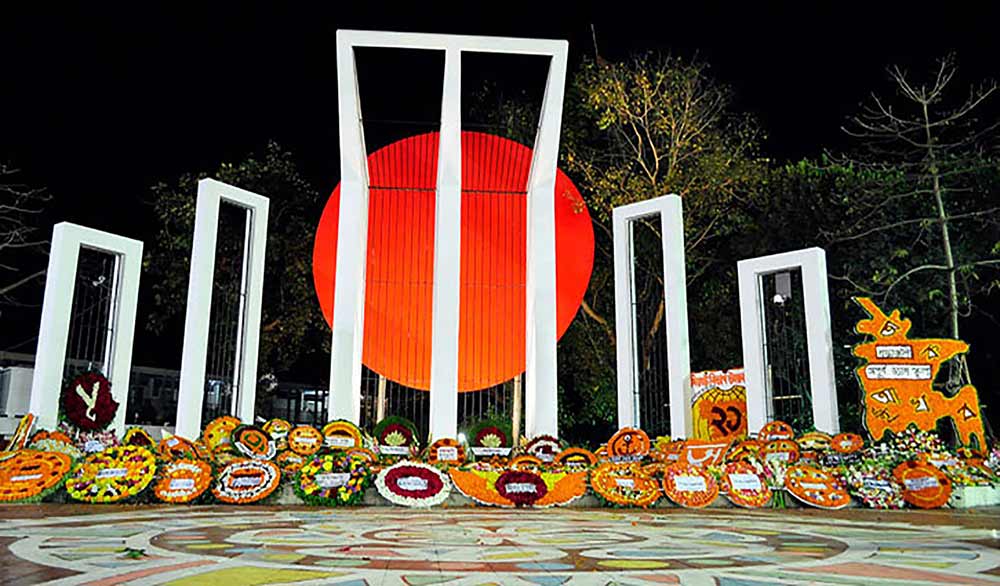 Language is more than just a means of communication; it is a reflection of a community's identity, history, and culture. The ability to speak one's mother tongue freely is a fundamental right, but there have been times in history when people had to fight and sacrifice their lives to protect their linguistic identity. 21st February, now observed as International Mother Language Day marks one such significant struggle-the Bengali Language Movement of 1952.
This article pays tribute to the language martyrs of 1952, who laid down their lives to establish Bangla (Bengali) as an official language in what was then East Pakistan (now Bangladesh). Their courage and sacrifice not only shaped the future of Bangladesh but also set an example for linguistic rights worldwide.
After the partition of British India in 1947, the newly formed state of Pakistan was divided into two regions: West Pakistan (present-day Pakistan) and East Pakistan (present-day Bangladesh). Although more than 56% of the total population of Pakistan spoke Bangla, the government of Pakistan attempted to impose Urdu as the sole national language.
This decision was met with widespread resistance from the people of East Pakistan, who saw it as a threat to their linguistic and cultural identity. The demand for the recognition of Bangla as one of the state languages grew stronger, leading to the emergence of the Bengali Language Movement (BhashaAndolon).
The language movement reached its peak in 1952 when students and activists intensified their protests. On 21st February 1952, students of Dhaka University, Dhaka Medical College, and other institutions organized a protest against the government's refusal to recognize Bangla as an official language.
The government responded by imposing Section 144, which prohibited public gatherings. Defying this ban, students gathered at Dhaka University, marching in protest. In response, police opened fire on the unarmed students, killing several young protesters. The most notable among them were:Salam, Rafiq, Barkat, Jabbar, and Shafiur. These young men became martyrs for the Bengali language, sacrificing their lives to uphold their mother tongue. Their sacrifice became a turning point in Bangladesh's history, strengthening the demand for linguistic and cultural rights.
The tragic events of 21st February sparked national outrage. Protests continued, and the pressure on the government increased. Finally, on 7th May 1954, the Pakistani government was forced to recognize Bangla as one of the official state languages alongside Urdu.
The recognition of Bangla was a major victory, but the struggle for independence continued. The Language Movement of 1952 eventually inspired the people of East Pakistan to demand political and economic autonomy, leading to the Liberation War of 1971 and the birth of Bangladesh as an independent nation.
Recognizing the importance of linguistic diversity, UNESCO declared 21st February as International Mother Language Day in 1999. Since 2000, the day has been observed worldwide to promote multilingualism and the preservation of endangered languages.
Significance of International Mother Language Day: 1. Honoring Language Martyrs: It commemorates the sacrifices made by the language martyrs of 1952.2. Promoting Linguistic Diversity: It raises awareness about the importance of preserving native languages.3. Encouraging Multilingual Education: It emphasizes the need for education in one's mother tongue.4. Protecting Endangered Languages: It highlights the urgent need to save languages that are disappearing due to globalization.
In Bangladesh, 21st February is a national holiday known as 'Shaheed Dibosh' (Martyrs' Day). The day is observed with great respect and solemnity:Early morning processions (ProbhatFeri) where people walk barefoot, carrying flowers to the Shaheed Minar (Martyrs' Monument) in Dhaka.Silent tributes are paid to the language martyrs by laying floral wreaths at the Shaheed Minar.Cultural programs, poetry recitations, and discussions are held across the country.Educational institutions organize special events to educate students about the significance of the day.The national flag is flown at half-mast as a mark of respect.
The Language Movement of 1952 was not just about linguistic rights; it was about the right to self-expression, cultural freedom, and national identity. Language plays a crucial role in:Preserving history and heritagefostering unity and patriotismStrengthening education and communicationDefining national consciousnessThe victory of Bangla as a state language ultimately led to the creation of Bangladesh in 1971, proving that language can be a powerful force in nation-building.
So, the sacrifice of the language martyrs on 21st February 1952 remains one of the most profound examples of the fight for linguistic rights in history. Their courage and determination ensured that future generations could speak, learn, and express themselves in their mother tongue.Today, as we observe International Mother Language Day, we must remember their sacrifice and work towards protecting linguistic diversity worldwide. The story of 21st February is a timeless reminder that language is not just words; it is the soul of a people, the heart of a nation, and a symbol of freedom.By honoring the language martyrs and promoting multilingualism, we can build a more inclusive, diverse, and culturally rich world.
The writer is a PhD Researcher at the University of Rajshahi and Lecturer of Rajshahi Cantonment Public School & College
Loading...
Loading...
Also read



Editor : Iqbal Sobhan Chowdhury
Published by the Editor on behalf of the Observer Ltd. from Globe Printers, 24/A, New Eskaton Road, Ramna, Dhaka.
Editorial, News and Commercial Offices : Aziz Bhaban (2nd floor), 93, Motijheel C/A, Dhaka-1000.
Phone: PABX- 41053001-06; Advertisement: 41053012; 01793317829, 01550707291, E-mail: [email protected], [email protected] Online: email: [email protected] 41053014; 01550707297 Advertisement: 01550707296
Published by the Editor on behalf of the Observer Ltd. from Globe Printers, 24/A, New Eskaton Road, Ramna, Dhaka.
Editorial, News and Commercial Offices : Aziz Bhaban (2nd floor), 93, Motijheel C/A, Dhaka-1000.
Phone: PABX- 41053001-06; Advertisement: 41053012; 01793317829, 01550707291, E-mail: [email protected], [email protected] Online: email: [email protected] 41053014; 01550707297 Advertisement: 01550707296


