



| HEADLINE |

|
How literature mirrors life and society
Published : Sunday, 9 February, 2025 at 12:00 AM
Mahmuda Begum Sinthia


 Literature serves as a communication bridge across life, society, countries, and centuries. It acts as a mirror reflecting human experiences, actions, and moral dilemmas, transitions and transactions. Aristotle famously stated that "literature is an imitation of life," encapsulating his view on literature in his work Poetics. This perspective emphasizes that literature is not merely a reproduction of reality but an interpretation that captures the full spectrum of human existence. Literature is regarded as one of the most profound and enduring forms of human expression. It transcends the boundaries of time, geography, and culture. It also acts as a medium of connecting individuals, societies, and even entire civilizations. The development of a country is approached by contemporary literary compositions. Literature mirrors the realities of life while offering new perspectives on the human condition. It is a living interpretive art form that captures the breadth of all exiting existences of the world.
 The mimetic part of the whole worldly life is displaying through literature, examining its role in each moment of human experiences, preserving worldly heritage, and inspiring constancy of changes in the way of righteousness. At its core, it delves into the complexities of life, portraying senses and sensibilities in every ways of life that resonate universally. Whether it is Shakespeare's exploration of ambition and guilt in 'Macbeth', Jane Austen's portrayal of love and societal expectations in 'Pride and Prejudice' or Rabindranath Tagore's poetic depiction of spiritual longing in 'Gitanjali', literature reflects the multifaceted nature of worldly life phenomena. Literary narratives, expressions, traditions, practices are the plight of worldly goodness, positive duties and the fostered, purified pleasure and delight towards enlightenment.
For instance, while Khaled Hosseini's 'The Kite Runner' is set in Afghanistan during tumultuous political times, its themes of friendship, betrayal, and redemption are universally relatable. In this way, literature becomes a medium through which readers can see their own lives gaining insights into the lives of others.
One of literature's most powerful functions is its ability to foster witty empathy, not witless, lethargic intrinsic fragility and pillar of emotion-process. For instance, human life and worldly life appear as well-regulated and well-balanced through the journey of life literature. By immersing readers in the thoughts across characters from diverse backgrounds and circumstances, literature enables us to see the world into different eyes. This capacity for empathy is crucial in bridging divides within society and across cultures. For instance, Charles Dickens' novels such as 'Oliver Twist' exposed the harsh realities faced by impoverished children during the Industrial Revolution in England. Similarly, Upton Sinclair's 'The Jungle' revealed exploitative labor practices in America's meatpacking industry at the turn of the 20th century. These works galvanized public opinion and contributed to significant reforms. Beyond reflecting reality and preserving culture, literature has often served as a catalyst for social change. By shedding light on injustices and envisioning alternative futures, literary works inspire individuals to challenge societal norms and work toward progress.
Moreover, literature ensures that cultural knowledge is passed down to future generations. Oral traditions such as folktales, myths, puthi-literature have been written down to preserve them for posterity. These are examples of how stories transcend time to remain relevant across centuries. By preserving cultural heritage while adapting to contemporary contexts, literature acts as a bridge between past and present. It allows each generation to connect with its roots while reinterpreting those roots in light of current realities.
In today's interconnected yet fragmented world, where misunderstandings often fuel division, literature serves as a unifying force. It reminds us that despite our differences in language, culture, or geography, we share common aspirations and actions. By fostering empathy on both an individual and collective level, literature helps build bridges between people who might otherwise remain isolated from one another.
Through its ability to provoke thought and inspire action, literature becomes more than just an art form-it becomes a tool for transformation. It empowers individuals to imagine better worlds while equipping them with the knowledge needed to bring those worlds into existence. By bridging temporal divides between past generations and present ones-and even projecting visions for future societies-literature fosters continuity within humanity's collective journey. In today's globalized world where cultures intermingle connecting authors worldwide-literature takes on new significance as both medium and message uniting disparate voices under shared themes despite differences geographically linguistically politically economically globally!
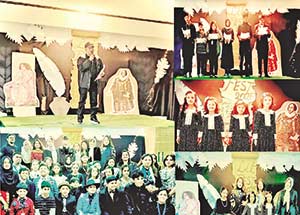
The first edition of the Lit Fest was inaugurated at Imperial International School, Dhaka, (IISD) Auditorium. It was organised by IISD Literature Club (Orpheus) under the supervision of the Department of English and Bangla. The purpose of the fest was to create a platform for literary enthusiasts to develop their thinking power, explore their creativity and to promote English and Bangla literature. Lit Fest was open for all the school students by pre and spot registration. As an inter-school competition, different segments like Lit Quiz, Recitation of Poetry, Creative Writing, Scrap Book Presentation, Stage Drama etc were organised sequentially.
IISD Principal and Advisor of IISD Literature Club (Orpheus) Ashraf Hossain chaired the session. Mahmuda Begum Sinthia, head of the Department of English (IISD), moderated the programme. Among others, the distinguished IISD faculty members, students, and the invited guests were present in the ceremony. Speaking at the event, Ashraf Hossain, Principal (IISD), said, "The key goal of the Lit Fest is to spread out the literature-driven light amongst the students. The bond created here between teachers and students is truly encouraging for us. Being a part of such an initiative has been a source of pride for IISD. He highlighted the importance of literature knowledge dissemination for enlightening development from individual, intellectual, societal, cultural to all leading intuitions. He praised for potential initiatives towards gigantic flow of literary resources and practices." "This is undoubtedly a glorious event for us", he stated lastly as the closing speech-line.
Indeed, literary practices through literature festivals play an immeasurable vital role in our contemporary world, creating spaces for intellectual exchange and engagement in literary enrichment.
The writer is a teacher at Imperial International School, Dhaka (IISD)
Loading...
Loading...
Also read



Editor : Iqbal Sobhan Chowdhury
Published by the Editor on behalf of the Observer Ltd. from Globe Printers, 24/A, New Eskaton Road, Ramna, Dhaka.
Editorial, News and Commercial Offices : Aziz Bhaban (2nd floor), 93, Motijheel C/A, Dhaka-1000.
Phone: PABX- 41053001-06; Advertisement: 41053012; 01793317829, 01550707291, E-mail: [email protected], [email protected] Online: email: [email protected] 41053014; 01550707297 Advertisement: 01550707296
Published by the Editor on behalf of the Observer Ltd. from Globe Printers, 24/A, New Eskaton Road, Ramna, Dhaka.
Editorial, News and Commercial Offices : Aziz Bhaban (2nd floor), 93, Motijheel C/A, Dhaka-1000.
Phone: PABX- 41053001-06; Advertisement: 41053012; 01793317829, 01550707291, E-mail: [email protected], [email protected] Online: email: [email protected] 41053014; 01550707297 Advertisement: 01550707296


