Nine
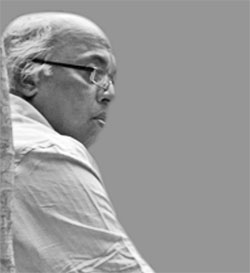
years after he transited to the Great Beyond, Justice KM Subhan is
remembered --- and remembered with deep emotion --- by men and women of
principle in this country. He was one of a class of good men, decent
men, that has fast been dwindling as a band of brothers dedicated to the
cause of justice and democracy.
Justice KM Subhan was among the
courageous and the principled. The facts around his life and career
speak for themselves. When the Awami League returned to power in 1996,
twenty one years after Bangabandhu's government was overthrown in a
violent coup, there was the expectation among many that Subhan would
seek a restoration of his position in the Supreme Court. The expectation
did not reach fruition, because Subhan was in little mood to ask for
favours. He was not willing that the new government place him back in a
position that had earlier been seized from him by a military
dictatorship. That was part of his integrity.
I was young when I
came in touch with Justice KM Subhan sometime in the later part of the
1980s. It was a time when a democratic upsurge against the Ershad regime
widened and gathered steam. It was joy seeing Justice Subhan turning up
at public rallies demanding a restoration of democracy, for his was a
voice of hope against despair, a presence which promised light at the
end of the tunnel. He spoke in quiet yet insistent tones, informing us
of the fundamentals of the War of Liberation, of why we needed to find
our way back to secular democracy. For the relative youth that I was,
those moments defined the future. And, of course, there was the sheer
happiness in me in knowing that my write-ups had drawn Justice Subhan's
attention. He understood why I was being subtle in my references to
history, for the times were out of joint. And he combed through my
articles, spotting in them my principled views, as he called them, on
Bangladesh's national history. He was thus one man, among many others,
who instilled in me the confidence to carry on doing what I needed to
do.
My respect for Justice Subhan has never wavered. Like Justice
M.R. Kayani and Justice S.M. Murshid in Pakistan before him, Justice
Subhan has for me been a constant reminder of the agents of change who
have kept the torch of liberty alight and democratic rights alive in our
world. It was an era when many superannuated judges lapsed into silence
or ended up serving military as well as elected autocratic politicians.
But KM Subhan was different. He elected to be on the side of the
ramparts where the disaffected masses were ready to storm the Bastille.
His was a loud presence in the campaign against communalism, against the
fanaticism of religion. His courage in defending Taslima Nasreen when a
band of fanatics put a price on her head gave the rest of us the chance
to emulate him, to believe in the power of political and moral
conviction.
When the outfit calling itself the Khatme Nabuwat
stirred up hate against the Ahmadiyya community, Justice Subhan lost
little time in rising to the defence of the community. As a significant
cog in the wheel of secular democracy, he identified, naturally, with
the Ekatturer Ghatak Dalal Nirmul Committee. As part of the Bangabandhu
Parishad, KM Subhan was forever aware of the truth that the legacy of
the Father of the Nation mattered, that Bangladesh's history would only
dwindle into being a black hole if Sheikh Mujibur Rahman's life and
times were not made the centre piece of collective national life.
It
was an activist KM Subhan that I had the great fortune to interact
with. At receptions where he and I met, the happiness that emanated from
him at seeing me was palpable. We would talk for a while, he doing most
of the talking. I listened and learned. It is not every day that one
gets to be in the company of a man of wisdom. Nothing of the snobbish
was there in Justice Subhan. Humility dripped from him. But he did not
suffer fools or the ignorant. He was not averse to making plain his
disdain for those who tried to question the genesis of the state of
Bangladesh. Unlike other judges, who even in retirement chose to remain
circumspect, even politically correct, in an articulation of their
political preferences, Subhan knew what position he had to take. He
never had any doubt that the Awami League offered hope to the country.
His faith in Sheikh Hasina did not waver. It was his conviction that
politics which rested on religion, or religion which was imposed on
statecraft, was an insult to the intelligence and dignity of
Bangladesh's people.
Justice Subhan remained aware of the direction
he thought the country needed to take. Not for him the need for
compromise. Not for him the subtlety necessary for an assessment of
political realities. He was categorical in making his opinions known in
the public domain. His self-esteem underpinned his life, his worldview.
It was a principle he shared with his contemporaries --- Justice
Kemaluddin, Justice Abdur Rahman Chowdhury, Justice Syed Muhammad
Hussain. KM Subhan had little wish to indulge the hollow men who
wielded authority. His wrath for the local collaborators of the Pakistan
occupation army in 1971 was pronounced. Patriotic men and women, he
believed, could have no truck, could not be in the same room, with
treacherous elements. Denizens of the dark did not have to step out into
the light of the sun.
Brave men are consistently threatened men.
Villainy always aims at cutting good men down. Justice Subhan's enemies
--- ageing collaborators, religious bigots and pseudo-nationalists ---
were legion. He remained unperturbed. His advancing years were no
barrier to his continued involvement with political and social causes.
Inspiring ubiquity was what defined his presence at rallies, at news
conferences, at seminars. An all-purpose man, he loved to walk, and so
kept himself in good shape. His conversations were animated, his
laughter was deep and spontaneous. In his eighties, he could easily make
you think he had just stepped into his sixties.
It was my good
fortune to know Justice KM Subhan. He was of a club of wise men from
whom I learned about politics, about the values that energise us in
doing all the good we can in a furtherance of the interests of this
sovereign Bengali state.
Seven winters have come, and gone. Yet every
thought of Justice KM Subhan is a soulful throwback to spring and the
times that he defined, as also the other way round.
This morning, our
homage goes out to a man for whom life was an endless mission of high
morals, for whom respect for individuals was concomitant with love of
country.
(Justice KM Subhan passed away on 31 December 2007).
Syed Badrul Ahsan is Associate Editor,
The Daily Observer