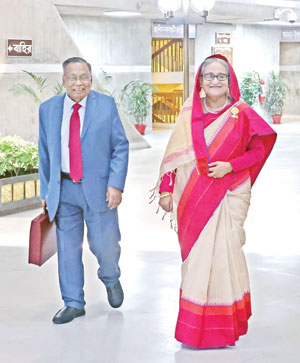
Finance Minister Abul Hassan Mahmood Ali on Thursday proposed a budget of Tk 797,000 crore for the fiscal year 2024-25 while the deficit of the proposed budget is Tk 256,000 crore or 4.6 per cent of the total budget and aiming at collection of tax and non-tax revenue of total Tk 5,41,000 crore.
Of the target of revenue collection, Tk 4,80,000 would be collected from taxation sector which may create additional pressure to the countrys general people, especially the lower and middle income group.
Mahmood Ali presented this budget proposal under the pressure of inflation. Inflation is touching 10 per cent.
In this situation, the Minister expects inflation to be 6.5 per cent in the proposed. In the budget of the outgoing fiscal year, the inflation target was 6.5 per cent.
In addition to listening to the message of hope to bring down inflation to 6.5 per cent, the GDP growth target for the proposed budget has been set at 6.75 per cent. In the budget of the outgoing fiscal year, the GDP growth target is 7.5 per cent, later it is reduced to 6.5 per cent.
In the proposed budget, the Finance Minister has given top priority to containing inflation stemming from the fallout from the foreign and domestic crises.
Mahmood Ali presented the budget proposal in the Jatiya Sangsad in the presence of Prime Minister Sheikh Hasina while Speaker Shirin Sharmin Choudhury chaired the JS session.
Before placing in the JS, the budget was approved by the Cabinet and later the proposed budget was signed by
President Mohammad Sahabuddin. This is the first budget of Mahmood Ali as Finance Minister.
This is the 53rd National Budget of the government and 25th of the Awami League government in its five terms.
Mahmood Ali is the 18th Finance Minister of the country.
The new budget is going to be the highest in the history of Bangladesh. Tajuddin Ahmad presented the countrys first budget as finance minister of the post-independence Bangabandhu government in 1972.
The Finance Minister said that by 2041, all necessary activities will be given special priority to transform Bangladesh into a developed, prosperous and smart country.
He said, "In order to implement the pledges we have made in this years election manifesto to build a developed, prosperous, smart Bangladesh, with the aim of ensuring suitable employment for all the able-bodied, development of agriculture, expansion of investment and industry, right to proper health and education, etc, besides providing protection to peoples quality of life. Above all, the main goal of our budget this year will be to lay the foundation for the implementation of the promises made in the election manifesto."
The issues that have been prioritized in this years budget are protecting economic stability, ensuring a supportive learning environment for science education, scientific research and innovation, providing necessary support to agriculture sector and ensuring food security, improving and expanding basic health services, ensuring youth training and self-employment arrangements, use of technology at all levels including digitizing all possible services, development of physical infrastructure, optimal utilization of marine resources, ensuring financial sector discipline, eradicate extreme poverty by 2031 and reduce general poverty to three per cent by 2041, ensuring supportive environment for industrial establishment and investment, and taking action to combat the effects of climate change.
To develop public welfare oriented, accountable, efficient and smart administration and continue zero tolerance policy against corruption.
In the budget speech, the Minister said, "The people of this country are the true claimants of all our glorious achievements. Utilizing this manpower, we are running at an unstoppable speed under the visionary and strong leadership of the Prime Minister. By already fulfilling all the necessary conditions, we have confirmed the transition to the ranks of developing countries in 2026. Now its time to move forward."
In the budget proposal presented by the Finance Minister expressing hope for big growth by reducing inflation, the deficit without grants has been estimated at Tk 256,000 crore. The total deficit including grants has been estimated at Tk 251,600 crore. In addition, the target of receiving a grant of Tk 4,400 crore has been set.
To meet this deficit, the foreign loan target has been fixed at Tk 127,200 crore. Tk 36,500 crore of foreign debt will be repaid. In this, the net foreign debt will stand at Tk 90,700 crore.
Tk 160,000 crore will be borrowed from domestic sources. Out of this, Tk 137,500 crore will be taken from the banking system, of which Tk 72,682 crore are long-term loans and Tk 64,818 crore are short-term loans. Tk 23,400 crore of non-bank loans will be taken. The target for sale of savings bonds is Tk 15,400 crore.
In the proposed budget, the interest payment cost of the loan has been estimated at Tk 113,500 crore. Out of this, interest on domestic debt is Tk 93,000 crore. And foreign loan interest is Tk 20,500 crore.
This time the revenue target has been fixed at Tk 541,000 crore. Out of this, the target of National Board of Revenue (NBR) is Tk 480,000 crore. Tk 15,000 crore of non-NBR tax has been assessed. And the target of receipt without tax has been fixed at Tk 46,000 crore.
In the proposed budget, the operational expenditure has been estimated at Tk 506,971 crore. Out of operating expenses, outgoing expenses are Tk 468,983 crore. And the interest payment of domestic and foreign loans is Tk 113,500 crore. This time the capital expenditure has been estimated at Tk 37,989 crore.
In the proposed budget, the development expenditure has been estimated at Tk 281,450 crore. Out of this, the scheme will spend Tk 5,943 crore. Expenditure of special projects other than ADP has been estimated at Tk 7,627 crore. The expenditure on the Annual Development Programme has been estimated at Tk 265,000 crore. And in exchange for work, food programmes (non-ADP) and relocation has been estimated at Tk 2,884 crore. Rebuilding foreign exchange reserves will be challenging in the coming months as the high interest rate in advanced countries may continue for a while, according to the Medium Term Macroeconomic Policy Statement placed with the proposed budget for FY25.
The high interest rates prevailing in advanced economies is one of the major reasons for the dwindling foreign exchange reserves in Bangladesh.
The Finance Minister, in his budget speech, said, "When the impact of Covid-19 slowed down in 2021-2022, businesses gathered momentum. As a result, the trade deficit exceeded over $35 billion, which essentially created pressure on foreign exchange reserves and the exchange rate.
"The gross foreign exchange reserves stood at $39.6 billion in July 2022-2023, which went down to $24.22 billion in May this year. To stabilise the foreign exchange market, the Bangladesh Bank had to sell off approximately $22 billion from the reserves. This also caused the decline of reserves.
The proposed budget includes a Tk 265,000 crore ADP. The National Economic Council (NEC) has already approved the ADP, allocating the highest amount of Tk 70,687.75 crore (26.67 per cent of the allocation) to the transport and communication sector.
Additionally, the NEC approved an ADP of Tk 13,288.91 crore for autonomous bodies and corporations, bringing the total ADP for 2024-2025 to Tk 278,288.91 crore.
The ADP includes 1,321 projects: 1,133 investment projects, 21 survey projects, 87 technical assistance projects, and 80 projects from autonomous bodies and corporations.
Among the ministries and divisions, the Local Government Division is set to receive the highest allocation of approximately Tk 38,809 crore (15 per cent) of the total allocation) in the ADP.
Private research organization Policy Research Institute (PRI) Chairman Economist Dr Zayedi Sattar said that the proposed budget cannot be called too contractionary, rather it can be called a moderately expansionary budget. Because if there is a deficit in the budget and the amount of spending increases a little, it is expansionary. However, the monetary policy announced so far is contractionary. Based on the information available so far, the new budget is expected to help meet monetary policy targets.
He further said that in the current scenario, it would have been better if the deficit could have been kept at 4 per cent of GDP by increasing the revenue. Apart from that, there is no opportunity to take loans from Bangladesh Bank during high inflation. Therefore, taking more loans from the banking sector may create problems in financing the private sector.
Former Finance Secretary Mahbub Ahmed said that the budget deficit is being reduced, it would be better if it could be reduced further. Because, in the meantime, the pressure of paying the interest of the domestic and foreign debt of the government has increased. It will increase in the coming days. Therefore, in the future, the debt should be reduced and the expenditure of own money should be increased. Although the initiative to increase revenue has been talked about for a long time, it has not been implemented. Just as there is talk from the highest levels of government to bring down inflation, the same is needed to raise revenue. Because sustainable development is never possible with a tax-GDP ratio of less than 8 per cent.





