



| HEADLINE |

|
7th March speech paved the path towards our independence
Published : Thursday, 7 March, 2024 at 12:00 AM
Md Jony Miah


 The 7th March speech served as a clarion call for the people of East Pakistan (now Bangladesh) to unite and fight for their rights and freedom. Political leaders have always inspired their followers to fight and even sacrifice their lives for their country and the welfare of its citizens. A few political figures have the ability to effectively appeal to the public and persuade them to believe and act on what they say in their speeches. Bangabandhu Sheikh Mujibur Rahmans speech on the 7th of March was of the kind that went beyond simply issuing a call for the 75 million people of Bangladesh to be freed; rather, his speech brought about a revolutionary transition in the psyche of the nation that inspired people to snatch away independence from the clutches of West Pakistan.
 The speech effectively declared the independence of Bangladesh. The aftermath of the brave speech is our freedom. The people of Bangladesh are still moved to make any sacrifices for their beloved nation. Recent UNESCOs declaration of the 7th March speech as an important documentary heritage will get the world to know about the speechs significance and our glorious Liberation War.
Bangabandhu Sheikh Mujibur Rahman, considered the Father of the Nation and one of the most prominent Bangalis in history, called for independence in his historic speech on the 7th of March in 1971. He spoke in a fiery voice in front of a sea of crowd at Race Course Maidan (now Suhrawardy Udyan), Dhaka. When utilised by proficient orators, words may be a potent instrument. Bangabandhu Sheikh Mujibur Rahman knew just how to utilise language to motivate and energise a people that had been oppressed for a long time to achieve independence. Bangabandhu Sheikh Mujibur Rahmans speech on March 7 altered the course of Bangladeshi history. The speech gave the countrys people the most important guidance and strong encouragement to start the freedom fight against the Pakistani government.
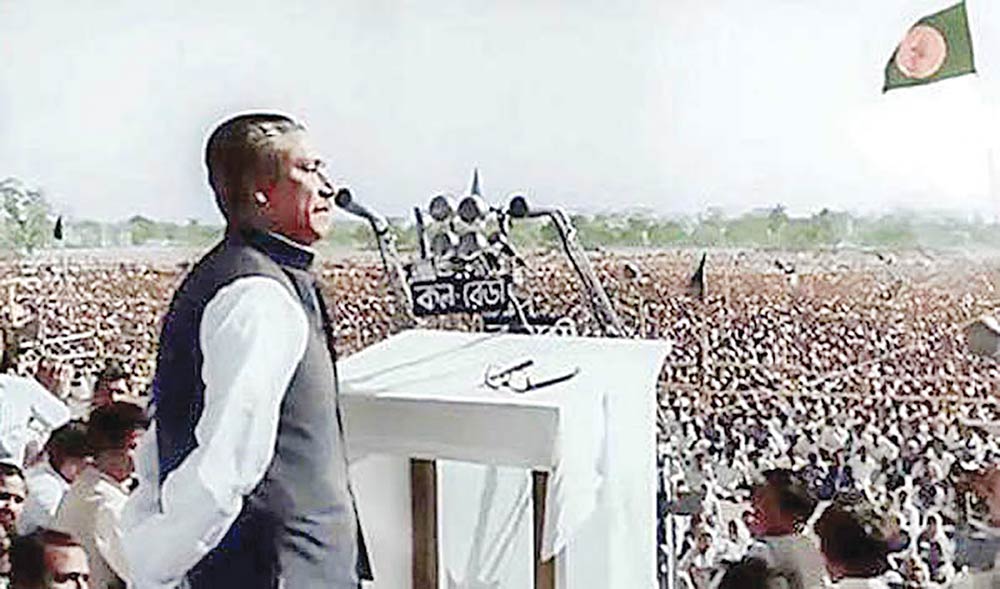
This excellent speech continually inspires others. It ignites our insatiable desire for freedom. It prompts us to align with the essence of the Liberation War. This speech deeply resonated with every Bangladeshi and has continued to inspire and steer us in nation-building since 1971. The speech was given spontaneously without a planned script, and both the audio and visual records of the address were saved. Many comments and writings have been made about Bangabandhus speech on March 7. The 19-minute speech is considered the finest poem in our nation and a poem of liberty by many people. William Wordsworth, a famous romantic poet in English literature, believes that poetry is influenced by emotion and inspiration. Poetry develops from the emotions of the poet. The origin of poetry comes from the emotions in the heart, rather than the concepts of the mind. It is the sudden outpouring of strong emotion. Therefore, Bangabandhus March 7 speech could be seen as the poetic expression of Bangladesh.
The spontaneous statement expressed the hopes and dreams of 75 million people who had been enduring hardship for a long period. It marked the beginning of our significant liberation war. We would no longer be a colony and go back to our usual lives as independent individuals reside in a sovereign country. The speech was delivered at a time when Pakistans military leaders were not willing to transfer power to Bangabandhu Sheikh Mujibur Rahman, a key figure in the Bengali nationalist movement. His political party, the Awami League, had secured the majority in Pakistans National Assembly during the 1970 general election. The speech effectively declared Bangladeshs independence. After the violent event carried out by Pakistans military rulers on the night of March 25, 1971, the fight for the Bengalis democratic rights escalated into the War of Liberation.
Even though Sheikh Mujibur Rahman was arrested by Pakistans military authorities on the same night and kept in West Pakistan for the next nine months, his speech continued to inspire the Bengalis to pick up weapons and struggle for Bangladeshs independence. Actually, the speech was the driving force behind the first successful struggle for freedom. The message of this important speech is still important today for countries worldwide that have not yet effectively created a democracy that includes the political, economic, and socio-cultural desires of the different ethnic, linguistic, cultural, or religious groups living within their borders.
The two recordings with the 7th March speech were secretly sent to the Swadhin Bangla Betar Kendro (Free Bengal Radio Station) by the Bengali nationalist forces when the Pakistani Army began killing Bengalis without distinction on the night of March 25. The Swadhin Bangla Betar Kendro played a recording of this speech nonstop for the next nine months to inspire freedom fighters.
The address given on March 7 is regarded as one of the most significant addresses in human history. The speech was considered one of the most inspiring war speeches in the past 2,500 years in Jacob F. Fields book "We Shall Fight on the Beaches: The Speeches That Inspired History." The speech is globally important because of where it was given, what it included, and its lasting impact on the basic principles that the international system after World War II was built upon. It is now universally recognised that Bangabandhus significant speech on March 7 is among the greatest ever given. Sheikh Mujibur Rahman has a special place of respect and significance. The speech was included in UNESCOs international documentary collection, earning it broad admiration. Moreover, it is included in the "Memory of the World Register," which is a compilation of important documentary heritage works maintained by UNESCO.
Following a significant win in the general election in Pakistan, Bengali nationalist leader Sheikh Mujibur Rahman initiated discussions with the military leadership over the establishment of a civilian government and the creation of a new constitution for Pakistan. These conversations occurred in an environment of doubt, suspicion, and concern about military response. The speech on March 7th provided a quick overview of the history of the Bengali peoples efforts to secure their rightful position within Pakistan. This included the language movement of 1952, where numerous Bengali youths lost their lives while advocating for Bangla to be acknowledged as the official language of Pakistan, the election outcomes of 1954, where Bengalis obtained a majority but were unable to establish the government, and the "Six Point Movement" in June 1966, which called for increased autonomy.
The Bengali individuals were motivated by Bangabandhu Sheikh Mujibur Rahmans address on March 7 in their struggle for liberation . The speech also motivated the entire nation and prepared everyone for the approaching liberation battle. It was also a significant source of inspiration during the struggle. Many freedom fighters who joined the Mukti Bahini found their greatest inspiration from it too. During major national occasions, Bangabandhus speech is broadcast nationwide and continues to resonate in Bengalis hearts and thoughts.. This speech still captivates the people of our country and will inspire future generations.
The writer is a Lecturer in the Department of English at Noakhali Science & Technology University
Loading...
Loading...
Also read






Editor : Iqbal Sobhan Chowdhury
Published by the Editor on behalf of the Observer Ltd. from Globe Printers, 24/A, New Eskaton Road, Ramna, Dhaka.
Editorial, News and Commercial Offices : Aziz Bhaban (2nd floor), 93, Motijheel C/A, Dhaka-1000.
Phone: PABX- 41053001-06; Advertisement: 41053012; 01793317829, 01550707291, E-mail: [email protected], [email protected] Online: email: [email protected] 41053014; 01550707297 Advertisement: 01550707296
Published by the Editor on behalf of the Observer Ltd. from Globe Printers, 24/A, New Eskaton Road, Ramna, Dhaka.
Editorial, News and Commercial Offices : Aziz Bhaban (2nd floor), 93, Motijheel C/A, Dhaka-1000.
Phone: PABX- 41053001-06; Advertisement: 41053012; 01793317829, 01550707291, E-mail: [email protected], [email protected] Online: email: [email protected] 41053014; 01550707297 Advertisement: 01550707296


