
The Fiery Lute," (Agnibina) translated by Dr Mustofa Munir and published by the Kobi Nazrul Institute, Dhaka, Bangladesh, in February 2018, brings forth a timeless collection of poems originally curated by the illustrious poet Kazi Nazrul Islam in 1922. With its rich history and evocative themes, this anthology continues to captivate readers around the world.
At its core, Dr. Munir's translated work of "The Fiery Lute" symbolizes truly a potent fusion of words and emotions of Poet Kazi Nazrul Islam. The title itself, with Sanskrit word 'Agni' representing fire and 'Vina' or 'bina' signifying a stringed Indian musical instrument akin to a lute, encapsulates the fiery spirit that defines the poems within. Comprising twelve carefully selected poems, this anthology resonates with themes of rebellion, enthusiasm, courage, determination, hope, and sacrifice.
Dr. Munir's translation of the anthology 'The Fiery Lute' upholds the true themes of Poet Nazrul's bold divergence from convention as therein the Poet has channeled his passionate energy into articulating dissent and protest against oppression and injustice. These verses brim with revolutionary fervor, unapologetically challenging the established norms and advocating for transformative social change. Nazrul's words in 'The Fiery Lute' serve as a resounding voice for the marginalized and oppressed, a call to action against systemic injustices.
The themes, woven into poems, transcend the boundaries of time and geography. They not only stirred the hearts of people in British colonial India but also ignited a sense of rejuvenation among oppressed populations of the world at large. Nazrul's metaphorical 'Vina strings', once known for their soothing melodies, now echo the fiery melodies of oppressed hearts.
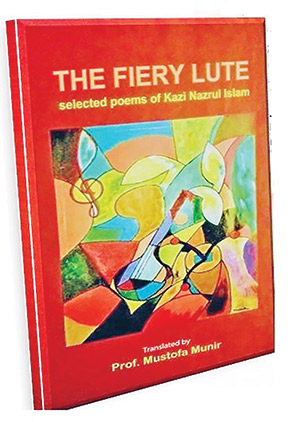
The translator Dr. Munir maintained as much originality as possible in the rhythms, rhymes and themes in the whole English versions of the poems of 'The Fiery Lute'.
Within this translated anthology, several poems, including 'The Rebel,' 'Comet,' 'Anwar,' 'Kamal Pasha,' 'Sacrifice,' and 'Moharram,' showcase Nazrul's literary virtuosity. These verses inspire, compel, and blur the lines between them, celebrating each great individual who sacrificed their lives for truth and justice.
The readers will glimpse the poem 'The Rebel,' therein Nazrul's powerful voice champions courage, determination, freedom, and self-respect. Poet Nazrul extols the valiant, equating him to forces of nature - volcanoes, tempests, cyclones, deluge and cataclysm. The valiant, as depicted by Nazrul, is the one who embodies both the indomitability and tenderness, a duality that adds depth and allurement to the poem- the valiant is an angry Durbasha, also he is a disciple of Vishwamitra. The valiant is defiant, at the same time the softness in his heart bespeaks a virgin's lotus-heart, a heart that experiences the feelings of her first touch and a furtive kiss with shivering and throbbing. Valiant is restless like a sea, also he is the flute of Orpheus. In his one hand he carries a curved bamboo flute to create melodies; in the other he has a war trumpet to wage war against the oppressors.
In the poem 'Comet', (Dhumketu)' Poet Nazrul, the Narrator, presents himself much like the relentless and swift comet; he wants to appear again and again in every epoch for a great revolution.
In the inspirational marching, rhythmic battle ground poem 'Kamal Pasha', Poet Nazrul symbolized Kamal Atat�rk as a courageous nationalist who fought against the tyrant occupiers and liberated his mother land.
The whole anthology reverberates with themes of sacrifice, rebellion, patriotism, humanity, beauty, and valor, all are masterfully woven together by the skillful translation works of Poet Nazrul's mesmerizing poetry. While Nazrul is often labeled a rebellious poet, his true essence lies in romanticism, with rebellion serving as an essential facet of his poetic versatility and talent.
In the Editor's note of 'The Fiery lute' Dr. Binoy Barman wrote "That Mustofa Munir has translated his Agnibina in English as The Fiery Lute is good news.
He has demonstrated his formidable rendition skills, remaining sincere to the original enunciations. He has adopted a style of flowing prose with the diction of classical flavor."
This translation allows the English-speaking readers to delve into the depths of Nazrul's brilliance, offering a sincere and authentic experience.
In conclusion, "The Fiery Lute" is a masterpiece of Bengali literature that deserves recognition on a global scale. Its themes and emotions transcend borders, making it a valuable addition to world literature. Kazi Nazrul Islam's poems, brilliantly translated and cover designed by Dr. Mustofa Munir, continue to inspire and resonate with audiences worldwide, echoing the enduring power of art to challenge, provoke, and uplift the human spirit.
Mustofa Munir has higher academic degrees from Dhaka University, Uppsala University, and George Mason University, Virginia, USA. Following his retirement ne is settled in Houston, Texas.





