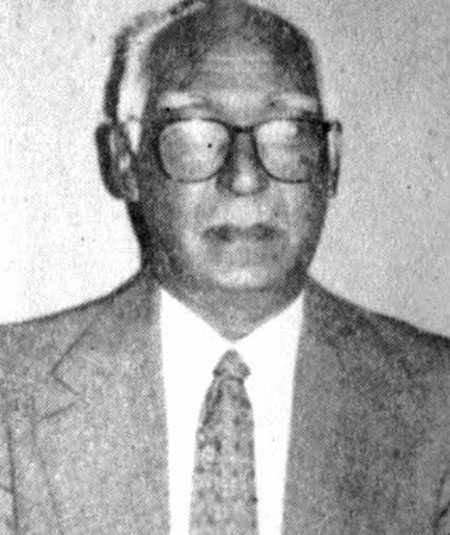
Not many of our good men do we remember. There are those who serve the country, who light up our lives and then pass into the Great Beyond in silence. Not a soul knows that they have gone.
Such a good man, in very many shades of meaning, was Khan Shamsur Rahman. He was the younger brother of the reputed political leader Ataur Rahman Khan. In his own right, he was a civil servant, a diplomat, a scholar.
Khan Shamsur Rahman, or call him Shamsur Rahman Khan, died six years ago at the age of eighty four. Those who have studied Bangladesh's unfolding history since the 1960s and 1970s will surely recall Rahman as the man whose contributions to the creation of Bangladesh were based on pure conviction and inimitable courage. The Agartala conspiracy case clamped by the Ayub Khan regime in late 1967 on as many as thirty five Bengalis and pursued with vigour bordering on vengeance all the way to early 1969 made Khan Shamsur Rahman a household name. Khan was accused number nineteen in the case. We who remember the tumultuous decade of the 1960s cannot but recall the repression Bangabandhu Sheikh Mujibur Rahman, Khan Shamsur Rahman and everyone else implicated in the Agartala case were subjected to by the Pakistani military and civilian establishment. All of them could have gone to the gallows had it not been for the protests which erupted all over the land in their defence.
When Khan Shamsur Rahman died in October 2010, not many noticed his passing. That was a shame. He did not deserve such silence on our part. His was not an inconsequential soul transiting to the Great Beyond, for he was a Bengali whose superiority of character matched his greatness of humility. His public life was his own. Nothing of the hubristic came into his being. He did not speak of himself. He did not drop names. There was intellectual brilliance in the man. He topped the Central Superior Service examinations of Pakistan in 1951, but he never flaunted that achievement. As a civil servant, he served with distinction in different regions of East Pakistan, in a variety of responsible positions. For a time, he was at the Pakistan embassy in Jakarta in the 1960s, where the power of his mind always emitted the necessary light.
It was light which informed his commitment to the cause of his fellow Bengalis. That was his politics. And then came the scholarly in him. His friends and associates were cognisant of the mettle which underpinned his character. They called him Dr Johnson, a throwback to the times of Samuel Johnson. History swirled around him, which fact he used in explaining the undulating paths of life as it was lived everywhere. Men of wisdom are men of courage, which perhaps explains why Khan Shamsur Rahman did not flinch when the Agartala case loomed over him. And that case was a glowing instance of how men like Khan stood ready to sacrifice themselves in the defence of their land and heritage. As part of Pakistan's civil service, he was especially under pressure to confess, to inform the regime that he and his co-accused had all been party to a grand conspiracy to break Pakistan into two and lead its eastern wing to independence. Khan did not break. Nobody broke. In the end, all the accused Bengalis but one emerged free of the case, not because Pakistan had relented but because the Bengali nation had prevailed in its determination to have these patriotic men come home. One did not come home. Sergeant Zahurul Haq was murdered by the military in the cantonment. Nearly two years down the road, one other brave one among the lot, Commander Moazzem Hossain, would be brutally cut down by the army of occupation from Pakistan in the early hours of the genocide on 26 March 1971.
Khan Shamsur Rahman's place in Bangladesh's history was infused with greater substance long before Bangabandhu Sheikh Mujibur Rahman sent him off to Moscow and Delhi as the new nation's envoy, to speak for the country in two of the more influential capitals of the world. In the early 1980s, he faded into silence. It was typical of him. He was among those who did not wear their heroism on their sleeves. Khan Shamsur Rahman had served the country and that was all that mattered.
As the Agartala case wore on in the 1960s, Khan Shamsur Rahman was convinced that Bengalis would not let him down. Emerging into freedom, he repaid the debt: he waged war for his people's freedom.
We yet wait for a Boswell to relate to us the full story of our very own Dr Johnson.r
(Khan Shamsur Rahman --- civil servant, diplomat, scholar --- died on 25 October 2010)
Syed Badrul Ahsan is Associated Editor,
The Daily Observer





