History of Diorama
Pioneered by Louis Daguerre and Charles-Marie Bouton in the 1820s, 'Dioramas' were theatrical experiences using light on landscape paintings. From the beginning of 20th century, a three-dimensional model often displayed against a painted background. Museums traditionally use dioramas to portray a wide variety of content like wildlife in natural habitats, historic events such as battles, landscapes, or scenes of domestic life.
Diorama of military museums usually reflects the important and decisive battles, victors, special operations, and landmarks in the national history etc. Dioramas of assault across the American soldiers during Battle of the Bulge at National Museum of Military History in Diekirch at Luxembourg, the First World War dioramas at the St Joseph's Nudgee College Museum, Queensland, Australia and Australian War Memorial Museum in Canberra are always hoped to be the high art in this regard. In the broader museum sense, some museums added interactive and multimedia features as diorama, although this does not meet the real aim of making dioramas.
However, "Bangabandhu Military Museum" at Dhaka includes dioramas in the galleries to portray the battles of Liberation War.The Museum created some life size dioramas and displays variable from single to multiple figures. Diorama is one of the techniques of museum display, particularly those in military museums, are expected to be attracted by all kinds of visitor. Diorama represents history, art, and war that survive in the modern military museum as artifact or artworks. It is flexible to adjust with the changes of taste and perception of visitors.
A diorama shows battle to communicate the individual human experience of conflict. The great battles of history are traditionally linked to national achievement. War is a destroyer of civilizations, but Liberation War of 1971 is the creation of a nation state 'Bangladesh'.
Usages of large-scale figures in battle dioramas can quickly become communicative both in message and demonstration.Dioramas are static representations of time and age that moves like wheels.
Bangabandhu Military Museum is the custodian of country's military history, heritage, and to display of its large andrare objects. The museum is heir to the legacy of Bangladesh Armed Forces, born out from a bloody war of liberation that created visitor's attraction from the day one it is being opened. It is now a state-of-the-art museum, complete with interactive displays and holograms. The museum is not about power, battles, and bloodshed rather its innovative design, uses of advanced technology, wonderful works of art, and splendid examples of fine craftsmanshipbrought it in a different height. There are displays exploring the effects of weapons and the potential for a future free of arms.
Architect Tanjim Hasan Salim who was the team leader of diorama is confident that visitors of that museum willget a mesmerizing idea of art with some of thetraditional galleries which are juxtaposed with older weapons such as guns and swords, compared to the galleries of advance technology and interactive zones. This museum is a blending of being display, one of the oldest and one of the newest military artifacts in Bangladesh Armed Forces.
Bangabandhu Military Museum Dioramas
Bangladesh Army being one of the notable contributors of Liberation War patronized to conserve history, art and culture through making models of the Liberation War. Initially museum authority provided a vivid idea of dimensions through photographs and painting. Engaging best available artists of Bangladesh to work solely on the dioramas, Architect Tanzim HasanSalim demonstrated his conviction to engage with the viewer's emotions, rather than simply provide a documentary form of museum display.
These artists were willing to experiment with technique, combining painting, modeling, and sculpture to achieve results that capture the spirit of the Liberation War. Given pervasiveness of the Liberation War and importance of the BMM, presence of the dioramas in discussions of Bangladeshi war art was surprising when it first appeared. The dioramas were created to convey a sense of interaction and to engage the interest of the visitors. Artists wanted to give visitors a tangible focus through which to remember or visualize battlefield with the emotional impact of battle.
The massive work began on September 2020 and finished till inauguration. Dioramas created by Didarul Alam and his team sculpted the figures with mannequinthat measures approximately 2862 square feet and includes 16model soldiers with 02 Cannons, 10 arms and 02 Jeeps.
Despite corona pandemic, resource constrain, difficulties with dust and humid conditionthe team constructed dioramas which were intended to be the first in a series to show pivotal moments in the battle. The ratio of figures to soldier varies due to representing the correct tactical formations, and creating the illusion of movement and action. Artist sought to balance artistic and historical imperatives. Artists were well aware of representing the battle moments interactively.Dioramas survive because of its characteristics of being as document in itself. It's an artistic endeavor to create, recreate a landscape at a certain scale.
Liberation War Diorama
War depends on the particular country's nature and the use of its land. Friendly nature and the land of Bangladesh was one of the important catalysts for the Freedom Fighters to achieve victory in the Liberation War. By using the nature of this land, trenches dug during the Liberation War was accelerated the war. By constructing three model trenches 'Liberation War Diorama' at the entrance of Army Gallery depicts the Liberation War, the Father of the Nation and the Bangladesh Army. Withthreemodel trenches, an audio visual atmosphere was created through the Mujib Battery Cannon, Biography of Bangabandhu and other electrical devices.
Artillery Diorama
In ancient times, artillery used to destroy forts or fortified structure by firing a heavy shot at it. After the invention of gunpowder, light cannons could hit targets from a greater distance. The main task of artillery is to provide direct support to infantry and armored teams, to destroy or disable important installations deep in enemy positions, to neutralize the enemy by ambush fire.
Artillery was used in World War I to neutralize 'trench warfare'. The journey of 'Regiment of Artillery' in Bangladesh Army started with the establishment of two field batteries during the Liberation War. A significant number of soldiers of this corps participated in the Liberation War of 1971 and made heroic contributions and received gallantry awards.
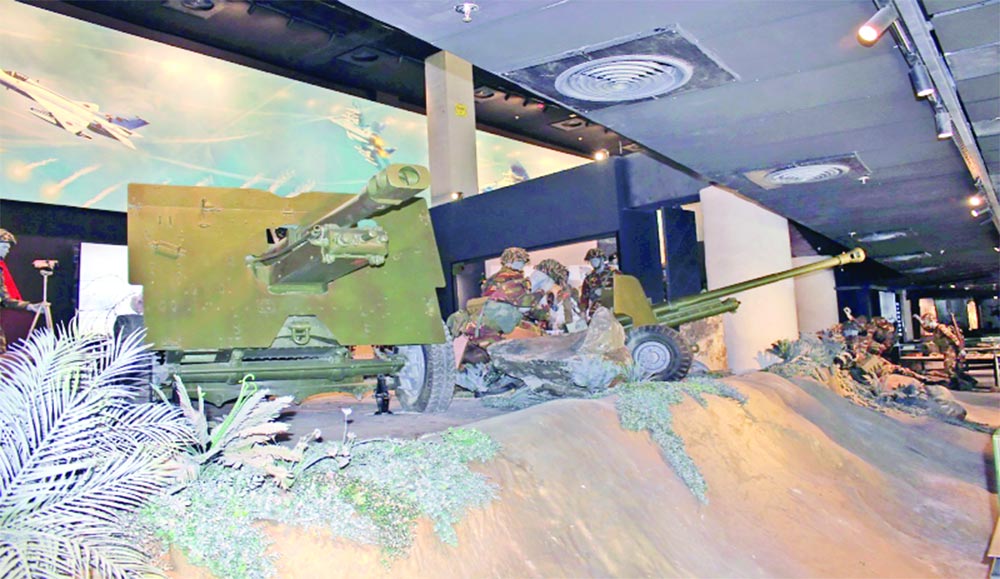
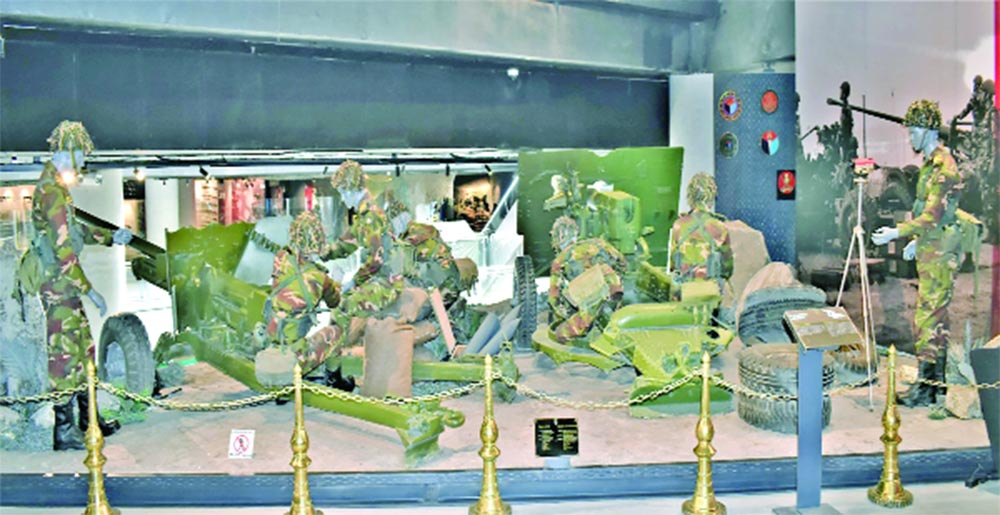
An artillery diorama has been created depicting the current Bangladesh Army troop's formation with two captured field guns from the Pakistan Army which includes 07model soldiers and 02 Cannons. The artists were meticulous in ensuring that the art would not subsume the history. Two artillery pieces that captured by our Valliant Freedom Fighters during our heroic Liberation War were the main artifacts to depict the Artillery diorama.
Infantry Diorama
'Queen of the Battle' bearing that traditional 'Nom De Plume' in mind, infantrysoldiers fights in the front with most terrifying parts of the war and faces thehighest number of causality. Root of Bangladesh Army and the inception of thecorps of Infantry are intertwined with historical references. History of this corpsis immensely magnificent and enriched with the stories of braveness since 1948. Members of this corps valiantly fought during the India Pakistan war in 1965, 1967 and our heroic Liberation War in 1971. 873 membersof this corps embraced martyr dome with 257 gallantry award during our heroicLiberation War. This infantry Diorama demonstrated with 11 model soldier with arms and grenade used in the Liberation War represents symbolic valor of Infantry.
Special Forces Diorama
'Do or Die'- keeping that motto in mind, commandos take death oath to confront enemy. 'Special Forces Diorama' comprising of five commandos depicted theirdistinctive and largely irresistible activities in the joint military operations. Acommando has to have high level of physical and mental endurance to fightagainst enemy. When a commando confronts the enemy, he had to adapt orovercome in inventing way in hostile environments and lands. No matter what theenemy strength is, they risk their lives to snatch victory or sacrifice on the battlefield.
Bangladesh Hospital Diorama
The medical center established as 'Bangladesh Field Hospital' in Agartala, India during the Liberation War is an evolved form of the present CMH. The commanding officer of the Bangladesh Field Hospital was Major Akhtar, accompanied by Captain Sitara Begum. This hospital conducted its operations in Agartala and provides health care to war casualties including Sector 2. A diorama has been created combining CJ-4 model Jeep ambulance captured from the Pakistan Army, stretcher used during the Liberation War and soldiers of the current Bangladesh Army Medical Corps. This diorama is a reflection of the Bangladesh Field Hospital established in Agartala, India during the Liberation War of 1971.
Command Post Diorama
A command post is considered the planning and control center of a battle or exercise in the army. Such command posts were used by both the Pakistan and Bangladesh armies duringLiberation War of 1971. A command post diorama has been created with tents, camouflage etc. which uses in the field level of Bangladesh Army. Video projections of some operations conducted by the Freedom Fighters during the Liberation War are also displayed inside the command post. Such a locally built command post is an important step in making the Bangladesh Army self-reliant.
Mujib Battery Diorama
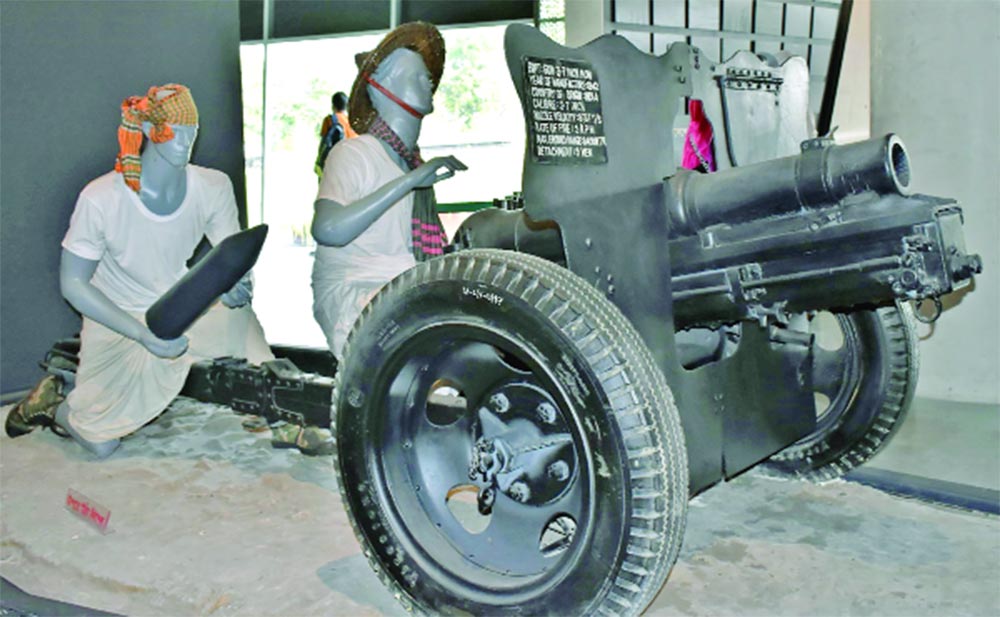
After the name of Father of the Nation Bangabandhu Sheikh MujiburRahman, the first artillery battery of Bangladesh was formed during the Liberation War and named 'Mujib Battery'. On 22 July 1971, its journey began with six 3.7-inch howitzers in the Konabon, India. The battery directly participated in various operations of the 'K' Force, including the Battle of Shalda River and the Battle of Mandabhag. 'Mujib Battery Diorama' has been created using the two original guns used in the Liberation War to highlight the immense contribution of Mujib Battery in the Liberation War and present its importance to the new generation.
RR Diorama
Jeep GS Willis with 106mm Recoilless Rifle (RR) recovered from Pakistan Army in the Liberation War, 'RR diorama'combining an RR detachment with virtual reality has been symbolizes the valor of Bangladesh Army in the Liberation War.
Conclusion
There is a perception that dioramas are not perceived as art. The idea generated from the fact that for the past centuries' diorama have been out of step with the rest of the art world. The museums have acted as citizen making environments in which the audience is united in ownership of the heritage it observes. The dioramas still hold a degree of power that stimulate an immediatereaction through flat images whereas isolated sculptures or even holography cannot. Dioramas connect our sense of perception thatinspires us making imaginative view into their constructs. Dioramas are certainly not a new art form. The Museum of Tin Figures in Germany, founded in 1929, regularly arranges its collection of 300 000 tin soldiers to depict a range of historical scenes since its inception. Nativity scenes were and remain relatively common in a range of institutions and venues such as churches, while panoramas have a history dating back to the eighteenth century.
The writer is a serving military officer





