Liberation war and the current state of Bangladesh from two freedom fighters�
Through the death of Dr. Zafrullah Chowdhury, Bangladesh lost such a great soul whose place as a social reformer is irreplaceable in our history. He devoted his life to the cause of removing sufferings of poor people, especially from lack of vital health services. He was a fighter for human rights, tested patriot, visionary reformer, social activist and one of the pioneers of nongovernment development activities in the independent Bangladesh. He encountered enormous difficulties in translating his lifelong dream of building a better Bangladesh into reality.
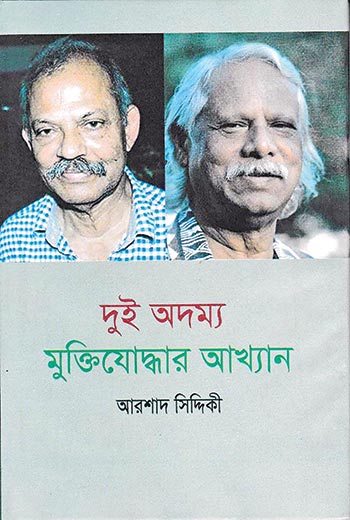
Reviewed by Alamgir KhanWe can know many of these things in his own words spoken to Arshad Siddiqqui. His friend and close ally Dr M A Mobin also gave his interview to Mr Siddiqqui, both of them revealing some truths unknown to many in the country. These two valuable interviews of these two freedom fighters and social reformers have come into a book entitled Dui Adammo Muktijoddhar Akkhan, published this year by Soummo Prokashani with cover design by Artist Mostafiz Karigar. But it is a matter of sadness for Arshad Siddiqqui that he could not deliver this book to Dr Zafrullah as he breathed his last before its publication.
Dr M A Mobin, an orthopedic surgeon now living abroad, was a medical student in London in 1971. The liberation war of Bangladesh pulled him away from the comfortable life of many ones' dream into the hotspot of life and death struggle of our people. As close friends together they left London throwing away their bright future as physicians in order to plunge into the liberation war.
Tajuddin's words when Mobin met him still rings in his ear: "See, war is going on and will go on. But we will die like Ben Bella, Ben Khedda. We will be gone as they did. We will be finished after independence of the country." It is surprising to know that even during the war Tajuddin saw his fate to end the way it did for the Algerian revolutionaries.
Carrying a letter written by Sadeq Khan they went to meet Sector Commander Major Khaled Mosharraf. Afterwards, they built a 480-bed Bangladesh Field Hospital for treating the wounded freedom fighters and thus saved many lives. Dr. Zafrullah gave training to girls to work as health volunteers at this hospital. Later this story got published in the world-famous medical journal Lancet.
Arshad Siddiqqui writes, "After independence, Dr Zafrullah started his health war across villages. He set up the Field Hospital in Cumilla as the first such hospital for people in the independent country. � He started a new health war with the slogan of 'Let's Go to Villages' for turning villages into the center of development. Bangabandhu Sheikh Mujibur Rahman gave the name of Gonoshasthaya Kendra to the Field Hospital. He also allocated 31 acres of land in Savar for this hospital."
In 1948 Zafrullah's father came to Lalbagh thana as its OC (Officer in charge). It was like having a zamindary all over Dhaka in that period, but he did not acquire a piece of land for his family. His mother used to tell him, you studied with the money of the poor people of this country, so to take care of them and serve this country is your responsibility. For this, Zafrullah whose suit was made by the tailor of the British Queen, who once drove a car more expensive than Mercedes-Benz on London roads, who had a license for a personal airplane, who could easily have been the number one heart surgeon in Pakistan, tore away his Pakistani Passport as soon as he heard the news of Pakistani military onslaught upon the innocent people in erstwhile East Pakistan He flew to Agartala from London to join the liberation war of Bangladesh dropping his FRCS final exam and since then devoted his life to serve the poor wearing one shirt and one pair of pants year after year throughout his life.
The book 'Politics of Drugs' written by him is published in London. Another famous book Arens's Jhagrapur, translated and published by Gonoshasthaya is widely popular. Indian High Commission sent him a visa in Savar at midnight because their Prime Minister wanted to talk with him and an Indian air carried him to India for this. Arshad Siddiqui has written, "Dr. Zafrullah did not join BAKSAL in violation of Bangabandhu's request. He refused to be a minister under Ziaur Rahman by writing him a 4-page letter. He also refused the offer of Ershad to be his health minister."
Mr Ershad once said to him, so many people were taking so many privileges from him, "but you never asked anything." Zafrullah replied, "What should I ask? Am I starving?" No, no, not that. Mr. Ershad selected 10 katha land for him at Baridhara, he only required to put a signature. Zafrullah's reply was, "Do you think I have no roof over my head?"
One of the great contributions of Zafrullah is making the National Drug Policy in 1982. He made Ershad understand with the aid of math what positive effects such a policy would have in the country. Zafrullah said, "Such a small size of tablet costs 32 taka. Why, is it gold? � It is pure cheating, fraudulence."
Arshad Siddiqui writes, "The imported items of medicine came down to 225 for this policy. At present 90 percent medicines are being produced at home and Bangladesh has turned into a medicine exporting country." This policy hurt the narrow interests of the physicians in the country. So leaders of BMA (Bangladesh Medical Association) opposed this policy vehemently. They brought out procession against it calling for Zafrullah's death by hanging.
Dr. Zafrullah's last words in this interview are: "Change, we need change, so that we can all live well. If Bangladesh can become a welfare state, it will be an ideal country in the world. We shall be a model for everyone. Here capitalists give us a pat on the back. They lead us to the wrong direction. Our young people can make the change."
In many cases, the publisher, however, should have been more careful about spelling and proper sentence construction. The introduction to the book is written by Professor Ahmed Kamal who has given importance on the small stories side by side the big narrative surrounding the liberation war of Bangladesh. This book containing the interviews of Dr. Mobin and Dr. Zafrullah will enlighten readers by shedding light on many grey corners of our liberation history.
Alamgir Khan is Editor, Biggan O Sangskriti