



| HEADLINE |

|
Bankim Chandra - A literary sailor: sailed off romances to free his countrymen
Published : Saturday, 8 April, 2023 at 12:00 AM
Shaon Arafat



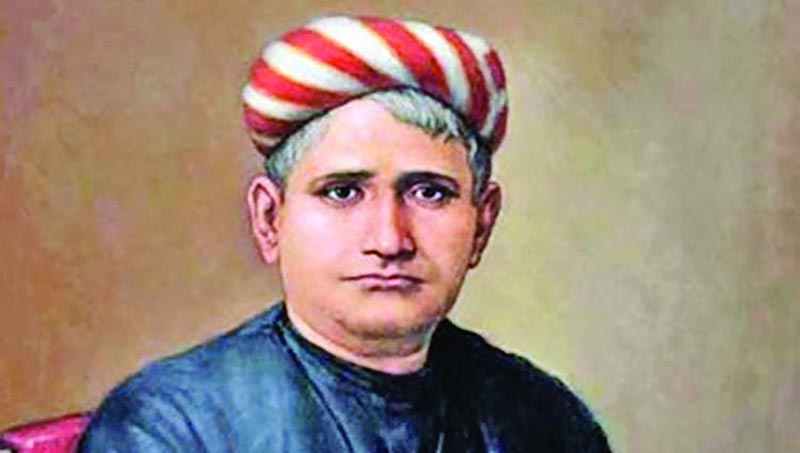
Bankim Chandra Chattopadhyay, the pioneer of the Bengali Novel, sailed off his literary voyage with pen and paper from historical romances to the novels highlighting nationalist fervour which reflects the socio-political and economical conditions of the 19th century Bengal. His writings were also instrumental in articulating a healthy provincialism and thoughts about the nascent Indian subcontinental as well as freeing them from the oppression of the British rulers.
Today, April 8 marks the 129thdeath anniversary of the litterateur.
Born in an orthodox Bengali Brahman family in Kanthalpara Village at Nalihati of Bengal in 1838, Bankim Chandra Chattopadhyay went on to become a significant figure in India's struggle for independence.
Other than penning India's national song Vande Mataram, he wrote several novels, and many serious, serio-comic, satirical, scientific and critical treaties in Bengali.
He was one of the first two graduates of the University of Calcutta, who later obtained a degree in Law as well, in 1869. Before retiring from government service in 1891 as a deputy magistrate, his years at work were peppered with incidents that brought him into conflict with the ruling British.
Despite being a government servant, Bankim could see how British colonialism was adversely affecting India's rich civilisation. In his writings and publications, Bankim used to criticise the British government and hence during his service with the government, he was always involved in conflicts with the colonisers.
He began his writing career with Rajmohan's Wife, which is considered as the first Indian novel written in English. Although Bankim demonstrated an economic exploration of the Bengali family and domesticity in Rajmohan's Wife, he then moved on to depicting romance with historical essence in his later works.
He wrote his first Bengali novel Durgeshnandini, which was published in 1865. His second novel Kapalkundundala, published in 1866, is considered as one of the finest literary works of undivided India. His next romance, Mrinalini (1869), marks the shift from Chattopadhyay's early career, within which he was strictly an author of romances, to a later amount within which he aimed to stimulate the intellect of the Bengali speaking folks and bring a few cultural renaissances of Bengali literature.
In 1872, Bankim started publishing a monthly literary magazine Bangadarshan, which played an important role in establishing a Bengali identity and nationalism.
The magazine also carried serialised novels, stories, humorous sketches, historical and miscellaneous essays, informative articles, religious discourses, literary criticisms and reviews. The magazine, basically, worked for creating a link between the literature and the illiterate classes.
Bishabriksha (The Poison Tree, 1873) was the first novel of Bankim that appeared serially in Bangadarshan. This work tackled the issue of widow remarriage and again showed women as capable of living on their own.
Beyond ushering a new wave of literature in Bengali, he was also a famed satirist. His Kamalakanter Daptar (From the Desk of Kamalakanta, 1875) depicts colonial India as a marketplace where sit deceitful fishmongers, oil millers of sycophancy, and a European stall that invites Indian youth to experience experimental science, only to punch them in the face - a symbol of the violence of the British. Also present is the 'market of justice' where smaller animals are killed but larger beasts run free.
In Krishnakanter Will (Krishnakanta's Will, 1878) Chattopadhyay produced a depiction of contemporary India and its lifestyle and corruption.
The most noteworthy contribution Bankim made to the nationalistic imagination was his political novel Anandamath (The Abbey of Bliss, 1882), which was based on the 'sannyasi rebellion' of the late 18th century that features the theme of Hindu nationalism against the British rule. It depicts the sanatans' uprising against a Muslim ruler. Critics have read the Muslim enemy in the novel as a partial stand-in for the English rulers that Bankim did not dare to criticise openly as a civil servant. The novel became identical with India's struggle for freedom from the British and was, later, banned by the then government. Rabindranath Tagore picked up the song 'Vande Mataram' from the novel, and as the song became popular when the British tried to divide Bengal on religious lines, it was eventually converted as the national song of independent India. It was the song for a nation seeking to free itself from the shackles of imperialism, both in Anandamath as well as in reality.
Chattopadhyay's next novel, Devi Chaudhurani, was published in 1884. Following closely after Anandamath, Bankim Chandra renewed call for a resurgent India that fights against oppression of the British Empire with strength from within the common people, based on traditional Indian values of austerity, dedication and selflessness. Since it fuelled the patriotic struggle for Indian independence from the British Empire, the novel was banned by the British. In this novel, Bankim Chandra reinforced his belief that armed face-to-face conflict with the Royal Army is the only way to win independence.
His final novel, Sitaram (1886), tells the story of a neighbourhood Hindu lord, torn between his girl, and therefore, the woman he needs however unable to realise, makes a series of blunders and takes arrogant, dangerous choices. Finally, he must confront his self and encourage the few loyal soldiers that stand between his estate and the Muslim Nababs army about to take over.
Besides Bankim's acknowledgement as a great proponent of nationalist feeling in Bengal and in India as well as a true social reformer, his greatest accomplishments are his novels that brought contemporary society into the reading experience of modern Bengalis.
Thus, spiritual guru Sri Aurobindo had rightly said, "Bankim created a language, a literature and a nation."
Loading...
Loading...



Editor : Iqbal Sobhan Chowdhury
Published by the Editor on behalf of the Observer Ltd. from Globe Printers, 24/A, New Eskaton Road, Ramna, Dhaka.
Editorial, News and Commercial Offices : Aziz Bhaban (2nd floor), 93, Motijheel C/A, Dhaka-1000.
Phone: PABX- 41053001-06; Advertisement: 41053012; 01793317829, 01550707291, E-mail: [email protected], [email protected] Online: email: [email protected] 41053014; 01550707297 Advertisement: 01550707296
Published by the Editor on behalf of the Observer Ltd. from Globe Printers, 24/A, New Eskaton Road, Ramna, Dhaka.
Editorial, News and Commercial Offices : Aziz Bhaban (2nd floor), 93, Motijheel C/A, Dhaka-1000.
Phone: PABX- 41053001-06; Advertisement: 41053012; 01793317829, 01550707291, E-mail: [email protected], [email protected] Online: email: [email protected] 41053014; 01550707297 Advertisement: 01550707296


