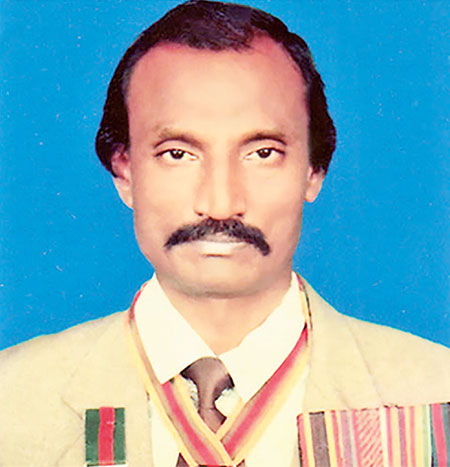
Hemayet Uddin, Bir Bikrom, Chief of the Hemayet Bahini, passed away on Saturday.
At the age of 78, he died of cardiac arrest at Mirpur National Heart Foundation Hospital in the capital at about 6:10am.
He was admitted to the hospital as he felt illness suddenly around 2:00am, said his family members.
Hemayet Bahini is one of the prominent organisations of the War of Liberation in 1971.
The valiant freedom fighter left behind his wife, 11 sons, two daughters and a host of relatives and friends.
Prime Minister Sheikh Hasina expressed her deep shock at the death of the heroic freedom fighter.
His family members added that his body would be kept at the Central Shaheed Minar at 10:00am today (Sunday) to be paid tributes.
The body of the valiant son of the nation would be taken to his native village at Tupuria in Kotalipara of Gopalganj by airplane on Monday.
He would be laid on eternal peace in front of Hemayet Bahini Memorial Museum after his
Namaz-e-Janaza after Asr prayer.
On his death news, freedom fighters and relatives rushed to his body and burst into tears.
Hemayet Uddin, son of Sheikh Abdul Karim and Sakhina Begum, was born on December 3, 1941.
He was awarded with 'Bir Bikrom' title for his outstanding contributions to the country's independence.
Prime Minister Sheikh Hasina established a liberation war memorial museum after his name at Kotalipara on November 12 in 2013.
Hemayet Uddin was a Habilder at East Bengal Regiment's Band party.
On March 29 of 1971, he accompanied by some rebel soldiers came to Faridpur from Joydebpur cantonment and resisted Pakistani army over some days.
The valiant freedom fighter came to his village Tupuria on April 28 and formed 'Hemayet Bahini' to resist the Pakistani occupational forces.
Later, the bahini under his leadership attacked Kotalipara Police Station and possessed huge firearms and bullets.
The number of freedom fighters in the bahini was some 5,558.
The battle fields of the bahini extended to the North part of Barisal, Khulna, Bagerhat, Kalia of Narail and the west part of Madaripur.
The Bahini was divided in 42 groups.