



| HEADLINE |

|
Begum Rokeya: A pioneer of women education
Published : Thursday, 8 December, 2022 at 12:00 AM
Monirul Haque Rony


 Begum Rokeya, a renowned literary, educationist, social reformer and one of the pioneers of women's awakening and women's rights movement, was born on December 9, 1880 in Pairaband village of Rangpur in an elite Muslim family. He was born into a very conservative family. Not only her family but the entire society of that time was governed by strict religious restrictions. Despite being born in that orthodox Muslim family, she was a protesting woman with modern thoughts and mindset. It was almost impossible for women to get an education outside the social order of that time. But with the encouragement of her elder brothers and sisters and later with the companionship of her husband, she came out of that conservative society and became self-educated despite all the obstacles and tried to achieve women's rights. The illiteracy, superstitions, excesses of veiling in the Muslim women's society made her suffer greatly. So she started a movement for the emancipation of women by attacking the roots of the traditional society. Her women's liberation movement was not against veiling but it was basically against the patriarchal society's low mentality towards women. The main goal of her movement was to free the backward Muslim women from the grip of the male-dominated society.
Begum Rokeya realized that establishing the woman of her imagination in the society was not so easy. So, it is important to change the mindset of society and women.And therefore there is no alternative to women's education. She understood that the root cause of women's backwardness, subordination and subjugation was their lack of education. "We are unfit for freedom through lack of education. We have lost our freedom because we have become incompetent. We are falling behind because we do not have the same opportunities to practice good education as men"- she wanted to make the society realize the importance of women's education through this message. She believed in the fact that education is necessary for women not only for mental development but also for playing a proper role in family and social life. But in the society of that time, getting formal education for women freed from the family was just a fantasy.
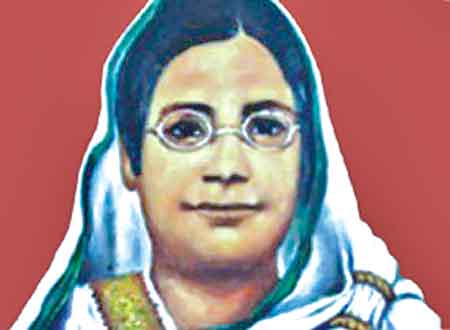 At that time education was considered as the sole right of men. She locked the door of that society and established 'Sakhawat Memorial Girls School' in Bhagalpur in 1909 with only 8 female students in her husband's name. It was not an easy task to establish a school for girls where there was no opportunity for girls' education. But she did not lose her morale. She went from house to house explaining the importance of women's education and brought the girls to school. She made them Educated. She did not stop with just establishing schools. She also campaigned strongly for women's education to deliver the message of women's freedom from door to door. Nevertheless the society at that time did not take her initiative cordially. Instead, many saw it with the eyes of condemnation and hatred. Yet nothing could stop her. After establishing the school, Begum Rokeya realized that Muslim women needed an institutional basis for the pursuit of their demands. And so, in 1916, she established a women's organization called 'Anjumane Khawatine Islam' to create an organizational basis for achieving various demands and leadership qualities of Muslim women of Bengal. It was an institutional step in Begum Rokeya's women's movement.
In the family and society in which Begum Rokeya grew up, Urdu, Persian and Arabic were the dominant languages. Speaking and learning these languages was like a religious practice. English was considered a foreign language. Bengal was also viewed with reluctance. Although she could speak and write fluent English, she did not follow that way. She saw that there is no alternative to Bengal to awaken the women's society of Bengal. That is why she wrote all her works in Bengali language. She first wrote a book in English called 'Sultana's Dream' but later translated it into Bengali herself. She had great attraction and love for Bengal. At that time, writing in Bengali against the flow of society was also a kind of revolutionary work. Evidence of her steadfastness towards the Bengali language can be found in her strong statement in favor of the Bengali language at the Bengal Muslim Conference in 1930. Which was an adventure in the context of that era.
Begum Rokeya has worked for the welfare and emancipation of women forever with her strong spirit and infinite courage in the hostile environment of that time. In all her meditations and knowledge, thoughts and consciousness, mind and heart were women. Establishing equal rights for women in a male-dominated society was her cherished dream. While it is a matter of debate as to how far the dream of women that she dreamed of at this stage of the twenty-first century has come true today, there is no denying that the movement she started for women's empowerment or women's liberation will remain unforgettable for ages. Her contribution to the awakening of women, the end of all discrimination against women, the upholding of women in their dignity and the economic and social emancipation of women will be written in golden letters in the pages of history. This noble woman, the pioneer of Bengali Muslim women's awakening, passed away on December 9, 1932 in Calcutta.
The writer is a social worker and lecturer, Department of Social Work, Savar Government College
Loading...
Loading...
Also read



Editor : Iqbal Sobhan Chowdhury
Published by the Editor on behalf of the Observer Ltd. from Globe Printers, 24/A, New Eskaton Road, Ramna, Dhaka.
Editorial, News and Commercial Offices : Aziz Bhaban (2nd floor), 93, Motijheel C/A, Dhaka-1000.
Phone: PABX- 41053001-06; Advertisement: 41053012; 01793317829, 01550707291, E-mail: [email protected], [email protected] Online: email: [email protected] 41053014; 01550707297 Advertisement: 01550707296
Published by the Editor on behalf of the Observer Ltd. from Globe Printers, 24/A, New Eskaton Road, Ramna, Dhaka.
Editorial, News and Commercial Offices : Aziz Bhaban (2nd floor), 93, Motijheel C/A, Dhaka-1000.
Phone: PABX- 41053001-06; Advertisement: 41053012; 01793317829, 01550707291, E-mail: [email protected], [email protected] Online: email: [email protected] 41053014; 01550707297 Advertisement: 01550707296


