



| HEADLINE |

|
Bangladeshi school children’s early drop-out tied to climate change
Published : Saturday, 13 August, 2022 at 12:00 AM
Shaikh Shahrukh


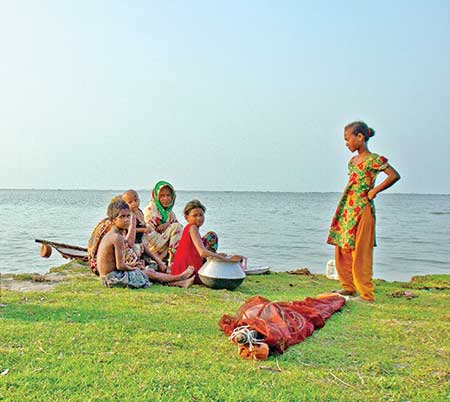 Moin Gazi lived on the bank of Shakbaria River, Koyra in Khulna district in southwestern Bangladesh. Before the massive attack of cyclone Aila in 2009, he stayed at Jhorshing village, South Bedkashi union near Shakbaria River. Moin moved to Khulna with his family at the age of eight losing their house and cropland due to cyclone Aila.
 Moin's father died a few years back after contracting several diseases while working in railway terminal as potter. His mother Jamila Begum used to work as a maid servant in the city's house. Though the family burdened with four more children aged 14 and 17 except Moin could not run comfortably with his parents' income, it could at least survive.
Jamila Begum said, 'Once we did not lack. My husband and I used to earn. Crops also came from agricultural land. Our son (Moin) used to study in primary school.' But now the situation has changed. We have become refugees because the river took away our houses and lands. My husband died in 2015 due to lack of treatment for money.
She further added after that cyclone many families still live on Shakbaria River dam.
One of the reasons for Moin and his family's plight is the hostile weather. Due to global warming and climate change, cyclone-storm-floods and landslides have increased in the entire low-lying areas of Bangladesh including South Bengal. As a result, thousands of families have been displaced from these areas being subjected to inhumane life in the slums of Khulna and capital Dhaka.
School going children of these refugee families are falling victims to drop out. Although child labour is banned, many are involved in hard work. Like Moin, Milon has to earn money at a young age to support his family.
Last August, UNICEF voiced concern that children in three South Asian countries are at extreme risk of climate change. The countries are Bangladesh, Afghanistan and India. Eventually, 1 billion children in 33 countries around the world are at such extreme risk.
According to the annual census of primary schools last year, there are around 65,000 primary schools in the country. The number of students is more than 10 million. But last year the school dropout rate was over 17 percent. In terms of numbers, around 2 million students have dropped out from their studies.
Earlier, in this regard, UNICEF's Regional Director for South Asia, George Laria-Aji said, "This is the first time we have received clear evidence that hundreds of thousands of children in South Asian countries are at extreme risk due to climate change."
According to agency officials, extreme weather conditions, particularly droughts, floods and landslides, have left millions of children homeless in South Asia. They are in dire need of food, healthcare and clean water. In many cases these children are forced to drop out of school.
Being a riverine country, the risk of disasters, especially storms, floods and riverbeds is relatively high in Bangladesh. Almost 40 percent of the country's total population is children. Therefore, many analysts think that these children have to pay the price due to climate change and disasters.
According to UNICEF, most children in urban slums do not attend primary school. Even children in disaster-prone areas have even fewer opportunities to go to school. According to the organization's research, about 1.7 million children are engaged in prohibited and hazardous labor in the country. One in four of them are 11 years old or younger. Many girls work as domestic workers.
Most of the children living in slums in and around Dhaka work in tanneries launch yards, tailor shops, automobile factories, fruit and vegetable market and as porters at bus stands, launch ghats or railway stations. Most of them came to Dhaka as refugees from various disaster-prone districts.
Last year's floods damaged more than five hundred educational institutions in 10 districts across the country. Due to floods, school activities were closed in the disaster-prone areas for a long time. Because school buildings were used as shelters in disasters. Apart from this, students could not go to school for a long time due to the corona epidemic. Many school-going children have dropped out of it.
Climate change has direct and indirect effects on children. Children are more vulnerable than adults to the impacts of climate change on humans. The World Health Organization estimates that 88percent of the burden of disease worldwide is attributable to the effects of climate change on children under five.
Children of the country have no role in climate change. But the country's children are paying the highest price. According to the United Nations Children's Fund (UNICEF), one in three children in the country, or nearly two million children, are affected by adverse weather conditions, floods, river erosion, sea level rise and climate change.
The negotiators said that as a result of climate change, many of the children affected by environmental reasons are living in the slums of the city. Their health and education prospects are ruined.
Millions of children are trapped in exploitative child labour, child marriage and trafficking.
Bangladesh ranks 15th out of 163 countries in UNICEF's Children's Climate Risk Index. The index shows how vulnerable children are to climate and environmental shocks.
Another recent report stated that if the global temperature rises by 1.5 degrees Celsius, the sea level may rise by 10 to 30 inches by the year 2100.
Meanwhile, climate change has peaked the frequency and severity of natural disasters in various parts of the world; Climate experts fear its amount may increase in the future. All the world's leaders have not yet agreed on the steps to resolve this extremely undesirable situation. The recent climate conference held in Glasgow, Scotland was somewhat successful, but the necessary concerted efforts are still missing.
Bangladesh ranks seventh among the most affected countries in the world in terms of natural disasters due to climate change. All natural disasters cause temporary or long-term human suffering. We are all aware of the suffering and struggle of the marginalized people due to natural calamities in Bangladesh.
Most of the male members of the disaster-prone townships live a fragmented life in the city or elsewhere without other family members in search of life and livelihood. In this situation, the women and children of the families staying in the township during the disaster are the most vulnerable and in danger. Some 90 percent of people affected by the catastrophic cyclone of 1991 and Sidr in 2007 were women and children.
Previously, a research report in 2015 showed that after Cyclone Aila, about 60percent of the population of the affected areas moved to other places. These women and children of the abandoned families spend their days in extreme uncertainty.
With 32 percent suffering from food insecurity and alternative livelihoods, 23 percent experience sexual violence. We know that school dropout and child marriage among girls from affected families are common. Child marriage of adolescent girls is very common with family pressure and consent and support from society to escape the economic uncertainty caused by disasters.
Loading...
Loading...
Also read



Editor : Iqbal Sobhan Chowdhury
Published by the Editor on behalf of the Observer Ltd. from Globe Printers, 24/A, New Eskaton Road, Ramna, Dhaka.
Editorial, News and Commercial Offices : Aziz Bhaban (2nd floor), 93, Motijheel C/A, Dhaka-1000.
Phone: PABX- 41053001-06; Advertisement: 41053012; 01793317829, 01550707291, E-mail: [email protected], [email protected] Online: email: [email protected] 41053014; 01550707297 Advertisement: 01550707296
Published by the Editor on behalf of the Observer Ltd. from Globe Printers, 24/A, New Eskaton Road, Ramna, Dhaka.
Editorial, News and Commercial Offices : Aziz Bhaban (2nd floor), 93, Motijheel C/A, Dhaka-1000.
Phone: PABX- 41053001-06; Advertisement: 41053012; 01793317829, 01550707291, E-mail: [email protected], [email protected] Online: email: [email protected] 41053014; 01550707297 Advertisement: 01550707296


