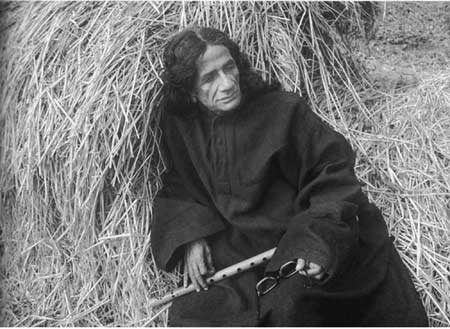
SM Sultan is a renowned painter and a perfect narrator of our peasant society, villagers and their daily chores. His paintings successfully documented their pains, joys, happiness and agonies. The rare personality was born in 1923 in Narail district. His father worked as a mason, and Sultan joined him after five years of schooling at a local school in Narail. He had a great passion for art from his childhood. He drew many things on the yard of home and open space. Sultan also helped his father in making the buildings. His father explored the hidden creativity of his beloved son. During that time, young Sultan knew that an art education was only possible in Kolkata, but family hardship stood in the way.
The local entrepreneur named Dhirendranath Roy gave him full support in his bid to acquire knowledge about art. With financial support from the local entrepreneur, Sultan went to Kolkata and joined the Kolkata Art School but left the educational institute without completing his degree.
Sultan had a strong Bohemian element in his temperament and something of a nomad. He soon took to the road, traveling to different places of the country and India. For livelihood, he limned the portraits of different people of the society, beggars, street urchins and surrounding atmospheres of the society where he stayed. Then he sold them to different art shops and galleries in India. He held the first exhibition of his artwork in Simla in the early 50s. The exhibition received high praises and the artist earned sufficient money for his livelihood.
For a time, Sultan lived and worked in Kashmir - mostly landscapes and portraits. Then, after the partition of the subcontinent in 1947, he returned to Narail. Then again, in 1951, he left for Karachi. There he taught as an art teacher at a school, and came in contact with artists like Abdur Rahman Chughtai and Shaker Ali, with whom he developed lasting friendship. In 1950 Sultan had gone to USA - exhibiting his work in New York, Washington, Chicago, and Boston, and later in London. In 1953 he returned to Narail. There he built a school for children. He also lived in a house full of cats and snakes. Except for occasional visits to Dhaka (where he had his first exhibition in 1976) he lived in the quiet isolation of his house. SM Sultan
A bohemian and mystic, Sultan's works delve deep into rural life - especially peasants, fishermen, day labourers and their simple lives. His works articulate the lives of the working class. His works mainly focus on disadvantaged communities, but also highlight their power of unity and the struggle for power. His paintings visually narrate stories of rural households, where men and women are seen immersed in chores and farmers toiling in the fields.
His figures are muscular and powerful, denoting a sense of prosperity - a vision the artist had for rural Bengal. Sultan drew male figures influenced by the European Renaissance tradition, while his women - buxom and curvaceous - belong to the old Indian tradition. Tiny huts and villages are also seen in the paintings. Sultan was mainly recognised for his depiction of rural beauty and villagers.
Needless to say, Sultan was not only a globally renowned artist but also a philanthropist. On a first impression at Sultan's paintings, one gets the impression of strength and vigour. His canvas is huge and denotes the harmony, simplicity and integrity of villagers. He was a good-natured secular. He had the rare ability to quickly become the centre of attention at any social and cultural gathering.
A bachelor and spiritualist, Sultan stayed in a bucolic environment at Narail. He lived with an adopted family and pets. He had a great fascination for both domestic and wild animals. He liked the company of children which encouraged him to do several projects for children. He later built a mini-zoo at his home.
Sultan received the Ekushey Padak, Swadhinata Padak, Bangladesh Charu Shilpi Sangsad Padak and other prestigious awards.
The master painter died in 1994.
Today marks the 22nd death anniversary of SM Sultan.
The writer is a freelance contributor.