There are many folk tales about the first Durga Puja in Bengal. Raja Kangsha Narayan of Taherpur organized the first autumn Durga Puja in Bengal. Tahirpur is a municipal town of Bagmara upazila under the district of Rajshahi. It is situated on the bank of the river Barahi or Barnai. It is said that, Tahirpur has been named after a certain Pathan fief-holder Tahir Khan. It is a very old zamindari. It came into being in the beginning of the 15th century. Its founder was one Kamdev Bhatta, a Barind Brahmin who ousted the Pathan fief-holder Tahir Khan and laid the foundation of the zamindari during the independent Sultanate period (1338-1538) of Bengal. The most noted zamindar of Tahirpur was Raja Kansa Narayan, son of Hari Narayan. It is recorded that by spending taka nine lakh he arranged for the gorgeous celebration in modern fashion of Durga Puja festival in Bengal.
Another story says the landlords or zamindars of Dinajpur and Malda initiated the first Achala Durga Puja in Bengal. While the third states that the first grand Puja was organised by Raja Nabakrishna Deb of Calcutta in honour of Lord Clive in 1757. The Hindu leaders of Bangladesh in October 2013 appealed to the present government to declare 500- years' old heritage site of Tahirpur Durga Mandir as the National Durga temple of Bangladesh.
Earlier, the Puja was organised only by the rich families who had the resources to spend on elaborate worship. In the late 19th and 20th century, the middle class in Calcutta and East Bengal brought about a transformation and started the tradition of Community Puja or Sarbojanin Puja. Community Puja is organized by each and every locality where a committee collects fund from the people to meet the expenses for 'pandal' construction, idol preparation, ceremonies, etc. It involves feasting, organization of games for children and other activities for all the people of the locality. The creation and ornamentation of idols is marked by rites and rituals. The clay used for the sculpture of Goddess Durga is collected from the banks of river. There is an old custom of mixing a handful of soil collected from the locality of sex workers and then making the sculpture. It may be mentioned here during Bangladesh War Hindus as evacuees in relief camps also observed Durga Puja in 1971. The Hindus belief that in a final burst of triumph, the truth must pinned devil force like Mahishashur down with her foot drove the trident into his heaving chest as he strove to hold back his escaping life-breath. Thus the demon met his doom in December 1971 gazing into truth frenzied eye; for the glance reread demon force doom-and deliverance'.
The present day Puja committees in Dhaka and other parts of the country depend on doles of government and protection of law enforcing agencies. The Hindus in Bangladesh usually organize Puja 'mondaps' and display communal harmony in the name of Puja once a year like other festivals but in reality, besides begging, there is no security and political and economic power to earn for them.
Durga Puja is celebrated twice a year in Bangladesh, many states of India and other parts of the world. According to Hindu religious scriptures, the conventional worship of Durga falls in the Bengali month of 'Chaitra' and is called Basanti Durga Puja. However, the autumnal ritual, also known as 'Akaal Bodhan', is more popular and widely celebrated as per Hindu almanac (Panjika) around different continents of the world in the Bengali month of 'Ashwin'.
According to Hindu Almanac, this year Durga Puja celebration started in Bangladesh with Mahalaya on 23 September will end with Dashami or Vijaya on 03 October. A lot of security measures had been taken by the home ministry to provide security to the more than 20,000 'puja mandaps' across the country so the festivity will be somewhat subdued in 2014.
It is believed that Goddess Durga, the slayer of Mahisasur, was first worshipped in autumn by Lord Ram before going for war with Ravan. Lord Ram had invoked the blessings of Goddess Durga by performing 'Chandi Homa', offering 108 blue lotuses and lighting 108 lamps. It was then on Ashvin Shukla Dashami that Lord Ram who was blessed by the Goddess had attained triumph by killing Ravan. Moreover, it is believed that Durga Puja is observed as the welcoming celebration of Goddess Durga who visits her mother's land for ten days on the completion of which she goes back to her husband Lord Shiva.
Rig Veda, the oldest religious scripture of the world bears the testimony of Shri Sakti Cult. In the Rig Veda it is revealed that Lord created by His wisdom the First Devi Cult to cool off the evil forces, it says, "To establish peace by protecting from the destructive fire of vain arrogant tyrants wielding the evil power like that of a mad Bull, Lord created by His wisdom the First Devee, to cool off the force evil fire as if by throwing water to quench the evil fire. Thus Veda clearly establishes the creation of Durga to kill the arrogant Evil to establish peace and joy on earth". (RV 10.109)
In the Markandiya Purana it is written that many dark, primordial moons ago when evil went stampeding through the heavens in the form of Mahisashura, the buffalo demon, the gods in their hour of need turned to Shiva and Vishnu. The pitch dark of wrongdoing and heedless ignorance were threatening to swallow up the steady glow of light of thinking and knowledge. The golden moments of heavenly existence were beginning to show the tarnish of demonic misconduct. The might of the gods, the Devas was in danger of being snuffed out by the misrule of the Ashuras, the demons. The light was going out of their lives.
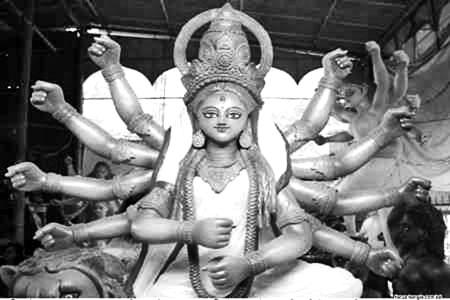
The darkness that had settled on the world burst open in a dazzle-and of the effulgence was born the sound and fury of blazing wrath that is Devi Durga, difficult to attain destroyer of all evil. Fiery red in hue, clad in the blue of the firmament her many arms fanned out to fill the sky as she received the martial equipment that each god separately created out of his own special weapons-a trident from Shiva, a discous from Vishnu, staff of death from Yama, a club from Kubera, a battle axe from Vishwakarma, a thunder bolt from Indra and many more.
The gods watched in wonder and relief as she went riding to battle on a rampant lion, her dreadful laughter mingling with its roar the three worlds echoing with the sound of fury as she made her way to the Vindalyas to seek out Mahisashur.
In a final burst of triumph, she pinned Mahishashur down with her foot drove the trident into his heaving chest as he strove to hold back his escaping life-breath. Thus the demon met his doom, gazing into her frenzied eye; for the glance reread his doom-and his deliverance.
Thus the conception of which Devi Durga is made the stuff of eternal challenge and fight and panting victory over the ugliness and terror that forms the morass of the world out of which like the lotus of slush the beauty of the good arises.
To commemorate the festival, messages from the figureheads of the country and other political personalities come forth to give finesse. Well-placed Hindus, like residual Babus of bygone days, of different walks of life in the metropolis, dressed in their best, attend state function of the 'Vijaya Dashami' reception at Bangabhaban, the president's palace and 'Ganobhaban', the residence of Prime Minister to exchange 'Vijoy Shuvechcha' or puja greetings among themselves.
With the spirit of complete surrender to achieve eternal liberty we wish may the Blessings of Ma Shri Shri Durga be bestowed on all of us with best Vijaya wishes and greeting.
Rabindranath Trivedi is a retired civil servant, freedom fighter, author and columnist.
Email: trivedi1944@gmail.com





