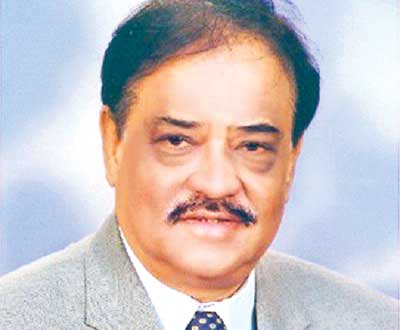
My batch mate Mohiuddin Ahmed (Modhu) called me after reading the instalment of 'Symphony' published last week. Mohiuddin retired as Foreign Secretary on the completion of his career. He fought valiantly in the diplomatic front in the Liberation war of Bangladesh, 1971. He is a avid and careful reader of my writings spoke with me and pointed out that there was a significant omission in enlisting the Deputy Director of the Civil Service Academy in 1967. I told him half jokingly that 'a great artist citing Hudson' "the great artist is known by what he omits".
Nevertheless, I was shaken when he pointed out that I had forgotten to mention the enigmatically affectionate Deputy Director Dr Tariq Siddiky. He made an enduring impression on us as at once a stern and loving teacher. That I did not mention his name could have been a temporary lapse of memory as I was under greater pressure of challenging circumstances as I wrote the last instalment. It could have been also due to the unconscious reserving of the memory of Dr Tariq Siddiky for a more elaborate and appropriate reference.
The first encounter was not very pleasant. On the second day of our year in the academy Dr Siddiky entered the dining hall as we were having our breakfast. Just as the clock was about to strike 7:30 am he virtually snatched away the tea cups from the late comers among whom I was one. Bereft of our morning tea before the classes started we felt bitter at the conduct of what seemed to us as a rough and ready administrator. We immediately started researching him. We found within day or two that he was a remarkable person considered eccentric by some of his elder and contemporary colleagues.
At a time when there were not many CSPs who had earned a PhD Degree Dr Siddiky got his doctorate from a reputed American University. His dissertation on public administration focused on the distribution of eggs and milk in the city of Chicago. Rumour had it that he was married to an American lady to be separated some time later. What was more significant was the fact that he was an ardent teacher who taught us to think out of the box. He also told us that government servants did not receive their salaries as a matter of right but one of grace by the state!
Dr Tariq Siddiky's extra-ordinary way of teaching became clear to us in course of two events. During the early time in the academy he gave us to write a paper on an aspect of public administration. The night before the date of submission, Shakoor came horridly to my room. He said the pressure of other assignment did not leave him time to prepare the paper. I said, I was in the same boat. Shakoor told me that failure to submit the paper would be disastrous as Dr Siddiky would entertain no excuse.
Shakoor thought for a moment and said, 'I have an idea. Akbar Ali Khan, hard working and dutiful had his paper ready. Come with me together we may pursue him to lend us his paper. We can then build up something on his model". Akbar was not only serious in studies but also generous. In the academy he soon acquired the name, "Learned Friend". Shakoor and I were grateful and happy. Working late at night I changed the introduction and conclusion and modified some sentences in the content of Akbar Ali's erudite writing. Shakoor did no such thing. He only copied the paper word for word.
Dr Tariq Siddiky evaluated our papers within a day. We were immensely surprised with the result. As far as I remember, I got 29 out of 30 and topped the list. Shakoor was second with 28 and poor Akbar Ali Khan stood third with only 27. Naturally, he was outraged and protested in annoyance. He told Dr Siddiky that the two who got more marks than me actually copied my writing. This is unjust". Dr Siddiky was unperturbed and said, "Mizan wrote his introduction and conclusion in his own way and made important changes in the contents.
Thats why he had earned more marks than you". Akbar Ali Khan was furious, I understand that about Shakoor he has not even changed one word. Why should he overtake me? Dr Siddiky thought for a moment and said, "Shakoor has neat and nice hand writing. It is easier to read his paper. Akbar Ali Khan knew that he had caught a Tartar. No one could win in this situation. Crestfallen Akbar was grim and did not seem to be friendly to either Shakoor or me.
Again, when we came to the then East Pakistan to have our attachment to Pakistan Academy for Rural Development (Now the Bangladesh Academy for Rural Development, BARD) in comilla. We used to travel to Dhaka on the weekends on Saturday and Sunday. Mostafa Kamal of PFS drove his car to Dhaka with us, Shakoor Muyeed and I. Shahed Shadullah also took the trip with other East Pakistani probationers with their homes in Dhaka. Before the second weekend Dr Tariq Siddiky who was our Deputy Director in charge in Comilla Academy said, "Don't you know that you require permission from your superior before leaving station?
We said, "Does the rule apply even during holidays? He said, "yes, as the second weekend was near I said, "we apply for your permission to leave station this time". Without batting an eyelid Dr Siddiky said, "I refuse to give you permission". As he left us, we were at a loss to decide what to do. Everyone wanted to go to Dhaka and spent time with his kith and kin. Those of us such as Shakoor and I who had wife and children in Dhaka felt deeply disappointed and sad. The Deputy Director's conduct appeared unreasonable and illogical as there was nothing important to do on weekends.
In a desperate move on defense I told my colleagues that we should not comply with this unreasonable order and defy it and go to Dhaka. Shakoor and a few others including Mostafa Kamal sided with me. Shahed Shadullah characteristically obedient and disciplined with a handful of other probationers stayed back saying that violation of Dr Siddiky's order would bring severe punishment to the culprits. We had a nice weekend in Dhaka but returned to Comilla with great trepidation. We were ready for some kind of censure and punishment. On reaching the Comilla Academy we found Shahed Shadullah and those who stayed back with long faces reflecting sorrow and sadness.
I asked Shahed, "What happened? Why are you looking depressed and sad"? An irate Shahed replied, "why shouldn't we be sad? "you know Shelley Bhai what happened? the few hours after you left for Dhaka Dr Tariq Siddiky said to us". Have you no spines, why didn't you have the courage to defy unreasonable order? You have a long way to go in your career. You should be brave when the situation demands you to be brave". There was nothing to do for us but break into hearty laughter. We were immensely relieved and wondered at the enigma that was Dr Takiq Siddiky.
It was again in the Comilla Academy that I had a heated altercation with Dr Siddiky on some trifling matter. For a couple of days after the event, I did not talk to him. On the third day as I was speaking with a group of colleagues in the lawn Dr Siddiky came alone with a smiling face. He said with disarming sincerity, "Mizan does not speak with me, because we quarreled over something the other day. Don't you know that friendship cannot be built without quarrels and disputes?" I felt all the irritations and anger in me melt into the warmth of fellow feelings that is enduring and lasting.
The inspiring story of Dr Takiq Siddiky would not be complete without the description of his positive feelings and stand with regard to the Bangladeshi war of Liberation in 1971. He was among the rare few at the West Pakistani intelligentsia who fully supported the cause of the Bengalis and denounced and condemned the injustice and atrocities committed by the then Pakistani ruling jenta and the Army Forces in the erstwhile East Pakistan, now, Bangladesh.
I got to learn of his feelings and sentiments during early 1972 when we the Bengali in Civil and Military Services and their families were stranded in the then West Pakistan. Colleagues and friend Mohiuddin Modhu also related Dr Siddiky's remarkable and inspiring thoughts and actions favouring the Liberation of Bangladesh. He was then and year's later a highly placed Civil Servant of Pakistan. That did not deter him from supporting a just cause. How and what he did is the story of later times. In 1967 we could not imagine all this.
Dr Mizanur Rahman Shelly, founder Chairman of Centre for Development Research (CDRB), and former
teachnocrat Cabinet Minister of Bangladesh, Died on August 12, 2019. He contributed his writeups to the Daily Observer which are being published regularly as "The Symphony of Our Times"





