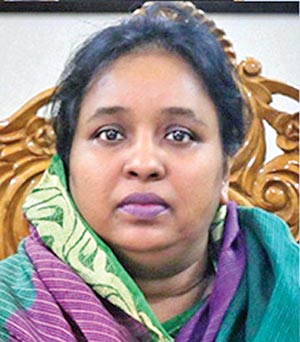
The ruling Awami League (AL) picked incumbent Mayor Selina Hayat Ivy as its candidate for the upcoming Narayanganj City Corporation election.
Her nomination was finalised at a joint meeting of AL's Local Government Nomination Board and the party's Parliamentary Nomination Board at Ganobhaban on Friday afternoon and AL President Prime Minister Sheikh Hasina presided over the meeting.
Earlier, four names of candidates were sent to nomination board for the Narayanganj City Corporation election. Out of these, the high command of AL chose Ivy again.
After the meeting, AL Presidium Member and Local Government Nomination Board Member Jahangir Kabir Nanak confirmed the matter to the Daily Observer.
bdnews24.com adds: Ivy became mayor by defeating AKM Shamim Osman, another leader of the party, in the first polls to
Narayanganj City Corporation in 2011.
She became the comfortable winner against her main challenger, the BNP's Sakhawat Hossain Khan, to begin her second term in 2016 as her rivalry with Shamim continued.
She had served as the chairperson of the Narayanganj municipality for eight years before becoming the first elected woman mayor of Bangladesh five years ago.
A foreign-trained medical practitioner by profession, Ivy joined the city politics in 2003, riding on the popularity of her father Ali Ahmed Chunka, the first chairman of the Narayanganj municipality and immensely popular as a local Awami League leader.
Ivy held together the Awami League in Narayanganj during the 2001-2006 BNP-Jamaat government when things were less than hunky-dory for it.
The doctor had joined the Chhatra League as an intern in Mitford Hospital after completing her medical degree from Russia in 1992.
In 1994, she joined the 200-bed hospital in Narayanganj and a year later, left for New Zealand for higher studies.
A mother of two sons, Ivy returned to the country, though her husband Quazi Ahsan Hayat has remained behind in New Zealand.
Her foray in the Narayanganj Awami League began in 2002 by running in municipality elections.
Ivy emerged as the main challenger of the Osman family that had returned to dominate the Awami League politics in Narayanganj after the end of the military-backed caretaker regime.
The huge margins of her victories helped her emerge from the shadows of her father and eke out a space of her own.





