Bangladesh emerged as an independent and sovereign country in 1971, whose history can be divided into two major phases. The first phase may be identified as the liberation struggle and the second phase as the liberation war. The Dhaka University, established in 1921, had enormous contribution in both the phases. The liberation struggle started long time ago with the ageing of Language debate that turned into language movement few months after the creation of Pakistan. The most important political event after 1952 was the formation of the United Front. The landslide victory of the front, assumption of power by United Front and musical Chair type of externally imposed changes of power led to the promulgation and perpetuation of military rules in Pakistan.
This prompted Sheikh Mujibur Rahman to grow bitter with the military rules and resort to form the Independent Bangla Revolutionary Council and East Bengal Liberation Front. Afterwards finding the symptoms of prolonged military rules, Sheikh Mujib started liaising with the Communist Party of Bangladesh and a part of National Awami Party to wage struggle for complete liberation. Secretly, he patronized the education movement of 1962-63, destabilized the convocation ceremony of Dhaka University in 1964 and humiliated Monzur Kader- the external affairs minister of Pakistan on Dhaka University Campus by engaging his own men. He was found supporting the Bengali armed forces personnel ready to secede around that time.
The students and people of Bangladesh responded to this by observing general strike on 7th June 1966. Thereafter, the movement for 6 point program continued slowly. Fortunately, intellectuals backed by political parties protested the ban on Robindra Sangeet and students of Dhaka University organized 11 point program against so-called Agartala Conspiracy case.
The movement gained momentum leading to the withdrawal of the case lodged against its mentor Sheikh Mujib and 34 others. This also caused the resignation of General Ayub Khan and assumption of power by General Yahya Khan who proceeded to hold a national election.
The students of the Dhaka University formed Independent Bangla Revolutionary Council on 1st March and, demonstrated the flag of independent Bangladesh on 2nd March 1971, readout the declaration of independence on 3rdMarch, started training and arming the colleagues and hoisted the flag of independent Bangladesh across the country, except cantonment, on March 23, even before the military crackdown. On March 2, 1971 teachers of Dhaka University supported Bangabandhu's Program of apparent non-cooperation announced on 1st day of March as a mark of denial to postponement of holding the national assembly session in Dhaka.
On March 3, the Teachers' Association of the University resolved to continue with freedom struggle instead of six-point program. As many as 128 teachers of the university made statements in the newspapers urging transfer of power. On the following day, they set fire on a newspaper at Bot tala for its publication of baseless and fabricated news. They also sent telegrams to the UN Secretary General, twice, sensing the upcoming genocide. A section of them helped in framing the constitution based on 6 point program and placed it to Bangabandhu for facilitating the bargaining with Pakistani central leaders.
The crackdown was challenged by resistance battle by the students of the Dhaka University and other educational institutions and a handful of teachers of Dhaka University and affiliated colleges. Then the nine month long liberation war was set in motion by the government formed with Bangabandhu Sheikh Mujibur Rahman as head of state. Syed Nazrul Islam, Tajuddin Ahmed, Khondokar Mostak Ahmed along with Kamruzzamn and Monsur Ali were given different portfolio. Except the last two, all of them belonged to Dhaka University. Those who framed the formal declaration of Independence and gave guard of honour to newly formed government were also the former students of Dhaka University. Almost all of secretaries or staffs of different ministries were one-time students or teachers of this university.
During the nine month long war many of whom who continued armed struggle were from Dhaka University. Apart from the three sector chiefs of the armed forces, top leaders of Mujib Bahini including Sheikh Fazlul Haque Moni and 10 others, the ADC of the Chief of Staff Sheikh Kamal in the war, and 21 of the general's specially trained persons, 4 leaders of the Independent Bangla Students' Struggle Council, 4 members of the All Party Advisory Committee, regional chairmen, youth camp heads, all members of the Planning Cell and the pioneers of campaigning and psychological warfare abroad were mostly current and former students of Dhaka University aided by their teachers.
As a tool for psychological warfare, a large number of students, alumni and teachers of Dhaka University joined in the publication of weeklies, the running of the independent Bangla Radio Centre and cultural organizations. Besides, Bangladesh Liberation War Council, Bangladesh Mukti Sangram Parishad, Bangladesh People's Solidarity Council formed in London, Bangladesh Teachers' Association, Bangladesh Information Centre established in Washington, Artist-Literature Support Association, Liberation Council of the Intelligentsia, Women Freedom Fighters Association, Independent Bangla Football Team, Bangabandhu Artist group, Bangladesh Young Artist group etc, played a major role in the psychological part of the liberation war.
Needless to say, the majority of the members of these organizations were students and teachers or former students of Dhaka University. For contribution in the frontal encounter, Mohiuddin Jahangir, a student of the university, has received the Bir Shrestha-the highest title of Liberation War.
19 teachers, 1 officer and 52 employees of Dhaka University sacrificed their lives at the altar of freedom and liberation. Some teachers and a large number of students from Dhaka University also helped in the liberation war staying within the country. In the final analysis, it may seem that the history of Dhaka University tantamount to mean the history of Bangladesh.
Despite of their negative stand of harbouring a culture of communal divisions, commotions, scuffles and communal riots, the university has participated in the creation of Bangladesh with the aim of establishing Bengali nationalism, Democracy, non-communal social order and exploitation free society.
Now, it is necessary to return to the cherished role of Dhaka University. The university was established to create knowledge and disseminate knowledge. The time is ripe now to pursue its initial goals with sincerity and dedication and gain a coveted place in the committee of educators.
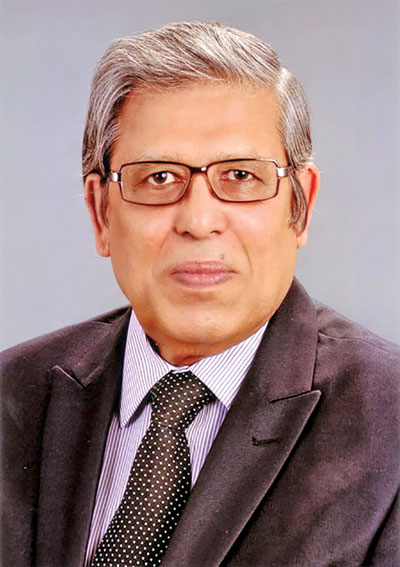
Dr Abdul Mannan Choudhury, teacher of Dhaka University, received training at Dehradun to participate in the country's War of Liberation in 1971





